How Standard Deduction Works in 2026 Step-by-Step Guide
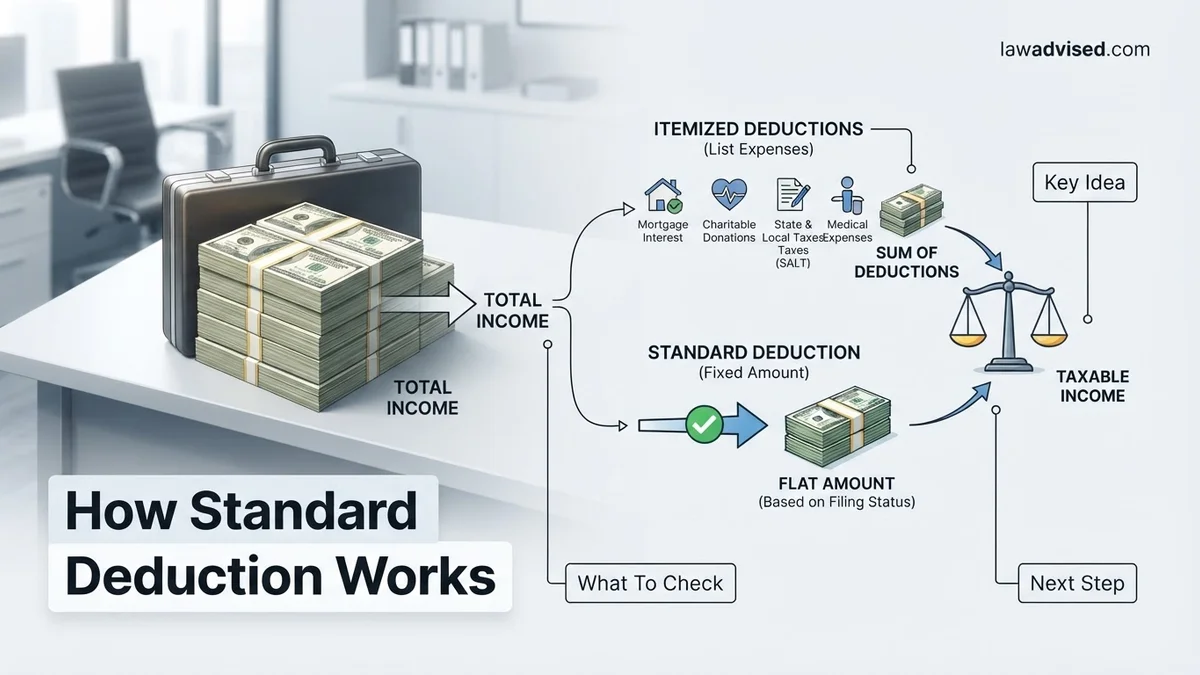
The standard deduction is a dollar amount that reduces the income you’re taxed on, instantly lowering your overall tax liability. By subtracting this fixed amount from your adjusted gross income, you bypass the need to track individual expenses. Knowing how standard deduction works helps you quickly decide whether to take the flat reduction or itemize instead.
The standard deduction is a flat, government-set dollar amount that directly reduces your adjusted gross income (AGI) before income tax is calculated. By claiming this deduction, you bypass the need to track individual expenses like medical bills or charitable donations, instantly lowering the total income subject to federal taxes in 2026.
Deciding between taking the standard deduction and itemizing your deductions dictates how much you will pay—or get back—at tax time. If your eligible personal expenses exceed the standard threshold set for your specific filing status, itemizing makes financial sense. Otherwise, taking the standard deduction is the fastest way to minimize your tax liability.
Key Takeaways
- The standard deduction directly lowers your taxable income without requiring receipts or expense tracking.
- Your standard deduction amount depends entirely on your IRS filing status.
- Take the standard deduction if it exceeds your total itemized deductions.
- Additional standard deduction amounts apply if you are age 65 or older or blind.
- Filing status changes directly impact which standard deduction threshold applies to you.
What Causes Confusion About How the Standard Deduction Works
Taxpayers often misunderstand the standard deduction because they confuse a tax deduction with a tax credit. A credit reduces your tax bill dollar-for-dollar, while the standard deduction simply shrinks the size of the income slice the IRS is allowed to tax.
The Misconception of “Free Money” Versus Income Reduction
- Not a cash refund: The standard deduction does not put money directly into your bank account.
- Taxable income shield: It acts as a shield, protecting a specific chunk of your earnings from federal income tax brackets.
- Bracket interaction: Lowering your AGI can pull your top dollars out of a higher tax bracket and drop them into a lower one.
Filing Status Determines Your Baseline
Another major point of confusion is how your life situation changes your baseline number. The IRS assigns vastly different standard deduction thresholds depending on whether you file as single, married filing jointly, or head of household, making it critical to choose the correct status.
How to Calculate Your Tax Savings Using the Standard Deduction
Calculating how the standard deduction saves you money requires a straightforward two-step math process using your projected annual income for 2026. You start with your gross income, subtract adjustments to find your AGI, and then subtract the standard deduction.
Step-by-Step Math Example for 2026
- Determine Gross Income: Imagine you earn a salary of $75,000 as a single filer in 2026.
- Apply Standard Deduction: You subtract the single filer standard deduction amount directly from that income.
- Resulting Taxable Income: Your final taxable income drops significantly, meaning you only pay taxes on the remainder.
Translating Taxable Income Into Actual Dollars Saved
To find out how much cash stays in your pocket, multiply the standard deduction amount by your marginal tax bracket percentage. If your standard deduction is $15,000 and you fall into the 22 percent tax bracket, the standard deduction saves you $3,300 in actual federal income taxes.
How to Fix Your Filing Strategy: Standard vs. Itemized Deductions
Choosing between the standard deduction and itemized deductions determines your ultimate taxable income for 2026. Financial analysts recommend a straightforward comparative approach to ensure you never leave money on the table. You should always select whichever option yields the higher deduction amount.
Step-by-Step Comparison Process
- Calculate your total projected itemized expenses for 2026, including state and local taxes capped at $10,000, mortgage interest on loans up to $750,000, and qualified charitable contributions.
- Locate your official 2026 standard deduction threshold based on your exact filing status, such as single, married filing jointly, or head of household.
- Compare the two final figures side by side; if your itemized total exceeds the standard deduction amount, itemizing is the mathematically superior strategy.
- Gather and organize all supporting receipts, Form 1098 statements, and charitable donation records if itemizing wins out as your preferred filing strategy.
What If Your Itemized Expenses Are Close to the Standard Limit?
Taxpayers often find their total itemized deductions hovering just below the 2026 standard deduction threshold. According to tax planning specialists, this scenario creates a prime opportunity to utilize strategic bunching methods. Bunching involves doubling up on deductible expenses within a single calendar year to cross the standard deduction hurdle.
Advanced Bunching Tactics
- Combine multiple years of charitable giving into a single 2026 lump sum, potentially utilizing a donor-advised fund to immediately secure the higher itemized write-off.
- Prepay your January 2027 mortgage payment and property taxes before December 31, 2026, to pull those deductions into the current tax year.
- Schedule elective medical procedures or major dental work within the same calendar year to ensure your out-of-pocket medical expenses surpass the 7.5 percent adjusted gross income threshold.
What If It Still Doesn’t Work?
Navigating the intersection of standard and itemized deductions can occasionally yield ambiguous results, particularly following complex life events like marriage, divorce, or purchasing a first home. If your self-calculated filing strategy remains unclear, consider these actionable fallback steps:
- Run your financial data through two separate reputable tax software packages to independently verify whether the standard or itemized deduction lowers your tax liability more effectively.
- Consult a certified public accountant (CPA) or an enrolled agent to review complex deductions, such as business expense allocations or multi-state property holdings.
- Prepare to invest in professional tax preparation services, which typically cost between $250 and $600 for standard individual returns depending on geographic location and complexity.
- Utilize the IRS Interactive Tax Assistant tool online to confirm your eligibility for specific specialized deductions that might alter your threshold math.
Conclusion
Mastering how the standard deduction works in 2026 is essential for minimizing your tax burden and accelerating your yearly return processing time. By comparing your itemized expenses against the updated inflation-adjusted thresholds, you can easily select the most profitable filing strategy. According to verified research and tax policy experts, proactive planning prevents costly filing errors. Take your next actionable step today by logging into your preferred tax software to review your projected 2026 income and deduction figures.
❓ Frequently Asked Questions
How does the standard deduction lower my overall tax liability?
The standard deduction is subtracted directly from your adjusted gross income (AGI). This reduced figure becomes your taxable income, meaning you pay federal income tax on a smaller pool of money.
What are the standard deduction amounts for different filing statuses?
Standard deduction amounts vary by category, including single, married filing jointly, head of household, and married filing separately. Each status features a specific threshold adjusted for inflation.
What common expenses are included if I choose to itemize instead?
Itemized deductions typically include state and local taxes, mortgage interest, charitable contributions, and un-reimbursed medical expenses that exceed a percentage of your AGI.
Can I claim both the standard deduction and itemize my deductions?
No, you must choose one or the other. You cannot take the standard deduction and also claim individual itemized deductions on the same tax return.
Are there extra standard deductions for seniors or individuals with visual impairments?
Yes, taxpayers who are age 65 or older or legally blind at the end of the tax year qualify for an additional standard deduction amount added to their base threshold.
What happens if my filing status changes mid-year?
Your filing status is generally determined by your marital status and household situation on the last day of the tax year, which dictates your standard deduction amount.

Ismail Hossain is the founder of Law Advised. He is an Divorce, Separation, marriage lawyer. Follow him.