Can Dependents Claim Standard Deduction? Expert Guide 2026
Yes, dependents can claim a standard deduction on their own tax returns, but the calculation has strict IRS limitations. The allowed amount depends on whether their income comes from a job or from investments like dividends and interest.
Yes, you can still claim a standard deduction on your own tax return even if someone else claims you as a dependent. However, the IRS applies a special formula that typically results in a much lower standard deduction limit than what independent filers receive.
For the 2026 tax year, this limitation prevents dependents from shielding as much income from taxes. Understanding how this calculation works ensures you file accurately and avoid overpaying taxes on your first job or investment portfolio.
Key Takeaways
- Dependents can claim a standard deduction, but the calculation rules differ from independent filers.
- The standard deduction for a dependent is limited to the greater of $1,250 or earned income plus $400.
- Earned income includes wages, salaries, and tips from a job.
- Unearned income includes interest, dividends, capital gains, and trust distributions.
- A dependent’s standard deduction can never exceed the basic standard deduction limit for single filers.
What Causes Lower Standard Deductions for Tax Dependents
The Dependency Disadvantage on Tax Returns
When you are claimed as a dependent on a parent or guardian’s tax return, your tax situation changes significantly. The main reason your standard deduction drops is to prevent high-income families from shifting unearned income to children to avoid higher tax brackets. The IRS restricts your deduction to ensure you only get a tax break on a basic amount of your own earnings.
Standard Deduction Limits for 2026
For 2026, a single independent filer generally enjoys a standard deduction of $15,000. But as a dependent, your standard deduction is limited to the greater of two amounts:
- A baseline fixed amount of $1,250 for 2026
- Your earned income plus $400, up to the regular single standard deduction limit of $15,000
Because of this rule, if you have zero income, you get a $1,250 deduction. If you earn thousands of dollars, your deduction scales up based directly on what you worked for.
How to Calculate the Standard Deduction for Earned Versus Unearned Income
Defining Earned and Unearned Income
To calculate your exact standard deduction as a dependent in 2026, you must separate your income into two distinct categories. The IRS treats money from a job very differently from money generated by investments or gifts.
- Earned income: Wages, salaries, tips, professional fees, and taxable scholarship or fellowship grants that you report on your W-2 or 1099.
- Unearned income: Interest from bank accounts, dividends from stocks, capital gains, and distributions from trusts.
The math changes based on which type of income makes up your total revenue for the year.
Calculation Examples for Working Dependents
Let look at a practical example for 2026. Suppose you have a part-time job and earned $5,000 over the year, with no unearned income. You take your earned income ($5,000) and add $400, giving you $5,400. Since $5,400 is greater than the $1,250 baseline, your standard deduction for 2026 is $5,400.
What if you only have unearned income, such as $2,000 in stock dividends? Because your earned income is zero, your calculation defaults to the baseline $1,250 amount (since $1,250 is greater than $0 plus $400). You cannot use the $400 bump to reach your total unearned income.
Step-by-Step Guide to Filing Your Dependent Tax Return
Filing a tax return as a dependent requires precision to ensure the standard deduction is calculated correctly. According to IRS guidelines for the 2026 tax year, you must carefully navigate reporting your earned and unearned income separately.
1. Gather Your Tax Documents
Collect all income statements before starting your return. If you held a job, you will need Form W-2 from your employer. If you earned interest or dividends from investments, ensure you have the appropriate Form 1099 documents ready.
2. Complete Form 1040
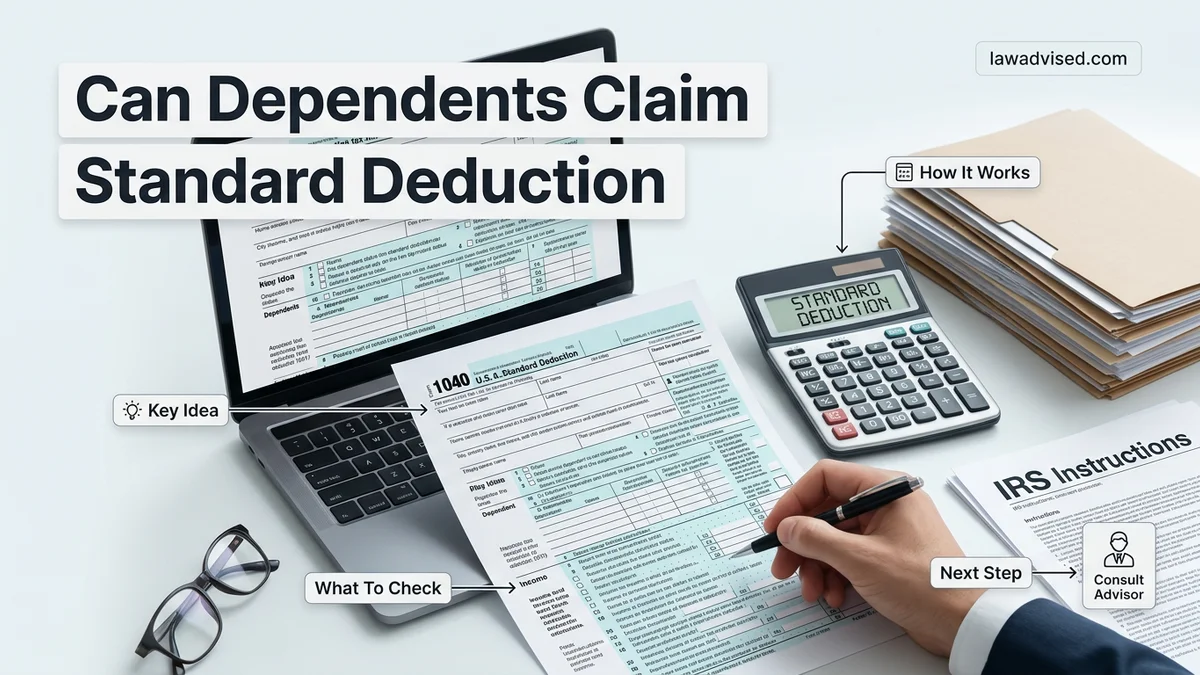
Dependents must file using IRS Form 1040 or Form 1040-SR. When you fill out the form, you must explicitly check the box indicating that you can be claimed as a dependent on someone else’s tax return. This triggers the IRS processing system to apply the dependent standard deduction formula instead of the full single filer amount.
3. Calculate the Standard Deduction Using Worksheet 8-1
Do not simply guess your standard deduction amount. Use the Standard Deduction Worksheet for Dependents found in the instructions for Form 1040. This worksheet will guide you through adding your earned income to the statutory minimum, comparing it against the maximum unearned income limit, and determining your final allowable deduction for 2026.
What If Your Income Exceeds the Filing Thresholds
If your total income surpasses the statutory limits for dependents, your tax obligations change significantly. Exceeding these thresholds means you are legally required to file a federal tax return, even if your parents or guardians still claim you as a dependent on their taxes.
Handling Excess Earned Income
When your wages or salary exceed the standard deduction limit, you will owe federal income tax only on the portion of your earnings that exceeds your calculated deduction. Your employer will have withheld federal income taxes from your paychecks throughout 2026. Filing your return will reconcile this amount, potentially resulting in a tax refund.
Handling Excess Unearned Income
If your unearned income—such as capital gains, trust distributions, or investment dividends—pushes you past the threshold, additional tax complexities may arise. For dependents with significant unearned income, the Kiddie Tax rules might apply. This means a portion of your unearned income could be taxed at your parents’ higher marginal tax rates rather than your own lower bracket.
What If It Still Doesn’t Work?
If calculating your dependent standard deduction or navigating filing software yields conflicting results, stop and utilize these troubleshooting steps:
- Double-check your income classifications: Separately verify which dollars qualify as earned income versus unearned income, as miscategorizing these figures invalidates the entire calculation.
- Review the primary taxpayer’s return: Confirm with the person claiming you that they have not accidentally checked or unchecked critical dependency boxes that affect your filing status.
- Consult a certified public accountant (CPA): If your investment income or self-employment revenue creates ambiguity, hire a licensed tax professional. According to the National Society of Accountants, professional tax preparation fees typically range from $220 to $450 for individual returns with basic investment schedules.
- Utilize IRS Free File software: Access guided, IRS-partnered filing software designed specifically for low-to-moderate-income dependents to prevent math errors during standard deduction computation.
Conclusion
Navigating whether dependents can claim the standard deduction in 2026 comes down to properly distinguishing between earned and unearned income while correctly applying the IRS dependent deduction limits. Failing to calculate this accurately can lead to delayed refunds or underpayment penalties. According to verified research and expert tax sources, utilizing the official IRS Standard Deduction Worksheet for Dependents is the most reliable way to ensure total compliance. Your immediate next step is to review your Form W-2 and 1099 statements to calculate your total gross income for the year.
❓ Frequently Asked Questions
How does the IRS calculate the standard deduction for a dependent with only job income?
For a dependent with only earned income, their standard deduction is generally their earned income plus $400, up to the maximum basic standard deduction for a single filer.
What happens if a dependent has both earned and unearned income?
The calculation adds $400 to their earned income, but the total cannot exceed the basic standard deduction, and unearned income faces separate specific threshold limits.
Is the dependent standard deduction threshold adjusted for inflation in 2026?
Yes, the IRS adjusts minimum standard deduction amounts and income thresholds annually to account for inflation, changing the exact baseline dollar amounts.
Can a dependent file a tax return to get a refund even if they earned very little?
Yes, if federal income tax was withheld from their paycheck, they must file a tax return to claim a refund of that withheld money, even if they fall below the filing threshold.
Does claiming the standard deduction affect the person claiming the dependent?
No, a dependent filing their own return to claim their standard deduction and get a refund does not prevent the primary taxpayer from claiming them as a dependent.
What form does a dependent use to file their federal tax return?
Dependents generally use Form 1040 (or Form 1040-SR for seniors, though rare for dependents) to report their income and calculate their allowable standard deduction.

Ismail Hossain is the founder of Law Advised. He is an Divorce, Separation, marriage lawyer. Follow him.