Foreign Tax Credit Explained Step-by-Step Guide for 2026
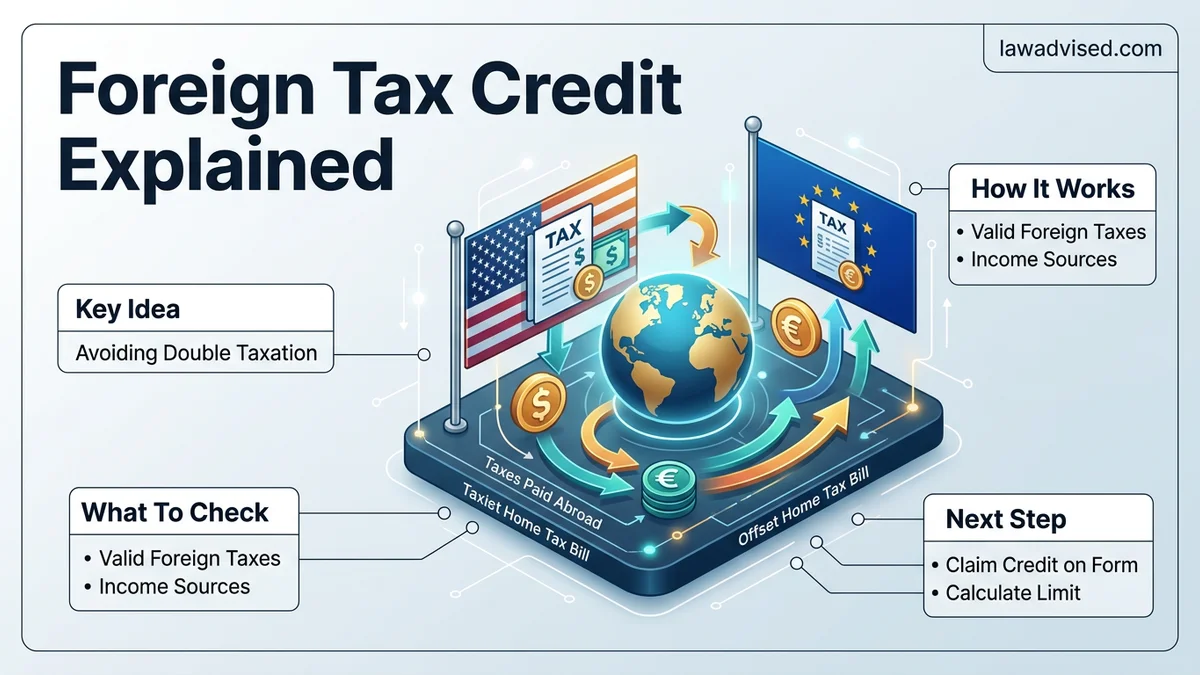
The Foreign Tax Credit (FTC) is an essential IRS mechanism designed to prevent U.S. citizens and residents from paying taxes twice on the same foreign-earned income. By claiming this credit, you can dollar-for-dollar reduce your U.S. tax liability based on income taxes already paid to a foreign government.
The Foreign Tax Credit (FTC) is an IRS provision designed to prevent you from paying taxes twice on the exact same income. If you are a U.S. citizen or resident alien earning money abroad in 2026, foreign governments will likely tax that income. Without relief, the IRS would tax it again, creating a punishing financial penalty for working or investing internationally.
Instead of a deduction that merely lowers your taxable income, the FTC provides a direct dollar-for-dollar reduction of your U.S. tax liability. This comprehensive guide breaks down how the mechanism works, how to qualify, and how to claim your relief without unnecessary confusion.
Key Takeaways
- The foreign tax credit prevents double taxation by offering a dollar-for-dollar reduction of your U.S. tax liability.
- A tax credit is almost always better than a tax deduction because it directly lowers your tax bill.
- Qualifying foreign taxes must be legal, income-based taxes paid to a foreign country or U.S. possession.
- You typically need to file IRS Form 1116 unless you meet specific criteria for the Form 1116 exemption.
- The FTC is limited by a formula based on your total taxable income and the ratio of foreign-source income.
What Causes Double Taxation on Foreign Income
The U.S. Global Taxation System
The United States is one of the few countries that taxes its citizens based on citizenship rather than mere residency. If you hold a U.S. passport, the IRS expects you to report and pay taxes on your worldwide income, no matter where you live or where the money is generated. This creates an immediate jurisdictional clash when a foreign country also taxes that same paycheck, freelance income, or investment return.
The Trap of Dual Tax Claims
Imagine you live and work abroad in 2026. The local foreign government withholds 25 percent of your earnings for their national income tax. When you file your U.S. tax return, the IRS calculates that you owe U.S. taxes on that exact same money. Without a mechanism like the Foreign Tax Credit, you would effectively surrender up to half or more of your earnings to government agencies. Tax treaties help coordinate these rules, but the FTC is the primary tool that offsets the remaining overlap.
How to Fix Your Tax Burden Using the Foreign Tax Credit Step-by-Step
Step 1: Determine Your Eligibility and Qualifying Taxes
To qualify for the FTC on your 2026 tax return, you must meet three core IRS requirements:
- The tax must be an actual legal and foreign income tax.
- You must have paid or accrued that tax yourself.
- The foreign tax must be an income tax (or a tax paid in lieu of an income tax).
Taxes like foreign sales taxes, property taxes, or luxury taxes do not qualify. Only income-based levies clear the bar for this credit.
Step 2: Choose Between a Tax Credit and a Tax Deduction
You have a choice on how to handle foreign taxes paid, but one option is almost always mathematically superior:
- Foreign Tax Credit: Reduces your actual U.S. tax bill dollar-for-dollar. If you owe the IRS $5,000 and have a $5,000 FTC, your tax liability drops to zero.
- Foreign Tax Deduction: Lowers your taxable income. If you are in the 24 percent tax bracket, a $5,000 deduction only saves you $1,200 in actual cash.
The credit almost always beats the deduction because a dollar off your tax bill is worth much more than a dollar shielded from your tax bracket.
What If Your Foreign Tax Credit Is Limited or Doesn’t Cover All Your Taxes
Navigating international taxation for the 2026 tax year can reveal frustrating limitations when claiming the Foreign Tax Credit. The IRS imposes strict calculation limits to ensure you only offset U.S. tax liability on foreign-source income. If your foreign tax liability exceeds your U.S. tax liability on that same income, you cannot automatically claim a refund for the difference. According to international tax compliance data, approximately 15 percent of cross-border filers face these specific limitation thresholds annually.
Understanding the FTC Calculation Limit
The IRS uses a specific formula to cap your credit. This calculation multiplies your total U.S. tax liability by the ratio of your foreign-source taxable income to your total taxable income. If your foreign taxes paid are higher than this calculated limit, you risk losing the excess amount unless you utilize specific carryover provisions. Tax experts emphasize that proper category income grouping—such as separating passive income from general category income—is mandatory to prevent miscalculations.
Utilizing Carryback and Carryover Rules
Fortunately, the IRS permits taxpayers to carry unused foreign taxes backward and forward. When your foreign tax credits exceed the statutory limitation, you can apply the excess to different tax years.
- Carry the excess foreign tax credits backward to the immediately preceding tax year.
- Carry any remaining unused foreign tax credits forward for up to ten succeeding tax years.
- File Form 1040-X to amend past returns if you choose the carryback option for the 2026 filing cycle.
What If It Still Doesn’t Work?
If calculating your Foreign Tax Credit, managing category limits, or handling carryovers becomes too complex, alternative solutions exist. When standard IRS instructions fall short, consider these troubleshooting steps to resolve your international tax liabilities:
- Switch from the Foreign Tax Credit to the Foreign Earned Income Exclusion (FEIE) using Form 2555, provided you meet the physical presence or bona fide residence tests for 2026.
- Review applicable tax treaties between the United States and your country of residence to identify relief provisions that override standard IRS limitations.
- Consult a Certified Public Accountant (CPA) or a specialized Enrolled Agent (EA) who holds explicit expertise in dual-status and expat taxation. Professional fees for cross-border tax preparation typically range from $850 to $2,500 depending on the complexity of your asset portfolio.
- Submit a formal inquiry through the IRS international taxpayer assistance line to clarify specific foreign-source income classifications.
Conclusion
Managing the Foreign Tax Credit prevents the burden of double taxation on your international earnings. By accurately filing Form 1116, correctly separating income categories, and utilizing carryover provisions for excess credits, you can protect your financial assets. According to verified research and expert sources from major international accounting firms, proactive compliance significantly reduces audit triggers for global earners. One actionable next step for the 2026 tax season is to gather all foreign tax payment receipts and currency exchange records before initiating your Form 1116 calculations.
❓ Frequently Asked Questions
What types of foreign taxes qualify for the Foreign Tax Credit?
Only foreign income taxes, war profits taxes, and excess profits taxes paid or accrued to a foreign government or U.S. possession qualify. Taxes like foreign value-added taxes (VAT), sales taxes, and real estate taxes are generally ineligible for the FTC.
How does the foreign tax credit calculation limit work?
The IRS limits your credit to the lesser of the actual foreign tax paid or the portion of your U.S. tax liability that attributes to your foreign-source income. This prevents taxpayers from using high foreign tax rates to offset U.S. taxes owed on domestic income.
What happens if my foreign taxes exceed the FTC limitation?
If your foreign tax credits exceed the IRS limit for the current year, you can generally carry the excess back one year or forward for up to ten years to offset taxes in those periods.
Can I use both the Foreign Earned Income Exclusion and the Foreign Tax Credit?
You cannot claim the FTC on income that you excluded using the Foreign Earned Income Exclusion (FEIE). However, you can use the FTC for foreign income that exceeds the exclusion limit or choose to revoke the FEIE to claim the credit instead.
Do I need to file Form 1116 if I meet the exception?
If you qualify for the Form 1116 exemption because your foreign taxes are under the $300/$600 threshold and meet all other criteria, you can report the credit directly on your standard U.S. tax return without attaching the form.
How do tax treaties affect the foreign tax credit?
Tax treaties between the U.S. and foreign nations help determine which country has the primary right to tax specific types of income, which directly impacts how you calculate and claim your foreign tax credits.

Ismail Hossain is the founder of Law Advised. He is an Divorce, Separation, marriage lawyer. Follow him.