Adoption Tax Credit Explained Step-by-Step Guide for 2026
The adoption tax credit helps families offset the high costs of expanding their households through domestic, international, or foster care adoptions. This nonrefundable credit allows you to reduce your federal income tax liability, with any unused credit carrying forward for up to five years. Understanding income limits, qualified expenses, and strict filing timelines is essential to claiming the maximum benefit.
The federal adoption tax credit is a dollar-for-dollar reduction of your federal income tax liability, designed to offset the significant costs of expanding your family. For the 2026 tax year, understanding the exact credit maximums, income phase-outs, and qualification rules ensures you do not leave thousands of dollars on the table when you file your return.
Navigating this credit requires careful attention to timing, as the rules differ depending on whether you complete a domestic, international, or foster care adoption. This guide breaks down the 2026 figures, calculation steps, and eligibility rules so you can claim your maximum benefit.
Key Takeaways
- The adoption tax credit is a nonrefundable tax credit, meaning it reduces tax liability dollar-for-dollar.
- Unused credit amounts can be carried forward for up to five consecutive tax years.
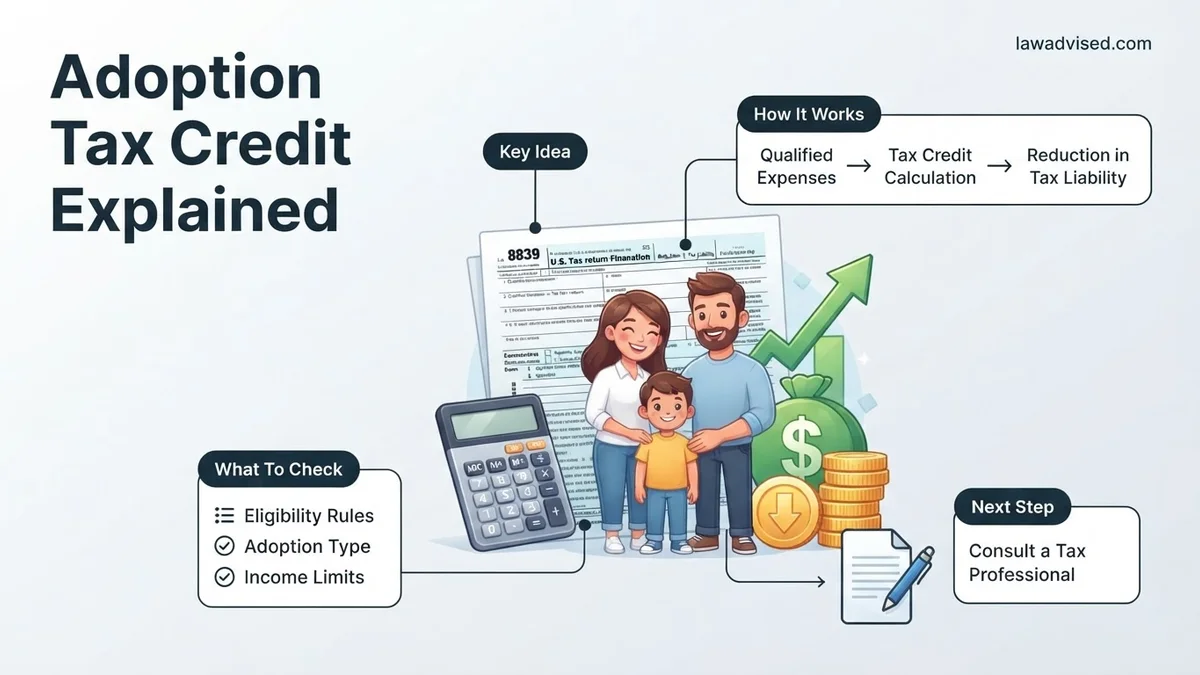
- Qualified expenses include reasonable adoption fees, court costs, attorney fees, and travel expenses.
- Domestic adoption expenses can be claimed before the adoption is finalized; international adoptions require finalization.
- Filing requires completing IRS Form 8839 and attaching it to your federal income tax return.
What Causes Confusion With the Adoption Tax Credit
Taxpayers often struggle with the adoption credit because the rules for claiming the money do not align neatly with standard calendar-year tax logic. Timing and expense categorization trip up most families during tax season.
Timing Rules Based on Adoption Type
When you can actually claim the credit depends entirely on how your adoption proceeds. The IRS enforces strict timing distinctions:
- Domestic Adoptions: You generally must claim the credit in the year after the expenses are paid, or in the tax year the adoption becomes final if expenses are paid during or after that finalization year.
- International Adoptions: You cannot claim any credit for a foreign adoption until the adoption is completely final. All prior-year expenses must be claimed on the tax return for the year of finalization.
- Special Needs Adoptions: If a state determines your child has special needs, you may be eligible for the full maximum credit amount even if your out-of-pocket expenses were lower.
Non-Refundable Versus Refundable Mechanics
Another major source of confusion is the credit structure itself. The federal adoption tax credit is non-refundable for most families. This means it can reduce your tax liability to zero, but the IRS will not send you a check for any remaining balance. However, any unused credit amount can be carried forward for up to five years until you exhaust the full value.
How to Calculate Your Adoption Tax Credit and Income Limits
Calculating your 2026 adoption tax credit requires tracking your qualified expenses and measuring them against the statutory maximums and modified adjusted gross income (MAGI) phase-out thresholds.
2026 Maximum Credit Amounts and Income Phase-Outs
The IRS adjusts the maximum credit limit and income thresholds annually for inflation. For tax year 2026, the baseline figures operate within specific financial boundaries:
- Maximum Credit Limit: The maximum potential credit per child is indexed for inflation projected near $16,810 (verify exact final IRS inflation adjustments for 2026 filing).
- Phase-Out Thresholds: Families with a MAGI beginning at the indexed threshold (projected around $252,150) will see their credit gradually reduced.
- Complete Phase-Out: Once your MAGI exceeds the upper limit (projected around $292,150), the adoption credit drops to zero.
Step-by-Step Calculation Example
To calculate your actual credit, follow a straightforward path based on your 2026 financial records:
- Add up all qualified adoption expenses paid across eligible tax years.
- Compare your total expenses against the 2026 maximum cap (e.g., $16,810) and take the lesser amount.
- Check your MAGI against the phase-out range to determine if your credit must be reduced.
- Subtract the final calculated credit amount from your total federal income tax liability using IRS Form 8839.
Step-by-Step Instructions to Claim the Credit Using Form 8839
Filing for the adoption tax credit requires careful attention to detail. You must attach IRS Form 8839, Qualified Adoption Expenses, to your Form 1040 or 1040-SR. According to the IRS instructions, you need a separate Form 8839 for each eligible child. Follow these procedural steps to complete the paperwork correctly for the 2026 tax year.
Completing Part I and Part II
- Gather documentation: Collect all adoption-related bills, receipts, agency records, and court documents. For domestic adoptions, keep final decree papers. For foreign adoptions, ensure you have the finalized foreign adoption decree along with the child’s U.S. citizenship documentation.
- Fill out Part I: Answer the screening questions to determine if your child has special needs as defined by your state or if they are a foreign child. This section establishes your baseline eligibility and impacts how your expenses are calculated.
- Calculate qualified expenses in Part II: List all out-of-pocket costs paid in the prior tax year for a domestic adoption that was not yet final, or costs paid in 2026 for an adoption that became final in 2026. Remember to apply the per-child maximum limit established for 2026.
Calculating Carryforwards and Finalizing Your Return
- Complete Part III: Compute your modified adjusted gross income (MAGI) to see if you fall within the 2026 phase-out range. If your MAGI exceeds the threshold, this section will automatically reduce your allowable credit.
- Calculate credit carryforwards: If your tax liability is lower than your credit amount, use Part III to determine your credit carryforward. The IRS permits taxpayers to carry forward unused adoption credits for up to five years.
- Attach and submit: Transfer the final allowable credit amount from Form 8839 to your main tax return (Form 1040, Schedule 3). Double-check that all social security numbers and employer identification numbers (EINs) for agencies are accurate before electronic filing.
What If Your Credit Is Rejected or Your Income Exceeds Phase-Out Limits
Navigating the complex threshold rules for the adoption tax credit can sometimes lead to an IRS rejection or a reduction in your payout. If your initial claim is denied or adjusted, specific fallback strategies can help you rectify the issue. According to tax data from the National Taxpayer Advocate, processing delays and documentation mismatches are among the most common reasons for credit freezes.
Troubleshooting Rejected Claims and Phase-Outs
- Review the IRS notice: Read the specific error code or explanation letter sent by the IRS. Many rejections stem from simple typographical errors in the child’s Social Security Number or Adoption Taxpayer Identification Number (ATIN).
- Verify special needs documentation: If your credit was reduced because an agency or state certification for a special needs adoption was missing, contact your caseworker immediately to secure formal, signed documentation.
- Recalculate your MAGI: Ensure you calculated your modified adjusted gross income correctly by adding back exclusions for foreign earned income or student loan interest deductions, as these affect phase-out limits.
- Seek professional tax assistance: If complex multi-year foreign adoptions trigger an audit or persistent rejection, hire a Certified Public Accountant (CPA) or a specialized Enrolled Agent. Professional tax advisory services for complex adoption returns typically range from $300 to $800 depending on the complexity of your documentation.
Conclusion
Navigating the adoption tax credit for the 2026 tax year requires strict adherence to IRS documentation rules, income phase-out thresholds, and the precise completion of Form 8839. While filing can be complex, utilizing carryforward provisions ensures that families do not lose valuable financial support when adoption costs outpace a single year of tax liability. According to verified research and expert tax sources, maintaining meticulous itemized records of every qualified expense is the single most effective way to prevent processing delays. Your actionable next step is to log into your tax preparation software or schedule a consultation with a certified tax professional to review your Form 8839 before the filing deadline.
❓ Frequently Asked Questions
How do modified adjusted gross income (MAGI) phase-outs affect the adoption tax credit?
As your MAGI exceeds the annual statutory threshold, the maximum credit amount begins to phase out gradually. If your income exceeds the upper limit phase-out threshold completely, you are no longer eligible to claim the credit for that tax year.
Can I claim the credit if I adopt a child with special needs?
Yes, if a state determines that a child has special needs, you may be eligible to claim the full maximum credit amount even if you had few or no actual out-of-pocket qualified adoption expenses.
What happens to the adoption tax credit if I have unused amounts left over?
If your tax liability is lower than your total allowable adoption tax credit, you can carry forward the remaining unused portion for up to five tax years or until you use it completely, whichever comes first.
Are employer-provided adoption assistance benefits taxable?
Employer-provided adoption benefits are generally excluded from your gross income up to the annual exclusion limit. However, you cannot claim a tax credit for the exact same expenses reimbursed by your employer.
What documentation do I need to keep to support my adoption tax credit claim?
You should retain all adoption agency invoices, court documents, legal fee receipts, home study assessments, and final adoption decrees in case the IRS audits your return.
Can unmarried couples claiming the same adoption split the credit?
Unmarried partners who adopt a child together must carefully allocate qualified expenses between them. They cannot claim more than the total maximum credit allowed combined for a single adoption.

Ismail Hossain is the founder of Law Advised. He is an Divorce, Separation, marriage lawyer. Follow him.