W2 vs 1099 Explained Guide for 2026 Taxes & Benefits
Understanding W2 vs 1099 classification is critical because it dictates your tax obligations, workplace autonomy, and legal protections. W-2 employees enjoy employer-paid payroll taxes and benefits, while 1099 contractors manage their own self-employment taxes and expenses. Knowing the distinction protects you from misclassification and IRS penalties.
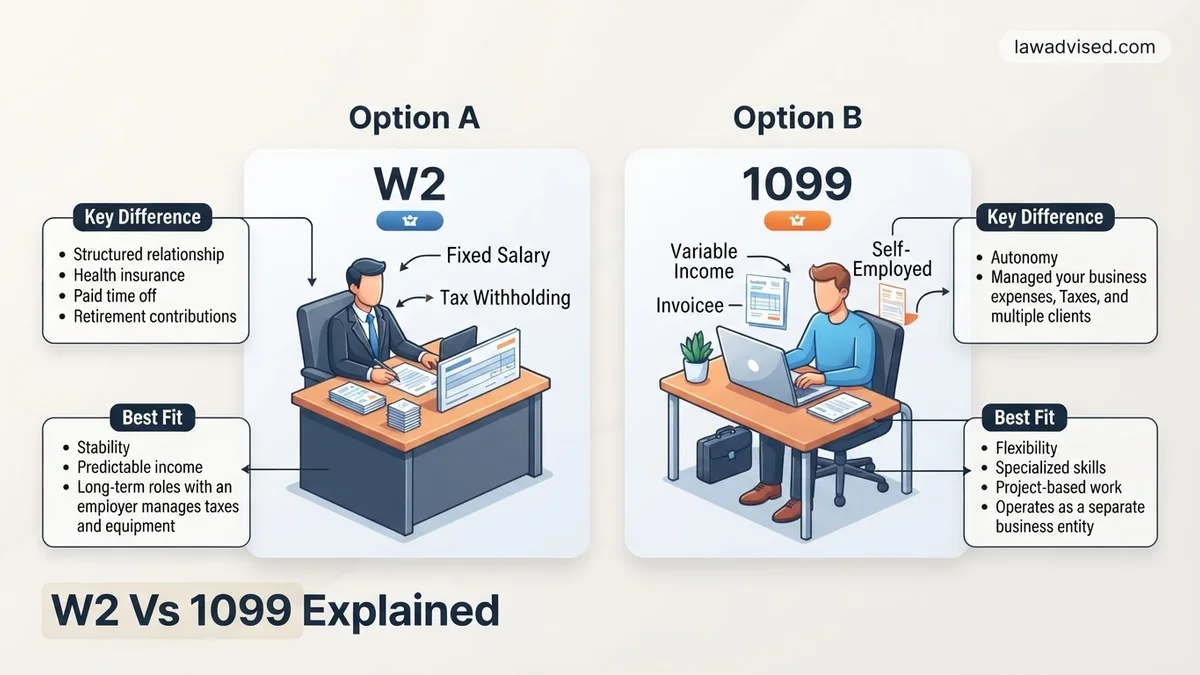
The fundamental difference between a W-2 employee and a 1099 independent contractor comes down to control, tax withholding, and guaranteed benefits. As a W-2 worker, your employer controls your schedule, withholds income taxes from your paycheck, and covers half of your FICA taxes. As a 1099 contractor, you operate as your own business, retain total control over your work methods, and carry the full burden of your own taxes and benefits.
Navigating this distinction is critical for your 2026 financial planning. Misjudging your status can lead to unexpected tax bills, penalties, or lost benefits. Whether you are evaluating a new job offer or transitioning into freelance work, understanding how these classifications impact your actual take-home pay helps you protect your bottom line.
Key Takeaways
- W-2 employers withhold income and half of FICA taxes automatically.
- 1099 contractors pay the entire 15.3% self-employment tax themselves.
- W-2 workers receive benefits like health insurance and paid time off.
- 1099 workers retain high operational control over their schedules and methods.
- Misclassification occurs when companies control 1099 workers like employees.
What Causes W2 vs 1099 Worker Misclassification Issues
The IRS and Department of Labor strictly regulate how workers are classified. Companies cannot simply label you a 1099 contractor to save money on benefits and payroll taxes. Misclassification occurs when a business treats an independent contractor like an employee without providing the legal protections of that status.
Behavioral and Financial Control Factors
- Behavioral control: If a company dictates your exact hours, provides extensive training, and controls how you complete tasks, the IRS views you as an employee.
- Financial control: Contractors typically invest in their own tools, set their own pricing, and work with multiple clients simultaneously. Employees rely on company-provided equipment and receive a steady salary.
- Relationship type: Providing a company’s core service with an expectation of indefinite employment points strongly toward W-2 status rather than 1099 contracting.
Legal Enforcement Trends for 2026
Federal and state labor boards have intensified audits regarding worker classification. Businesses face heavy fines, retroactive tax payments, and mandatory benefit payouts if they misclassify employees. Protecting your rights means ensuring your day-to-day working conditions match your legal paperwork, regardless of what a contract states.
How to Evaluate Your Tax Obligations and Withholding
Your tax burden changes dramatically depending on whether you receive a W-2 or a 1099. These differences directly alter your true take-home pay, making a gross salary comparison misleading.
W-2 Tax Withholding and Employer Contributions
- FICA splitting: Your employer automatically deducts 7.65 percent from your paycheck for Social Security and Medicare, and they match that 7.65 percent out of their own pocket.
- Income tax automation: Federal, state, and local income taxes are withheld every pay period based on your Form W-4 elections.
- Predictable net pay: You receive a clean net paycheck without having to calculate quarterly payments or reserve cash for unexpected tax bills.
1099 Self-Employment Tax Realities
- Double FICA burden: As a 1099 contractor, you pay the entire 15.3 percent self-employment tax to cover both the employee and employer portions of Social Security and Medicare.
- Quarterly estimated payments: You must calculate and pay your federal and state income taxes four times a year to avoid underpayment penalties in 2026.
- Deduction advantages: You can write off legitimate business expenses—such as home office costs, software subscriptions, and equipment—to lower your adjusted gross income.
How to Fix Workplace Control and Compliance Discrepancies
When an employer misclassifies a worker, correcting the discrepancy requires a systematic approach to align daily operations with current 2026 IRS guidelines. The Department of Labor emphasizes that behavioral control, financial control, and the type of relationship determine true legal status. Resolving these discrepancies protects both parties from severe financial penalties.
Step-by-Step Correction Process
- Review the Employment Agreement: Examine the original contract for clauses dictating strict work hours, mandatory training, or exclusive tool provision, which heavily favor W2 classification.
- Consult the IRS Factor Tests: Evaluate current duties against the three core pillars of behavioral control, financial control, and relationship type as outlined in official federal tax publications.
- Request a Status Reclassification: Formally petition human resources or management to transition the role from 1099 contractor status to proper W2 employee status to ensure correct payroll withholding.
- File Form SS-8 if Necessary: Submit IRS Form SS-8, Determination of Worker Status for Purposes of Federal Employment Taxes and Income Withholding, to request an official federal ruling if the employer refuses to correct the classification.
What If Your Employment Status Still Does Not Match IRS Rules
If informal discussions and internal appeals fail to resolve a worker misclassification, proactive escalation is necessary to protect legal and financial rights heading into the 2026 tax season. Ignoring persistent misclassification leaves workers vulnerable to bearing the entire burden of self-employment taxes unlawfully.
- File Form 8919 with Your Tax Return: Use IRS Form 8919, Uncollected Social Security and Medicare Tax on Wages, to report your earnings and pay only your share of employment taxes rather than the full 15.3 percent self-employment tax.
- Submit a Whistleblower Complaint: Report willful misclassification to the Department of Labor Wage and Hour Division, which recovered over $200 million in back wages for workers in recent enforcement cycles.
- Consult a Tax Professional: Engage a Certified Public Accountant or a tax attorney specializing in employment law to evaluate damages and oversee federal filings. Professional consultation fees typically range from $200 to $500 per hour depending on complexity.
Conclusion
Navigating the complex distinction between W2 and 1099 classifications directly impacts your annual tax liability, legal protections, and access to workplace benefits. Fixing a misclassification ensures compliance with evolving federal enforcement standards and secures the safety net you deserve. According to verified research and expert sources from the U.S. Department of Labor, proactive resolution of employment status prevents costly retroactive tax penalties and shields workers from financial liability. Your immediate actionable next step is to audit your current day-to-day work autonomy against official IRS guidelines today.
❓ Frequently Asked Questions
What is the primary difference between a W-2 employee and a 1099 contractor?
A W-2 employee works directly for an organization that controls how and when work is done, withholding taxes and offering benefits. A 1099 contractor operates as an independent business entity with higher autonomy, responsible for paying their own taxes and providing their own benefits.
How does the IRS determine if someone is a W-2 or 1099 worker?
The IRS evaluates behavioral control, financial control, and the relationship type between the worker and the business. If the company dictates exact procedures, hours, and provides all tools, the worker is typically a W-2 employee.
Why do some companies prefer hiring 1099 contractors over W-2 employees?
Companies save money by hiring 1099 contractors because they avoid paying matching FICA taxes, state unemployment insurance, workers’ compensation, and employee benefits like health insurance or paid leave.
Can I be fired or let go the same way as both a W-2 and 1099 worker?
W-2 employees are usually protected by labor laws and company termination policies, whereas 1099 relationships are governed by commercial contracts. Ending a 1099 contract typically involves terms outlined in the service agreement rather than traditional employment termination.
What should I do if my employer misclassifies me as a 1099 contractor?
You can file Form SS-8 with the IRS to request a determination of your worker status for federal employment tax and income tax withholding. You can also report the misclassification to your state’s department of labor.
Do 1099 contractors get overtime pay?
No, independent contractors are not covered by the Fair Labor Standards Act (FLSA) and do not qualify for overtime pay, minimum wage guarantees, or standard employee labor protections.

Ismail Hossain is the founder of Law Advised. He is an Divorce, Separation, marriage lawyer. Follow him.