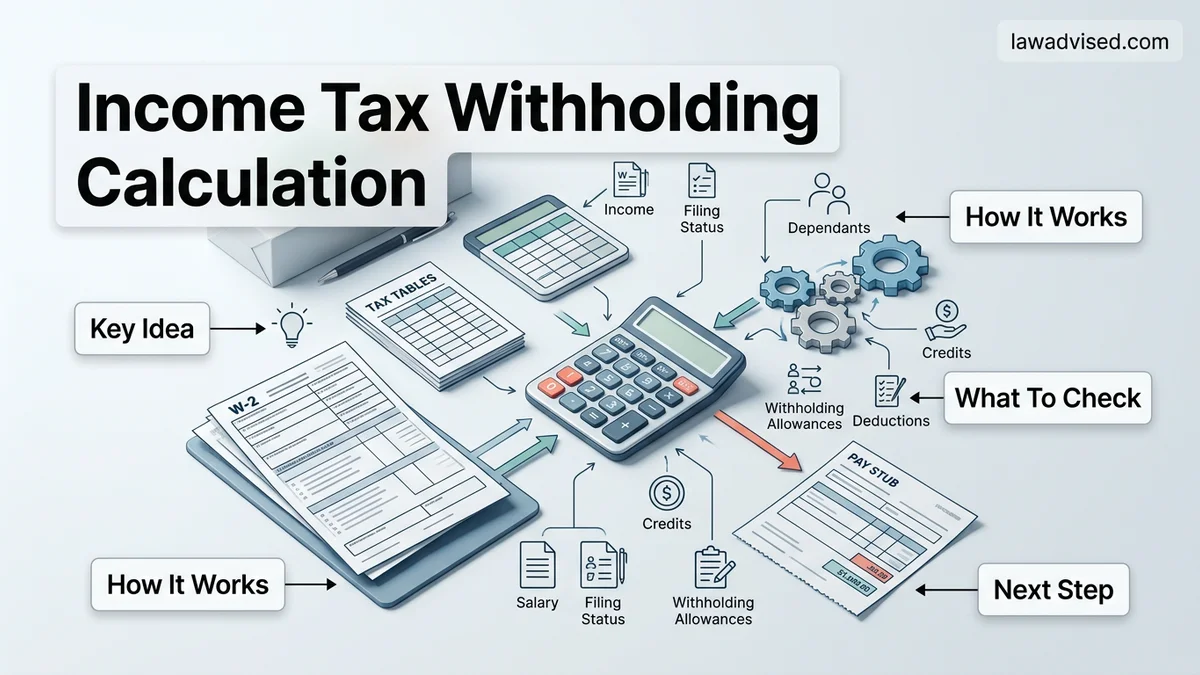
Income Tax Withholding Calculation Step-by-Step Guide 2026
An income tax withholding calculation determines the exact amount of federal income tax removed from each paycheck based on gross earnings and Form W-4 data. Using the correct calculation method ensures you neither owe a massive tax bill nor give the IRS an interest-free loan via a large refund. This guide walks you through the exact formulas, IRS withholding tables, and practical steps needed to compute deductions accurately.
Calculating income tax withholding accurately ensures you do not face a massive tax bill or give the government an interest-free loan throughout the year. To find the exact amount withheld from a paycheck, you must process gross earnings through specific IRS formulas or wage bracket tables using the precise data points provided by the employee on Form W-4.
Mastering this calculation protects your cash flow and keeps your payroll compliant for 2026. Whether you are an employer processing payroll or an individual auditing your own earnings, understanding the mechanics of gross pay, pay frequency, and the modern W-4 is essential for exact payroll math.
Key Takeaways
- Income tax withholding relies directly on the personal information provided on IRS Form W-4.
- Gross pay must be adjusted for pre-tax deductions before applying the tax withholding calculation.
- Pay frequency dictates how annual tax brackets are divided into per-pay-period deductions.
- The percentage method provides the most precise withholding calculation for varying salary amounts.
- Regularly reviewing your withholding prevents unexpected tax bills during annual filing.
What Causes Incorrect Income Tax Withholding Calculations
Even small errors in data entry or outdated formulas lead to drastically wrong tax withholdings. If your take-home pay fluctuates unexpectedly or your annual tax return results in a surprise balance due, one of these core calculation triggers is usually to blame.
Outdated Form W-4 Data
Tax laws and personal financial situations change constantly. Using data from an old W-4 form submitted years ago guarantees an inaccurate calculation.
- Failing to update withholding after major life events like marriage, divorce, or having a child.
- Ignoring changes in the 2026 tax brackets that affect standard deductions.
- Using pre-2020 withholding allowances instead of the current Step 1 through Step 4 multi-step design.
Mathematical and Frequency Errors
Payroll departments and individuals often trip up on the temporal aspect of income. If you annualize pay incorrectly, the final withholding number will miss the mark entirely.
- Confusing gross taxable wages with gross total pay before pre-tax deductions like 401(k) or health insurance.
- Applying the wrong pay frequency multiplier, such as treating semi-monthly pay periods (24 per year) as bi-weekly (26 per year).
- Misinterpreting the IRS percentage method tables by using the wrong filing status column.
How to Fix Your Income Tax Withholding Calculation Step-by-Step
To calculate the exact federal income tax withholding for a pay period, you must follow a strict sequential math process. This manual workflow mimics the automated payroll software engines used by modern businesses in 2026.
Step 1: Extract and Adjust Gross Pay
Your calculation must start with the correct baseline earnings figure. You cannot withhold taxes on money that is sheltered by pre-tax benefits.
- Determine total gross compensation for the specific pay period.
- Subtract pre-tax deductions such as traditional 401(k) contributions, health savings accounts (HSAs), and health insurance premiums.
- The resulting figure is your adjusted wage amount used for the remaining calculation steps.
Step 2: Annualize the Adjusted Wages and Apply W-4 Adjustments
The IRS withholding tables rely on annual figures to determine tax brackets. You must scale the single pay period up to a full year to run the math accurately.
- Multiply the adjusted wage amount by the number of pay periods in 2026 (e.g., 52 for weekly, 24 for semi-monthly).
- Factor in Form W-4, Step 2 (Multiple Jobs or Spouse Works) if applicable.
- Subtract or add any adjustments from Form W-4, Step 3 (Dependent Credits) and Step 4 (Other income or deductions) to find the final taxable withholding amount.
Numerical Example of a Bi-Weekly Withholding Calculation
To see how the 2026 tax brackets and standard deductions apply in practice, let us walk through a concrete numerical example. Consider a single filer earning a bi-weekly gross salary of $2,500, which translates to an annualized wage of $65,000. This taxpayer has opted for standard withholding without any additional adjustments.
Step 1: Determine Annualized Wages and Standard Deduction
First, multiply the bi-weekly gross income by 26 pay periods to determine the annualized wage of $65,000. Next, subtract the 2026 federal standard deduction for a single filer, which is projected at $15,000. This calculation leaves an adjusted annual taxable income of $50,000.
Step 2: Apply 2026 Tax Brackets and Divide by Pay Periods
According to projected IRS guidelines for 2026, the first portion of taxable income is taxed at 10 percent, while the next tier falls into the 12 percent and 22 percent brackets. Applying these progressive marginal tax rates results in a total estimated annual federal income tax liability of approximately $6,800. Dividing this annual liability across the 26 bi-weekly pay periods yields a target income tax withholding calculation of roughly $261.54 per paycheck.
What If It Still Doesn’t Work?
If your manual income tax withholding calculation diverges significantly from the actual figures appearing on your 2026 paystub, underlying discrepancies require systematic troubleshooting. According to payroll administration experts, minor rounding differences are normal, but persistent gaps exceeding ten percent indicate an input error.
- Review the IRS Tax Withholding Estimator: Input your most recent paystub data into the official digital tool to cross-reference your manual math against automated algorithms.
- Inspect Employer Payroll System Selections: Verify that your human resources department has fully processed your latest Form W-4 updates, as administrative lag often delays withholding changes by one to two pay cycles.
- Account for Pre-Tax Deductions: Ensure your calculations properly subtract pre-tax contributions such as traditional 401(k) plans, health savings accounts, and commuter benefits before applying tax tables.
- Consult a Certified Public Accountant: If complex multi-state income sources or self-employment blending causes persistent calculation errors, engage a licensed CPA or Enrolled Agent. Professional tax advisory fees typically range from $200 to $500 depending on the complexity of your financial portfolio.
Conclusion
Accurate income tax withholding calculations protect taxpayers from facing unexpected tax bills or severe underpayment penalties when filing season arrives. By systematically determining annualized wages, factoring in the correct standard deductions, and properly utilizing Form W-4 adjustments, individuals maintain strict control over their cash flow. According to verified research and expert sources from the American Payroll Association, reviewing your withholdings semi-annually minimizes end-of-year tax discrepancies. Your actionable next step for 2026 is to download your latest paystub today and run a complete recalculation against current IRS tax brackets.
❓ Frequently Asked Questions
How do pre-tax deductions affect income tax withholding calculation?
Pre-tax deductions such as 401(k) contributions, health insurance premiums, and flexible spending accounts reduce your taxable gross income before the withholding calculation is performed, lowering your overall tax deduction.
Can I use the percentage method for any salary level?
Yes, the percentage method can be used for any wage amount, regardless of how high it is, whereas wage bracket tables often have strict upper limits set by the IRS.
Why did my tax withholding change without me changing my W-4?
The IRS updates its tax brackets, standard deduction amounts, and Publication 15-T formulas annually to account for inflation, which automatically alters withholding calculations for the new year.
How do I account for multiple jobs in the withholding calculation?
If you hold multiple jobs or file jointly where both spouses work, you must complete Step 2 of Form W-4 to apply accurate adjustments that prevent under-withholding.
What happens if my income tax withholding is calculated incorrectly?
If your withholding is too low, you may owe additional taxes and potential penalties when filing your annual return. If it is too high, you will receive a larger tax refund but lower take-home pay throughout the year.
Are state and local income taxes calculated the same way as federal?
While state and local tax authorities use similar gross-income principles, they have their own unique tax tables, formulas, and state-specific withholding certificates separate from the federal W-4.

Ismail Hossain is the founder of Law Advised. He is an Divorce, Separation, marriage lawyer. Follow him.