How to Calculate Self Employment Tax Step-by-Step 2026
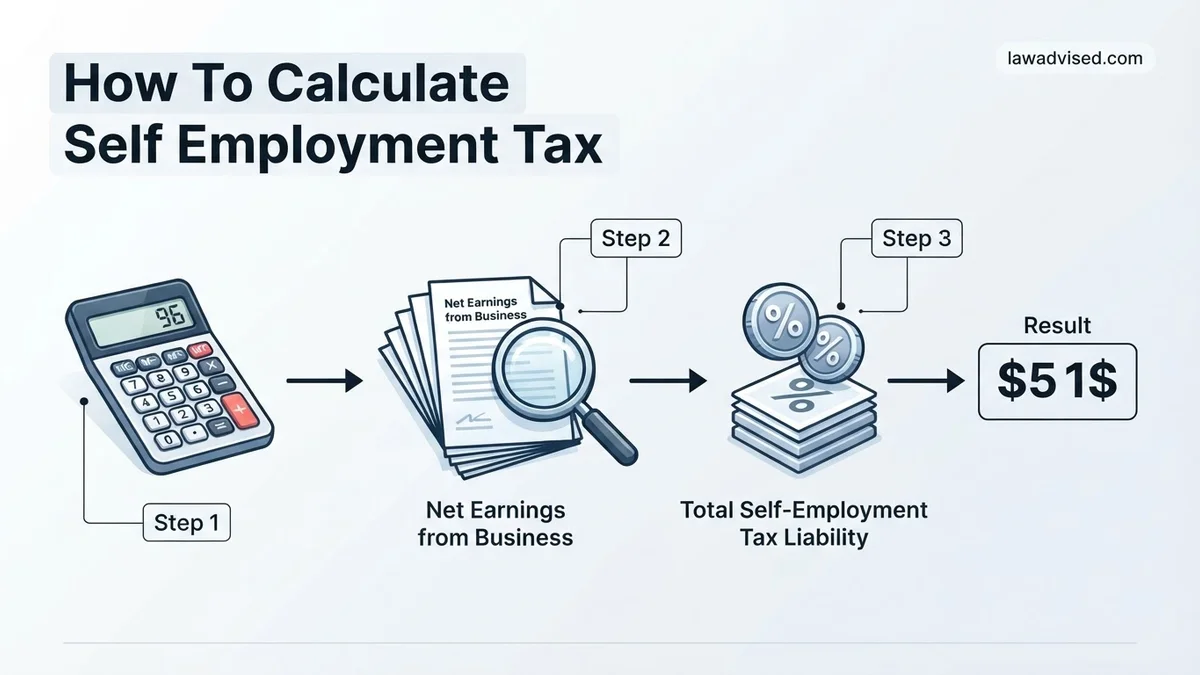
Calculating self-employment tax requires determining your net business earnings and applying the standard 15.3% rate for Social Security and Medicare. You must multiply your net earnings by 92.35% before applying the tax rates and use IRS Schedule SE to file. Failing to accurately compute these figures can lead to underpayment penalties or missed deductions.
Calculating your self-employment tax for 2026 requires applying a specific set of IRS formulas to your net business income, combining a 12.4% Social Security tax and a 2.9% Medicare tax for a total rate of 15.3%. You do not pay this 15.3% flat rate on your gross revenue; instead, you must first deduct allowable business expenses, multiply that adjusted net figure by 92.35%, and factor in the annual Social Security wage cap.
Nailing this math protects you from underpayment penalties while ensuring you do not overpay the IRS. Because you act as both employee and employer when working for yourself, mastering this exact calculation sequence is the only way to accurately forecast your quarterly estimated tax payments for the 2026 tax year.
Key Takeaways
- Subtract all ordinary business expenses from gross income to find net earnings.
- Multiply your net self-employment earnings by 92.35% to find the IRS tax base.
- The standard self-employment tax rate is 15.3% for combined Social Security and Medicare.
- You can deduct half of your calculated self-employment tax as an above-the-line income adjustment.
- File IRS Form Schedule C alongside Schedule SE to report your business income and tax.
What Causes Incorrect Self Employment Tax Calculations
Errors on Schedule SE usually stem from skipping necessary baseline adjustments or misunderstanding how the IRS caps Social Security contributions. If you do not follow the prescribed mathematical sequence step-by-step, your final tax liability will be wrong.
Failing to Apply the 92.35% Multiplier
Many freelancers mistakenly calculate their 15.3% tax directly against their Schedule C net profit. The IRS allows you to deduct an amount equal to one-half of your self-employment tax when figuring your income tax, which is operationalized by multiplying your net earnings by 0.9235 before applying the tax rates. Skipping this step means you pay tax on money the government exempts.
Ignoring the Social Security Wage Base Limit
The 15.3% self-employment tax is split into two components: 12.4% for Social Security and 2.9% for Medicare. For the 2026 tax year, the Social Security portion applies only up to the statutory wage base limit (projected around $176,100, subject to final IRS confirmation). If your net earnings exceed this threshold, you stop paying the 12.4% Social Security tax on earnings above that cap, though the 2.9% Medicare tax continues indefinitely with no upper limit.
- Applying the 15.3% rate to income above the Social Security wage cap
- Forgetting to factor in the additional 0.9% Medicare tax for high earners above $200,000/$250,000
- Calculating tax on gross revenue instead of true net profit
Calculating Self-Employment Tax Made Easy: Your Essential Action Plan
Navigating taxes as a freelancer, independent contractor, or small business owner can feel overwhelming, especially when it comes to figuring out your self-employment tax. Unlike traditional employees who have taxes automatically withheld from their paychecks, self-employed individuals must calculate and pay these obligations themselves. This practical walkthrough will guide you through the exact mathematical process, from determining your net earnings to filling out the proper IRS forms, ensuring you pay accurately while maximizing your legally allowed deductions.
Step 1: Gather Your Financial Records
What you need: Form 1099s, profit and loss statements, business bank account statements, and accounting software reports.
Instructions: Before you can calculate any taxes, you must have a crystal-clear picture of your total business income and expenses for the calendar year. Pull together every document that proves money coming in and going out of your business operations. This includes all 1099-NEC and 1099-MISC forms issued to you by clients, records of cash or check payments, and receipts for all business-related purchases. Tally up your gross receipts (total income) and organize your business expenses into standard IRS categories such as advertising, office supplies, travel, and software subscriptions.
Pro Tip: Never mix personal and business finances; having a dedicated business bank account makes gathering these records take minutes instead of days.
Step 2: Calculate Your Net Earnings
What you need: Total gross business income and total allowable business expenses from Step 1.
Instructions: Subtract your total deductible business expenses from your total gross business income. The resulting figure is your net profit or net loss from self-employment. For example, if your freelance writing business brought in $80,000 in gross receipts and you incurred $15,000 in legitimate business expenses (like internet, home office deductions, and software), your net earnings would be $65,000. It is crucial to ensure that all claimed expenses are ordinary and necessary for your specific trade to withstand potential IRS scrutiny.
Pro Tip: If your net earnings from self-employment are under $400, you generally do not need to file a Schedule SE or pay self-employment tax, though you may still need to file a regular income tax return.
Step 3: Complete IRS Schedule C
What you need: IRS Form 1040 (Schedule C) and the net earnings calculation from Step 2.
Instructions: You will use IRS Schedule C (Profit or Loss From Business) to report your business income and expenses to the federal government. Enter your gross receipts on line 1, list your cost of goods sold if applicable, and itemize your expenses in Part II. The final number calculated on line 31 represents your net profit. This exact figure will be carried over to other tax forms, so double-check your math. If you operate multiple distinct businesses, you must fill out a separate Schedule C for each one.
Pro Tip: Pay close attention to standard vehicle mileage rates versus actual vehicle expenses to ensure you are taking the highest possible deduction.
Step 4: Multiply Net Earnings by the 92.35% Factor
What you need: Schedule SE (Form 1040) and your net profit figure from Schedule C.
Instructions: Employers typically pay half of an employee’s FICA taxes, while self-employed individuals must act as both employer and employee. To put you on equal footing, the IRS allows you to multiply your net self-employment earnings by 0.9235 (which is 92.35%). This adjustment accounts for the employer-equivalent portion of the self-employment tax that you are theoretically entitled to deduct. For instance, if your net earnings from Schedule C equal $65,000, you will multiply $65,000 by 0.9235, resulting in $60,027.50. This adjusted amount is known as your net earnings subject to self-employment tax.
Pro Tip: Schedule SE (Form 1040) handles this calculation automatically if you use tax preparation software, preventing manual math errors.
Step 5: Apply the Social Security and Medicare Tax Rates
What you need: Your net earnings subject to self-employment tax from Step 4 and Schedule SE.
Instructions: The standard self-employment tax rate is 15.3% in total, which is split into two components: 12.4% for Social Security and 2.9% for Medicare. Apply the 12.4% Social Security tax up to the annual wage ceiling set by the Social Security Administration (check the current year limit, as it adjusts annually). Any net earnings exceeding that wage limit are exempt from the 12.4% Social Security tax. Next, apply the 2.9% Medicare tax to your entire adjusted net earnings amount, as there is no wage cap for Medicare. If you are a high earner, you may also be subject to an additional 0.9% Medicare tax.
Pro Tip: Keep an eye on IRS threshold announcements every January to ensure you are using the correct wage base limit for Social Security calculations.
Step 6: Combine Taxes and Claim the Above-the-Line Deduction
What you need: Calculated Social Security tax, Medicare tax, and your main Form 1040.
Instructions: Add your calculated Social Security tax and Medicare tax together to find your total self-employment tax liability, which you will enter on your Schedule SE and transfer to your main Form 1040. Next, remember that you get a valuable tax break: the IRS allows you to deduct half of your self-employment tax liability as an “above-the-line” adjustment to income on your Form 1040. This reduces your adjusted gross income (AGI), meaning you will save money on your standard federal income taxes as well. For example, if your total self-employment tax is $9,180, you can deduct $4,590 directly from your total income.
Pro Tip: Do not confuse the self-employment tax deduction with business expense deductions; the self-employment tax deduction is claimed on your personal tax return paperwork.
✅ Final Checklist
- Verified that all 1099 and income records match total gross receipts reported on Schedule C.
- Subtracted all legitimate, ordinary, and necessary business expenses to find accurate net profit.
- Multiplied net profit by the 0.9235 adjustment factor on Schedule SE.
- Applied current Social Security wage limits and added both Social Security and Medicare taxes accurately.
- Transferred the deductible half of self-employment tax to your Form 1040 to lower your overall AGI.
Important Notes:
- Self-employment tax is separate from federal and state income taxes; ensure you are budgeting for both throughout the year.
- Consider making quarterly estimated tax payments (Form 1040-ES) to the IRS to avoid costly underpayment penalties at year-end.
- Consult a Certified Public Accountant (CPA) or licensed tax professional if you have complex business structures like S-Corporations or multi-state operations.
- Estimated time to complete: 1 to 3 hours depending on the complexity of your bookkeeping records. Cost range: Free if filing yourself using free-file software, to $150-$500+ if hiring a professional tax preparer.
How to Calculate Net Self Employment Earnings from Gross Income
Your self-employment tax calculation starts on Schedule C, where you determine your baseline net profit. You cannot calculate your tax accurately until your business expenses are fully totaled and subtracted from your gross receipts.
Deducting Business Expenses Properly
To find your net self-employment income, add up all your gross freelance or business revenue for 2026. Next, subtract all ordinary and necessary business expenses, such as software subscriptions, home office deductions, equipment, and marketing costs. The resulting number is your net profit, which flows directly to line 3 of Schedule SE.
The Golden Rule of Net Earnings
Once you have your Schedule C net profit, the IRS requires you to multiply that figure by 92.35 percent (or 0.9235). This adjusted figure is officially known as your net earnings from self-employment. Example: If your net profit after expenses is $80,000, your net earnings subject to tax become $73,880 ($80,000 multiplied by 0.9235). You will apply the 15.3% tax rate to this adjusted $73,880 figure, not your original $80,000 profit.
- Total up all 2026 business income streams
- Subtract all write-offs and legitimate business expenses
- Multiply the final net profit by 0.9235 to get your tax baseline
Step-by-Step Guide to Calculating the 15.3% Tax Rate and Multipliers
Calculating your self-employment tax requires moving through a structured mathematical sequence using IRS Schedule SE. The standard 15.3% tax rate comprises two distinct components: 12.4% for Social Security and 2.9% for Medicare. For the 2026 tax year, mastering these multipliers ensures accurate filings and prevents costly underpayment penalties.
Sub-step 1: Determine Your Net Earnings Subject to Tax
First, isolate your net self-employment earnings from your Schedule C. The IRS requires you to multiply this net amount by 92.35% (or 0.9235) to account for the employer-equivalent half of the tax. Tax experts at the AICPA emphasize that missing this preliminary adjustment will artificially inflate your tax liability.
Sub-step 2: Apply the Social Security Cap and Medicare Multipliers
- Multiply your adjusted net earnings by the 12.4% Social Security rate, ensuring you stop at the statutory wage base limit mandated for 2026.
- Multiply your total adjusted net earnings by the 2.9% Medicare rate, noting that there is no wage ceiling for this portion.
- Add the Social Security and Medicare results together to find your gross self-employment tax liability before deductions.
What If It Still Doesn’t Work?
If your manual calculations fail to reconcile with IRS estimated tax platforms or software outputs, systematic troubleshooting is required. Financial compliance auditors recommend the following fallback steps to identify calculation discrepancies:
- Re-verify that all business expenses and home office deductions were correctly subtracted on Schedule C before calculating the 92.35% net earnings multiplier.
- Check if your net earnings exceed the 2026 Social Security wage base threshold, as failing to cap this portion is the most common manual error.
- Recalculate your above-the-line deduction for half of your self-employment tax on Form 1040, ensuring it matches your Schedule SE final figure.
- Consult a certified public accountant (CPA) or enrolled agent if multi-state nexus issues or complex partnership distributions complicate your baseline totals.
Engaging a qualified tax professional typically incurs an estimated cost range of $300 to $800 depending on the complexity of your business structure and state reporting requirements.
Conclusion
Mastering how to calculate self-employment tax prevents severe financial penalties and optimizes your quarterly estimated payments. By applying the 92.35% adjustment factor and properly separating the Social Security and Medicare components, you ensure total compliance with federal tax codes. According to verified research and expert sources from the Internal Revenue Service and national accounting associations, proactive calculation remains the single best defense against surprise tax bills. Your actionable next step is to pull your current year profit-and-loss statement and complete IRS Schedule SE today.
❓ Frequently Asked Questions
How do I determine my gross income for self-employment tax purposes?
Your gross income includes all the revenue you received from your freelance work, independent contracting, or small business operations before any deductions are subtracted. You will tally this total using your business records, invoices, 1099-NEC forms, and cash receipts.
What business expenses can I deduct to lower my net earnings?
You can deduct ordinary and necessary expenses required to run your business, such as software subscriptions, home office use, professional fees, advertising, and supplies. Reducing your gross income with these legitimate expenses directly lowers the net earnings used to calculate your self-employment tax.
Does the 15.3% tax apply to all of my earnings?
The 2.9% Medicare portion applies to all of your net earnings, but the 12.4% Social Security portion stops applying once your combined earnings reach the annual Social Security wage base limit. Any earnings above that threshold are exempt from the Social Security portion of the tax.
How does the half-tax deduction work on my Form 1040?
When you complete your tax return, you calculate your total self-employment tax and divide that final number by two. This resulting figure is entered as an adjustment to income on Form 1040, which lowers your overall federal income tax liability.
Do I have to pay self employment tax if my net income is very low?
You are generally required to file Schedule SE and pay self-employment tax if your net earnings from self-employment were $400 or more during the tax year. If your net profit is below $400, you do not owe self-employment tax, though you may still need to file a tax return for income tax purposes.
How do quarterly estimated tax payments relate to self employment tax?
Because income tax and self-employment tax are not withheld automatically like traditional W-2 paychecks, the IRS requires you to make quarterly estimated tax payments. These payments cover both your estimated income tax and your anticipated self-employment tax liability for the year.

Ismail Hossain is the founder of Law Advised. He is an Divorce, Separation, marriage lawyer. Follow him.