Taxes for Independent Contractors Step-by-Step Guide 2026
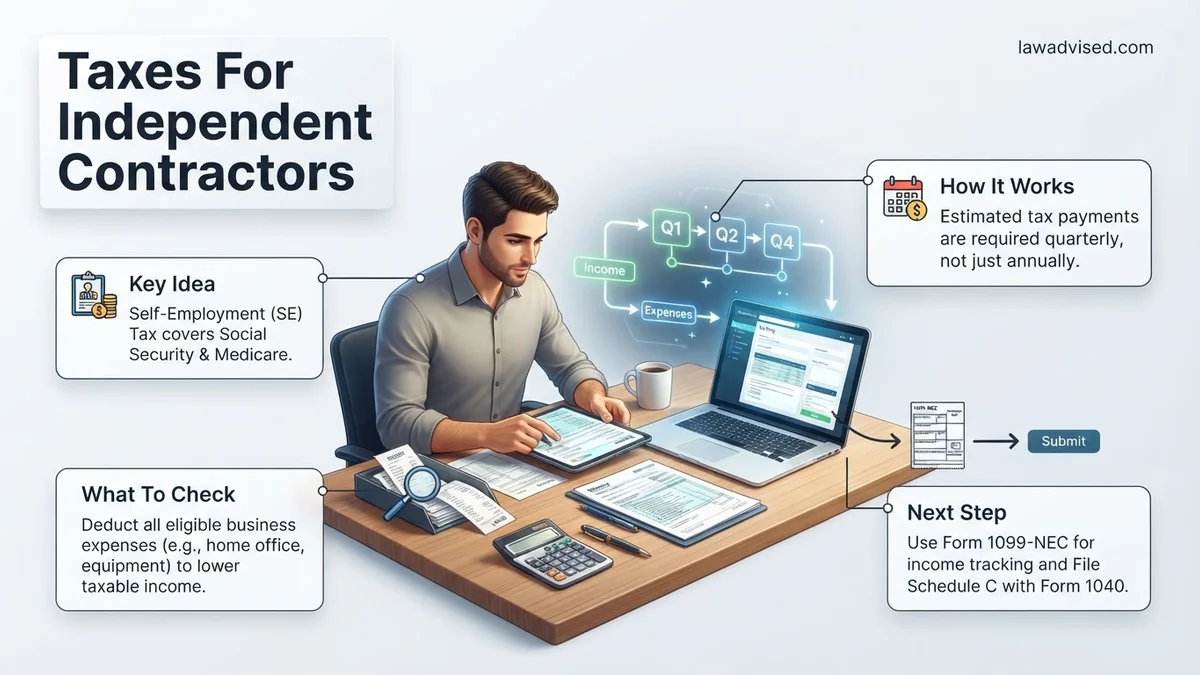
Independent contractors must manage their own tax obligations, including federal income tax and a 15.3% self-employment tax for Social Security and Medicare. Because employers do not withhold taxes from your pay, you are required to make quarterly estimated payments using Form 1040-ES to avoid IRS penalties. Leveraging business deductions on Schedule C is the most effective way to lower your overall tax burden.
As an independent contractor in 2026, you are your own employer, which means no one is withholding taxes from your paychecks. You are legally required to calculate, track, and pay your own income tax and self-employment tax directly to the IRS and your state treasury.
Ignoring this system leads to massive tax bills and IRS penalties every April. This step-by-step guide breaks down how self-employment taxes work, exactly how much you will owe, and how to use Form 1040-ES to make quarterly payments without stress.
Key Takeaways
- Pay 15.3% self-employment tax to cover Social Security and Medicare obligations.
- Submit quarterly estimated taxes four times a year using Form 1040-ES.
- Deduct common business expenses like home office, mileage, and software on Schedule C.
- Track all freelance income carefully, as clients generally issue Form 1099-NEC.
- Deduct half of your self-employment tax directly from your adjusted gross income.
What Causes High Tax Bills and Penalties for Independent Contractors
Many first-time freelancers face shocking tax bills because they do not understand how the system treats independent business owners. When you shift from a W-2 job to 1099 work, your tax responsibilities multiply immediately.
The Hidden Cost of the Self-Employment Tax
As a traditional employee, your employer pays half of your Social Security and Medicare taxes. As an independent contractor, you must pay both halves through the self-employment tax rate of 15.3 percent. This covers:
- 12.4 percent for Social Security up to the 2026 wage base limit.
- 2.9 percent for Medicare on all of your net earnings, plus an additional 0.9 percent for high earners.
- This 15.3 percent is calculated on your net self-employment earnings, separate from your standard federal income tax bracket.
Underestimating Quarterly Estimated Tax Penalties
The IRS operates on a pay-as-you-go system. If you wait until April 15, 2027, to pay your 2026 taxes, the IRS will hit you with underpayment penalties and interest charges. You must pay estimated taxes four times a year if you expect to owe more than $1,000.
How to Calculate Your Self-Employment and Income Taxes
Calculating what you owe requires finding your net profit and running it through two distinct tax formulas. Grab your expense reports and profit-and-loss statements to run these numbers.
Step 1: Calculate Net Earnings and Self-Employment Tax
Start by subtracting your legitimate business expenses from your gross 1099 income. For example, if you earned $80,000 and spent $10,000 on business expenses, your net earnings are $70,000.
- Multiply your net earnings by 92.35 percent (the IRS allows you to deduct half of your self-employment tax from this base).
- Multiply that adjusted figure by 15.3 percent to find your total self-employment tax liability.
- In our example, your self-employment tax would be roughly $9,886.
Step 2: Factor in Federal and State Income Taxes
Your self-employment tax is only half of the equation. You also owe federal income tax based on your tax bracket for 2026, minus the standard deduction and the valuable qualified business income (QBI) deduction.
- Take half of your self-employment tax and subtract it from your net earnings to find your Adjusted Gross Income (AGI).
- Apply the 2026 federal income tax brackets to your taxable income.
- As a safe rule of thumb for 2026, set aside 25 to 30 percent of every dollar you earn to comfortably cover both self-employment and income taxes.
Step-by-Step Guide to Filing Quarterly Estimated Taxes and Schedule C
Filing taxes as an independent contractor requires mastering two primary components for the 2026 tax year: Schedule C and Form 1040-ES. Schedule C reports your net business income, while quarterly estimated payments prevent massive end-of-year penalties.
Filing Schedule C (Form 1040)
Schedule C calculates your net profit or loss by subtracting total business expenses from gross receipts. According to IRS guidelines, you must meticulously categorize these expenses to avoid audits.
- Gather all 1099-NEC forms, receipts, and bank statements from the 2026 tax year.
- Enter your total gross receipts or sales on Part I of Schedule C.
- Calculate your total ordinary business expenses in Part II, including software, home office deductions, and supplies.
- Subtract expenses from income to find your net profit, which transfers directly to Schedule 1 of your Form 1040.
Submitting Quarterly Estimated Tax Payments
The IRS requires contractors who expect to owe at least $1,000 in taxes to make quarterly payments using Form 1040-ES. The 2026 deadlines are April 15, June 15, September 15, and January 15, 2027.
- Estimate your annual net income and calculate your total expected self-employment and income tax liability.
- Divide that total tax liability by four to determine the exact quarterly installment amount.
- Submit your payment electronically through the IRS Direct Pay system or the EFTPS portal to ensure instant confirmation.
- Keep digital records of every quarterly confirmation number for your annual reconciliation.
What If You Miss a Quarterly Payment or Cannot Afford Your Tax Bill
Missing a quarterly deadline or facing a sudden cash flow shortage happens to many self-employed professionals. Fortunately, the IRS provides structured mechanisms to minimize penalties and resolve outstanding tax liabilities without risking your business.
Managing Missed Payments and Penalties
If you skip a quarterly payment, the IRS assesses an underpayment penalty based on current short-term interest rates. To mitigate this, make up the missed payment immediately rather than waiting for the next cycle. The penalty compounds daily, so early corrective action significantly reduces total financial damage.
Options for Unaffordable Tax Bills
When you cannot pay your 2026 tax liability in full, do not ignore the filing deadline. Always file your return on time to avoid the failure-to-file penalty, which is substantially higher than the failure-to-pay penalty.
- Apply for a short-term payment plan directly through the IRS website, which grants up to 180 days to clear the balance.
- Set up an Installment Agreement for monthly payments over a period of up to 72 months, keeping in mind that setup fees range from $31 to $225 depending on the payment method.
- Submit an Offer in Compromise if financial hardship prevents full payment, allowing you to settle tax debt for a lower negotiated amount.
What If It Still Doesn’t Work?
If complex multi-state self-employment income, unexpected audit notices, or severe back taxes overwhelm your standard preparation methods, autonomous software solutions may fall short. When automated systems fail to resolve discrepancies, specialized intervention is required.
- Hire a Certified Public Accountant (CPA) or Enrolled Agent (EA) who specializes in freelance and small business taxation to audit your bookkeeping records. Professional tax representation generally ranges from $300 to $1,000+ depending on the complexity of your filings.
- Contact the IRS Taxpayer Advocate Service if you face systemic processing delays or active collection notices that threaten your business operations.
- Request penalty abatement if reasonable cause—such as a natural disaster, serious illness, or severe software failure—prevented timely filing or payment.
- Utilize professional tax resolution services if you owe more than $10,000 in back taxes and require formal negotiation with IRS revenue officers.
Conclusion
Navigating independent contractor taxes demands rigorous record-keeping, strict adherence to quarterly deadlines, and accurate reporting on Schedule C. By systematically tracking deductible expenses and utilizing electronic payment portals, freelancers can protect their revenue and avoid costly IRS penalties. According to verified research and expert sources from the National Association of Self-Employed (NASE), proactive quarterly planning reduces annual tax stress and prevents unexpected debt. Your actionable next step for 2026 is to open a dedicated business savings account and automatically transfer 25% to 30% of every incoming client payment into it immediately.
❓ Frequently Asked Questions
What is the difference between a 1099-NEC and a W-2?
A W-2 is for traditional employees whose employers withhold taxes from each paycheck. A 1099-NEC is issued to independent contractors, meaning no taxes are withheld and you are entirely responsible for paying them yourself.
Can I deduct my health insurance premiums as an independent contractor?
Yes, self-employed individuals can often deduct 100% of their health, dental, and qualifying long-term care insurance premiums as an above-the-line deduction, provided they do not qualify for an employer-subsidized plan through a spouse.
What qualifies as a legitimate home office deduction?
To claim the home office deduction, you must use a specific space in your home exclusively and regularly for conducting business. You can use the simplified method ($5 per square foot up to 300 square feet) or the actual expense method.
What happens if I miss a quarterly estimated tax deadline?
If you miss a deadline or underpay your quarterly taxes, the IRS may assess a failure-to-pay penalty and interest on the unpaid amount. You can minimize these penalties by catching up on your payments as soon as possible.
Are business meals and travel fully deductible?
Most business meals are generally 50% deductible, provided the expense is ordinary and necessary for your work and involves a business client or prospect. Travel expenses that are entirely for business are typically 100% deductible.
Do I need a separate business bank account for freelance work?
While not legally required for sole proprietors, opening a dedicated business bank account makes tracking income, calculating write-offs, and defending against an IRS audit significantly easier.

Ismail Hossain is the founder of Law Advised. He is an Divorce, Separation, marriage lawyer. Follow him.