
What Is Federal Taxable Income Step-by-Step Guide for 2026
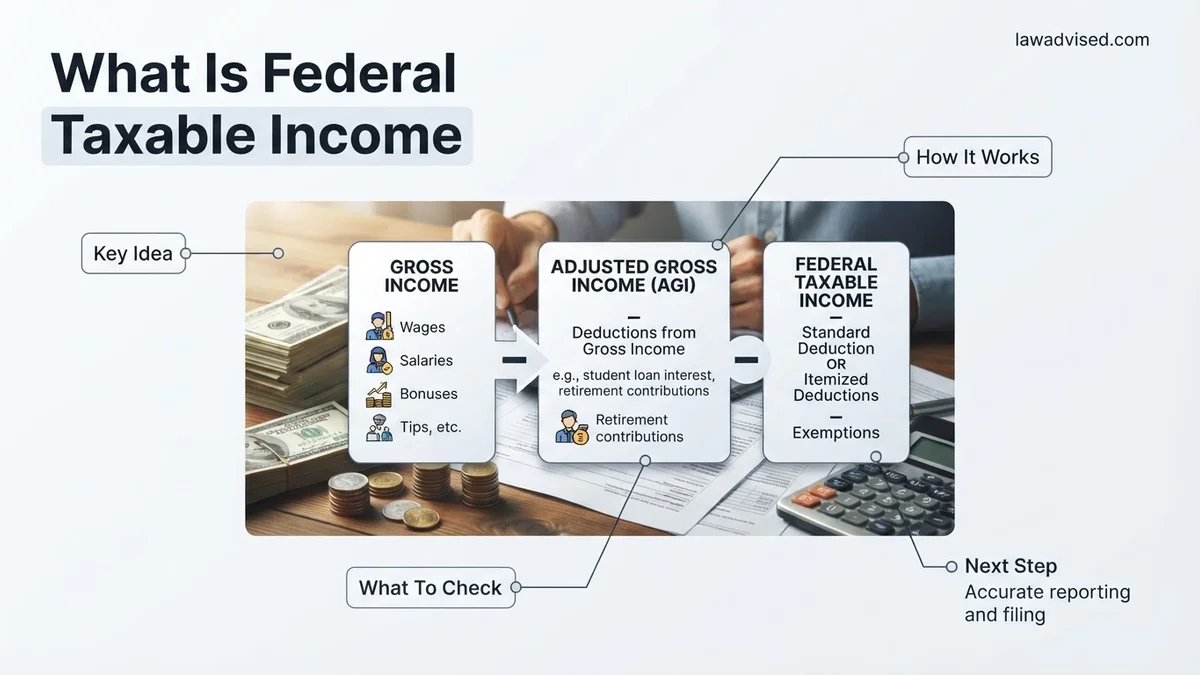
Federal taxable income is the final dollar amount used to calculate your actual federal income tax liability. It is determined by taking your total gross income and subtracting eligible adjustments, adjusted gross income (AGI), and either the standard deduction or itemized deductions.
Federal taxable income is the exact dollar amount the IRS uses to calculate your income tax liability for the year. It represents your total earnings minus allowable adjustments and deductions, forming the foundation of your entire tax return.
Knowing this number helps you avoid IRS penalties, plan your quarterly or withholding payments, and keep more of your hard-earned money. When you understand the formula, tax season stops feeling like a guessing game.
Key Takeaways
- Federal taxable income is the exact amount that federal tax brackets and rates are applied to.
- Calculate it by starting with gross income, subtracting adjustments to reach AGI, and applying deductions.
- Wages, tips, business earnings, and investment gains count as taxable income.
- You can choose between taking the standard deduction or itemizing your specific deductions.
- Tax credits and tax withholding are applied after your federal taxable income is determined.
What Causes Confusion About Federal Taxable Income
Gross Income Versus Taxable Income
Many taxpayers mistakenly believe that the salary listed on their employment offer letter is the amount the government taxes. That figure is your gross income, not your taxable income. The IRS does not tax every dollar you receive, and it accounts for the money you spend earning that living.
- Earned Income: Wages, salaries, tips, and professional fees count as fully taxable income.
- Unearned Income: Investment dividends, capital gains, and rental income also add to your gross baseline.
- Non-Taxable Items: Certain gifts, qualifying life insurance payouts, and federal tax refunds are excluded from your starting calculations.
The Misconception of Total Earnings
People often panic when they see their annual earnings statement, assuming they will owe taxes on the entire sum. In reality, the tax code builds in multiple checkpoints to reduce your burden before the final tax rates ever apply to your money.
How to Calculate Your Federal Taxable Income Step-by-Step
Step 1: Determine Your Gross Income
Your calculation always starts by adding up every taxable stream of revenue you received during the 2026 tax year. This includes your primary job earnings, side hustle revenue, unemployment benefits, and taxable interest from bank accounts. For 2026, keeping accurate records of these inflows prevents severe calculation errors right from the start.
Step 2: Subtract Above-the-Line Deductions
Next, you subtract your adjustments to income, often called above-the-line deductions. These do not require you to itemize your personal expenses to claim them. Common examples for 2026 include:
- Contributions to traditional individual retirement accounts (IRAs)
- Student loan interest payments up to allowable limits
- Self-employed health insurance deductions
Subtracting these adjustments from your gross income gives you your Adjusted Gross Income, or AGI. Your AGI is a critical metric because it determines your eligibility for various tax perks.
How to Choose Between Standard and Itemized Deductions
Choosing the right deduction method directly affects your federal taxable income. According to IRS tax data, over 90 percent of taxpayers utilize the standard deduction because of its simplicity and higher threshold. However, homeowners, high-state-tax residents, and heavy charitable donors often benefit more from itemizing.
Evaluating the Standard Deduction for 2026
The standard deduction reduces your adjusted gross income by a fixed dollar amount based on your filing status. For the 2026 tax year, inflation adjustments set the standard deduction at estimated levels of $15,000 for single filers and $30,000 for married couples filing jointly. You do not need to keep receipts or track individual expenses to claim this amount.
Evaluating Itemized Deductions
Itemizing requires you to list and total individual qualified expenses using Schedule A. Financial advisors recommend itemizing only if your total eligible expenses exceed the standard deduction threshold for your filing status. Common itemized expenses include:
- State and local taxes (SALT) up to the statutory cap.
- Mortgage interest paid on primary and secondary residences.
- Qualified medical and dental expenses exceeding a specific percentage of your adjusted gross income.
- Charitable contributions made to qualified 501(c)(3) organizations.
What If Your Income Calculations Do Not Match Your W-2 or 1099 Forms
Discrepancies between your personal income calculations and official tax reporting forms can trigger automated IRS notices and processing delays. Tax compliance experts emphasize that financial institutions and employers have strict reporting deadlines, but human error still occurs.
Steps to Resolve Income Discrepancies
- Review every information return, including W-2s, 1099-NECs, and 1099-INT forms, against your personal bank statements and pay stubs.
- Contact the issuing employer or payer immediately to request a corrected form, known as a W-2c or corrected 1099, if you identify a reporting error.
- Attach a detailed explanatory statement to your federal tax return if the payer refuses to issue a correction before your filing deadline.
- Calculate self-employment net earnings carefully using Schedule C to ensure business expense deductions match your accounting software records.
What If It Still Doesn’t Work?
If income calculations remain complex or discrepancies persist after thorough reviews, manual preparation carries significant financial risk. Try these fallback steps to ensure compliance:
- Utilize IRS-approved Free File software programs to cross-verify your gross income calculations and deduction limits automatically.
- Gather all missing tax documents and historical transcripts directly from your online IRS taxpayer account portal.
- Schedule a consultation with a Certified Public Accountant (CPA) or Enrolled Agent (EA) to review complex multi-stream income portfolios.
- Budget for professional tax preparation services, which typically range from $250 to $600+ depending on the complexity of your business and investment schedules.
Conclusion
Determining your federal taxable income is the foundation of accurate tax preparation and compliance. By systematically subtracting adjustments and choosing the optimal deduction method, you can accurately minimize your legal tax liability for 2026. According to verified research and expert sources from the American Institute of CPAs, maintaining organized financial records throughout the year prevents costly calculation errors. Your actionable next step is to log into your IRS account and download all incoming information forms before starting your return.
❓ Frequently Asked Questions
What is the primary difference between gross income and federal taxable income?
Gross income is the total amount of money you earn from all sources before any subtractions. Federal taxable income is what remains after you subtract above-the-line adjustments and your standard or itemized deductions.
Are all types of income considered part of federal taxable income?
No, certain types of income are excluded or tax-exempt, such as gifts, inheritances, municipal bond interest, and certain specialized government benefits.
How do deductions lower my federal taxable income?
Deductions directly reduce the amount of your income that is subject to tax. You can choose the standard deduction or itemize specific expenses like mortgage interest and charitable donations.
Does federal taxable income include state or local taxes?
State and local tax refunds may be taxable if you itemized deductions in a previous year and received a tax benefit, but current taxes paid are generally subject to state and local tax deduction limits.
How do tax credits affect my federal taxable income?
Tax credits do not change your federal taxable income directly; instead, they reduce your final tax liability dollar-for-dollar after the tax brackets have already been applied to your taxable income.
Where can I find my federal taxable income on my tax return?
On a standard IRS Form 1040, your final federal taxable income is typically located near the bottom of the first page, right before the tax calculation section.

Ismail Hossain is the founder of Law Advised. He is an Divorce, Separation, marriage lawyer. Follow him.