How to Avoid Estimated Tax Penalty Proven 2026 Guide
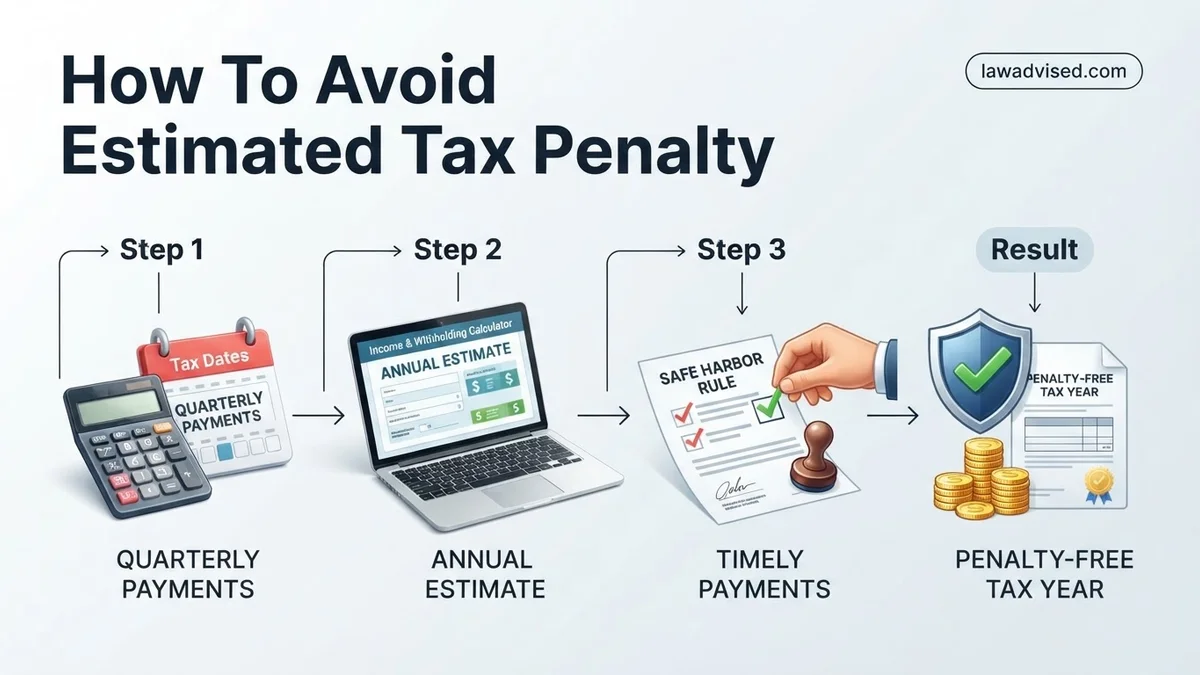
Facing an IRS underpayment penalty happens when you do not withhold or pay enough tax throughout the year. You can avoid estimated tax penalties by utilizing Safe Harbor rules, increasing your W-2 withholding before December 31, or qualifying for specific IRS waivers.
If you didn’t have enough taxes withheld throughout the year, you can completely avoid the IRS estimated tax penalty by utilizing the legal “Safe Harbor” thresholds or by adjusting your remaining W-2 withholdings before December 31, 2026. The IRS expects you to pay as you go via quarterly estimates or payroll deductions, and falling short triggers an underpayment penalty.
Navigating this situation successfully saves you from unnecessary interest charges and financial stress. By understanding how the IRS calculates these penalties and leveraging specific exceptions, you can protect your hard-earned money and keep your 2026 tax liability completely penalty-free.
Key Takeaways
- Pay at least 90% of your current year tax liability to meet Safe Harbor rules.
- Pay 100% (or 110% for high earners) of your prior year tax to eliminate penalties.
- Increase your W-2 paycheck withholding late in the year to offset underpayments.
- Use the annualized income installment method if your earnings fluctuate seasonally.
- File IRS Form 2210 to claim waivers for disasters, retirement, or disability.
What Causes IRS Estimated Tax Penalties and Underpayment Charges
The Pay-As-You-Go System and Triggering Events
The United States tax system operates on a pay-as-you-go rule. You are expected to pay taxes on your income as you earn it throughout 2026. If you are a freelancer, business owner, or investor with significant non-wage income, you generally must make quarterly estimated tax payments using IRS Form 1040-ES.
An underpayment penalty triggers when you reach tax filing time and realize you missed your quarterly payments, paid too little, or had insufficient W-2 withholding. Even if you write a massive check to the IRS on April 15, 2027, to cover what you owe, you can still face a penalty for not paying in equal installments throughout 2026.
How the IRS Calculates the Penalty
The IRS calculates your penalty based on the amount you underpaid, how long the underpayment remained unpaid, and the quarterly interest rate set by federal guidelines. For 2026, the IRS interest rate on underpayments stays indexed to the federal short-term rate plus three percentage points.
- Quarterly tracking: The IRS checks if you paid enough during each specific quarter (April, June, September, and January).
- Compound interest: The penalty accrues daily until you pay the balance or hit the safe harbor threshold.
- No penalty for refunds: If the IRS owes you a refund overall, they will not charge you an underpayment penalty for missing quarterly estimates.
Master Estimated Tax Penalties in 7 Simple Steps
Navigating the complex world of quarterly taxes can feel overwhelming, especially if your income fluctuates throughout the year. If you are a freelancer, independent contractor, or business owner, failing to pay enough tax throughout the year can result in costly IRS penalties. This comprehensive guide will walk you through the exact actions you need to take to calculate your liabilities correctly, make timely payments, and legally bypass unnecessary fines.
Step 1: Calculate Your Prior Year Adjusted Gross Income
What you need: Your previous year’s federal tax return (Form 1040) and a calculator.
Instructions: Start by looking up your Adjusted Gross Income (AGI) from the previous tax year. The IRS allows you to use a “safe harbor” rule to avoid penalties entirely, which is often the easiest route. For most taxpayers, if your prior year AGI was under $150,000, you can completely avoid underpayment penalties by paying 100% of the tax shown on your previous year’s return. If your AGI exceeded $150,000, that safe harbor threshold rises to 110%. Review line 11 of your past Form 1040 to find your exact AGI and determine your specific baseline target.
Pro Tip: Do not guess your prior year AGI. Pull the official transcript directly from the IRS website to ensure your numbers match their records precisely.
Step 2: Project Your Current Year Tax Liability
What you need: Current income statements, expense records, and IRS Form 1040-ES.
Instructions: If your income has dropped significantly since last year, relying on the prior-year safe harbor might cause you to overpay. In this scenario, you should calculate your projected tax liability for the current year. Estimate your total gross income, subtract your deductible business expenses to find your net self-employment income, and factor in the Qualified Business Income deduction if applicable. Next, estimate your income tax bracket and self-employment tax rate (15.3% on net earnings). Your goal is to pay at least 90% of what you will actually owe for the current tax year.
Pro Tip: Always err on the side of caution. If your freelance income is unpredictable, assume a slightly higher earnings bracket so you do not accidentally fall below the 90% threshold.
Step 3: Understand the Quarterly Payment Deadlines
What you need: A digital calendar, reminder apps, and IRS Form 1040-ES payment vouchers.
Instructions: The IRS does not collect estimated taxes on a standard quarterly schedule spaced evenly across the year. Instead, the four payment deadlines are irregular: April 15, June 15, September 15, and January 15 of the following year. Mark these dates prominently in your calendar. If any of these deadlines fall on a weekend or a legal holiday, the due date automatically shifts to the next business day. Missing even a single deadline by a few days can trigger a fractional penalty for that specific quarter, even if your total annual payment ends up being correct.
Pro Tip: Set up calendar alerts two weeks prior to each deadline to give yourself ample time to review your accounts and transfer funds.
Step 4: Divide and Schedule Your Payments
What you need: A spreadsheet tool like Excel or Google Sheets and your total annual tax target.
Instructions: Take your total annual estimated tax target (determined in Step 1 or Step 2) and divide it evenly by four. For example, if your safe harbor target is $12,000, you need to pay $3,000 by each of the four quarterly deadlines. Do not wait until the end of the year to lump your payments together; the IRS calculates penalties on a per-quarter basis. If you miss Q1 and double up in Q2, you may still owe a penalty for the late Q1 portion. Consistency is your best defense against algorithmic IRS fines.
Pro Tip: Open a separate business savings account specifically for taxes. Automatically transfer 25% to 30% of every incoming client payment into this account so the funds are always ready.
Step 5: Utilize IRS Direct Pay or EFTPS for Submissions
What you need: Bank account routing and account numbers, plus identification verification documents.
Instructions: Make your payments electronically to ensure immediate processing and confirmation. The fastest methods are IRS Direct Pay (for bank account debits without fees) or the Electronic Federal Tax Payment System (EFTPS). When submitting, select Form 1040-ES as the tax type and ensure you apply the payment to the correct tax year and specific quarter. Keep digital copies of all confirmation numbers and transaction receipts. Mailing physical checks with paper vouchers is prone to postal delays and lost payments, which can result in erroneous penalty notices.
Pro Tip: Avoid paying estimated taxes with a credit card unless you are chasing sign-up bonuses, as credit card processors charge a convenience fee of around 1.85% to 2%.
Step 6: Adjust Payments Mid-Year Using Annualized Income
What you need: Year-to-date profit and loss statements and IRS Form 2210.
Instructions: If your income fluctuates wildly—such as making 80% of your annual revenue in the fourth quarter—the standard quarterly division might force you to tie up capital unnecessarily. You can use the “Annualized Income Installment Method” on IRS Form 2210. This method allows you to calculate your tax based on what you actually earned during each specific period of the year. By annualizing your income, your Q1 and Q2 payments might be very small or zero, while your later payments scale up alongside your actual business growth.
Pro Tip: The annualized method requires detailed bookkeeping. Ensure your accounting software is up-to-date before attempting this calculation, or consult a certified public accountant.
Step 7: Apply for a Penalty Waiver If Unforeseen Events Occurred
What you need: Documentation of hardship, medical records, or disaster declarations.
Instructions: If you missed a payment or underpaid due to a casualty, disaster, or other unusual circumstance—or if you retired (after reaching age 62) or became disabled during the tax year—the IRS may waive the estimated tax penalty. File IRS Form 2210 and attach a written statement explaining the mitigating circumstances. The IRS reviews these waiver requests on a case-by-case basis. While not guaranteed, demonstrating a valid, uncontrollable emergency can successfully eliminate an otherwise mandatory penalty charge.
Pro Tip: Always include clear, objective proof of the hardship. Vague explanations are frequently rejected by automated IRS review systems.
✅ Final Checklist
- Verified your prior year AGI or calculated current year projected liability accurately
- Mapped all four quarterly payment deadlines (April, June, September, January) in your planner
- Set aside money monthly in a dedicated tax savings account
- Submitted payments electronically via IRS Direct Pay or EFTPS with correct quarterly designations
- Saved digital transaction receipts and confirmation numbers for every payment made
Important Notes:
- State and local tax authorities often have separate estimated tax requirements and penalty rules that you must satisfy independently from federal taxes.
- Seek professional help from a Certified Public Accountant (CPA) or Enrolled Agent (EA) if your business structure changes mid-year or if you receive an unexpected IRS penalty notice.
- Estimated time: 1-2 hours for initial setup and calculation; Cost range: Free when using IRS Direct Pay, variable if hiring a tax professional.
How to Fix Underpayment Using the Safe Harbor Rules
The 90% Current Year Rule
The most straightforward safe harbor rule allows you to avoid the penalty entirely if your total tax payments for 2026 cover at least 90 percent of your actual tax liability for the current year. Your total payments include both federal income tax withheld from a W-2 job and any timely quarterly estimated payments you already made.
For example, if your total 2026 tax liability ends up being 20,000 dollars, you must have paid at least 18,000 dollars through withholding or estimates by January 15, 2027. Meeting this 90 percent threshold completely shields you from IRS underpayment penalties, regardless of how much you owe upon filing your final return.
The 100% and 110% Prior Year Rules
If calculating your current year liability feels too unpredictable, you can rely on what you paid last year. The IRS grants a safe harbor if your total 2026 payments equal 100 percent of the total tax you owed for the previous tax year (2025).
- Standard threshold: Pay 100 percent of your 2025 total tax liability through 2026 withholding and estimates.
- High-income threshold: If your adjusted gross income for 2025 exceeded 150,000 dollars (or 75,000 dollars if married filing separately), the safe harbor requirement jumps to 110 percent of your 2025 tax liability.
- Practical application: Look at line 24 of your 2025 Form 1040. If your 2026 withholding matches or exceeds that specific dollar amount, you are 100 percent safe from penalties.
Step-by-Step Guide to Increasing W-2 Withholding and Adjusting Payments
For taxpayers with both W-2 employment and freelance income, the most effective defense against the estimated tax penalty is adjusting Form W-4 at your day job. Employers remit taxes steadily throughout the year, which the IRS treats as evenly timed payments regardless of when your paycheck arrived. According to IRS compliance guidelines, increasing W-2 withholding can completely wipe out an underpayment penalty accrued from self-employment.
How to File a Revised Form W-4
- Calculate your projected annual self-employment tax liability using current 2026 tax brackets and the 15.3 percent self-employment tax rate.
- Log into your employer’s payroll portal or request a physical Form W-4 (Employee’s Withholding Certificate) from your human resources department.
- Navigate to Step 4(a) on the form to account for other income, or Step 4(c) to specify an exact extra dollar amount withheld from every single paycheck.
- Divide your total estimated shortfall by the remaining number of pay periods in 2026 to determine the precise per-paycheck withholding figure.
- Submit the updated form and review your next pay stub to verify that the extra deduction has been successfully implemented by payroll.
What If It Still Doesn’t Work: IRS Form 2210 Waivers and Exceptions
If you missed quarterly deadlines or experienced a late-year income surge that traditional withholding adjustments could not fix, you may still avoid penalties. The IRS permits penalty waivers under specific, regulated circumstances. Review these fallback steps if your standard payments fall short for 2026:
- File IRS Form 2210 (Underpayment of Estimated Tax by Individuals, Estates, and Trusts) with your 2026 return to formally request a waiver due to casualty, disaster, or other unusual circumstances.
- Check the box for the waiver provision if you retired after age 62 or became disabled during the 2026 tax year, as the IRS automatically waives penalties for reasonable cause.
- Utilize the annualized income installment method on Form 2210 if your income fluctuated heavily, proving that you earned the bulk of your money late in the year.
- Consult a certified public accountant or enrolled agent if your calculations prove too complex; professional tax representation for penalty abatement typically costs between 300 and 800 dollars depending on the complexity of your return.
Conclusion
Navigating estimated tax penalties requires proactive calculation and strategic timing to match IRS compliance standards for 2026. By leveraging the annualized income installment method or adjusting your W-2 withholding, you can neutralize costly underpayment fees before they compound. According to verified research and tax advisory sources, the single most effective next step is to review your year-to-date earnings today and submit a revised Form W-4 or quarterly payment to bridge any existing deficit.
❓ Frequently Asked Questions
What are the exact IRS Safe Harbor thresholds for avoiding penalties?
To qualify for Safe Harbor, your total withholdings and estimated payments must equal at least 90% of the tax owed for the current year, or 100% of the tax shown on your prior year’s return. If your adjusted gross income exceeds $150,000, the prior year threshold increases to 110%.
Does increasing my W-2 withholding fix previous quarter underpayments?
Yes, unlike quarterly estimated tax payments which must be paid on time, the IRS treats income tax withheld from a paycheck as having been paid evenly across the entire year. Increasing your W-2 withholding in December can retroactively cover earlier shortfalls.
How do I calculate payments if my business is seasonal?
You can use IRS Schedule AI (Form 2210) for the annualized income installment method. This allows you to calculate your required estimated tax payment based on your actual income earned during specific periods of the year.
What form do I use to calculate or request a waiver for the penalty?
You use IRS Form 2210 (Underpayment of Estimated Tax by Individuals, Estates, and Trusts) to calculate any penalty owed or to claim an exception, such as retirement after age 62, disability, or a casualty disaster.
What happens if I miss a quarterly estimated tax deadline?
If you miss a deadline, you should make the payment as soon as possible to limit the accrual of interest and penalties. Even a late payment reduces the final underpayment calculation compared to paying nothing until April.
Are self-employed individuals subject to different penalty rules?
Self-employed individuals must pay self-employment tax along with income tax through quarterly estimated payments. The same Safe Harbor rules apply, but failing to budget for self-employment tax is the most common reason freelancers trigger penalties.

Ismail Hossain is the founder of Law Advised. He is an Divorce, Separation, marriage lawyer. Follow him.