Capital Gains Tax on Real Estate Best Guide for 2026
Capital gains tax on real estate is a levy on the profit made from selling property above its purchase price. Knowing how to calculate your gains and utilize exemptions can save you thousands of dollars in taxes during a property sale.
Capital gains tax on real estate is the tax you pay on the profit when you sell a property for more than you originally paid for it. This tax applies to investment properties, vacation homes, and sometimes your primary residence if your profits exceed specific legal exclusion limits.
Navigating this tax in 2026 requires a clear understanding of your purchase price, home improvements, and federal exclusion rules. Getting this right prevents you from handing over a massive chunk of your hard-earned profits to the government.
Key Takeaways
- Capital gains tax applies to the net profit realized from selling a real estate property.
- Section 121 exclusion allows single filers to exclude up to $250,000 of profit.
- Married couples filing jointly can exclude up to $500,000 of primary residence profit.
- Home improvements add to your cost basis, directly reducing your taxable profit.
- A 1031 exchange defers capital gains taxes on investment properties by reinvesting profits.
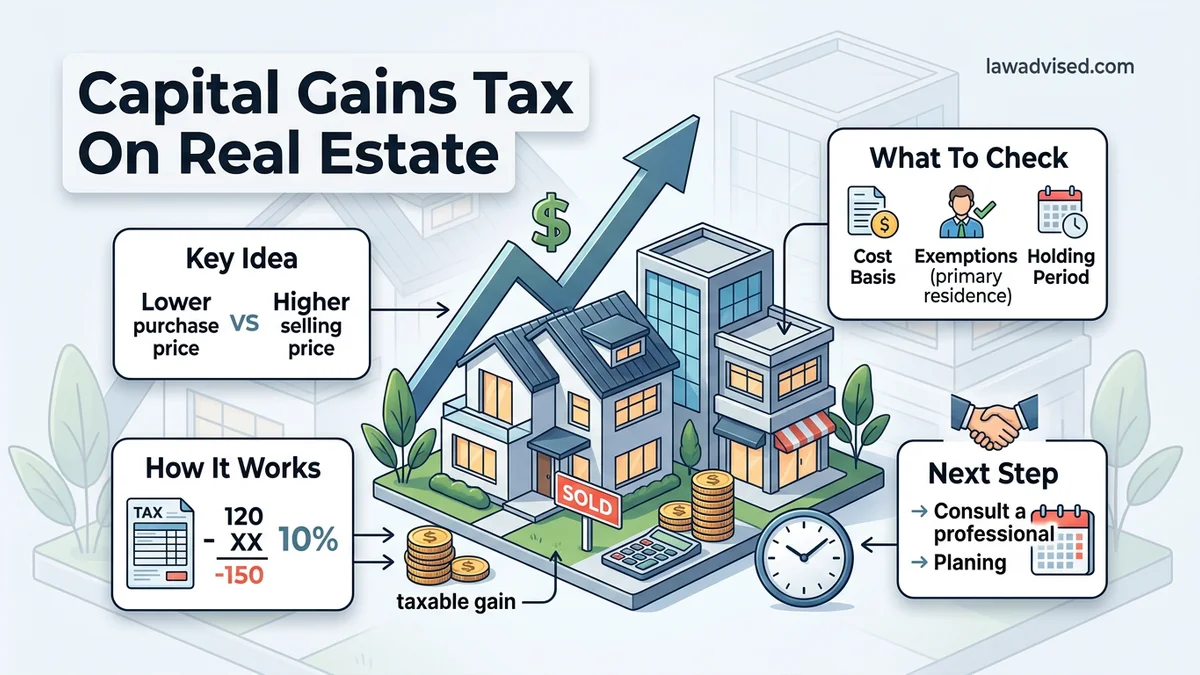
What Causes Capital Gains Tax on Real Estate to Apply
Capital gains tax triggers the moment you complete the sale of a property and realize a financial profit. However, the law treats different types of real estate in very distinct ways based on how you used the property.
Primary Residences Versus Investment Properties
If you sell your primary home, you might not owe any capital gains tax at all. Under current 2026 tax codes, you can exclude up to $250,000 of profit if you file as single, or up to $500,000 if you are married filing jointly. To qualify for this exclusion, you must pass two main tests:
- The Ownership Test: You must have owned the home for at least two out of the five years leading up to the sale.
- The Use Test: You must have lived in the home as your main residence for at least two out of those same five years.
When Vacation Homes and Rentals Trigger Taxes
Vacation homes and long-term rental properties never qualify for the primary residence exclusion. The moment you sell a rental property or a secondary vacation home at a profit, capital gains tax applies immediately. You cannot use the 250k or 500k exemption unless you first convert that rental property into your primary residence and live there for the required two-year period.
How to Calculate Your Real Estate Capital Gains Step-by-Step
Calculating your capital gains is not just as simple as subtracting your purchase price from your selling price. You need to determine your adjusted basis to find your true profit.
Step 1: Determine Your Cost Basis
Your cost basis starts with the actual purchase price you paid for the property. To this initial number, you add eligible buying costs, such as legal fees, title insurance, and recording fees. This gives you your starting baseline.
Step 2: Calculate Your Adjusted Basis
You increase your cost basis by adding the cost of major capital improvements made during your ownership. Routine repairs like painting a wall do not count, but substantial upgrades do. Eligible additions include:
- Building a brand new room or deck onto the house
- Installing a completely new roof or HVAC system
- Upgrading plumbing systems or adding permanent landscaping
Step 3: Subtract Selling Costs and Compute Final Gain
Finally, you subtract your selling expenses—such as real estate agent commissions, escrow fees, and transfer taxes—from your final sale price to find your amount realized. Subtract your adjusted basis from this amount realized, and your resulting number is your official capital gains profit subject to taxation in 2026.
How to Fix High Tax Bills Using Legal Exemptions and Deductions
Navigating capital gains tax on real estate in 2026 requires utilizing established legal frameworks to minimize your liability. The primary mechanism for deferring your tax burden is the 1031 Exchange, which applies strictly to investment or business properties. By reinvesting your proceeds into a like-kind property, you can defer both federal and state capital gains taxes indefinitely.
Executing a 1031 Exchange
To successfully execute this strategy without triggering a taxable event, you must follow strict Internal Revenue Service timelines. According to tax guidelines, failure to meet these deadlines instantly disqualifies the transaction.
- Identify potential replacement properties within exactly 45 days of selling your original asset.
- Acquire the replacement property within 180 days of the original sale closing.
- Utilize a qualified intermediary to hold all sales proceeds during the transaction window to prevent constructive receipt.
Maximizing Depreciation Recapture Strategies
Property owners must also account for depreciation recapture, taxed at a maximum rate of 25 percent. Real estate experts note that conducting a cost segregation study before selling can reclassify building components into shorter depreciation schedules. This offsets ordinary income during ownership, though strategic timing with a 1031 exchange remains essential to manage the final tax impact in 2026.
What If It Still Doesn’t Work?
If exemptions like the Section 121 exclusion or a 1031 exchange fail to cover your transaction, you may still face a substantial tax bill. When standard relief methods are insufficient, property owners should execute the following fallback steps to minimize financial fallout:
- Offset your capital gains by harvesting capital losses from underperforming stocks, bonds, or other investment assets within the 2026 tax year.
- Install an installment sale agreement to spread your capital gains payments across multiple tax years, keeping your annual income in a lower tax bracket.
- Consult a certified public accountant (CPA) or a tax attorney who specializes in real estate transactions. Professional advisory fees typically range from $300 to $1,000 depending on the complexity of your asset portfolio.
- Request a formal penalty abatement from the IRS if filing delays or calculation errors occurred due to reasonable cause.
Conclusion
Managing capital gains tax on real estate demands careful adherence to 2026 tax laws, strict timelines, and strategic use of exemptions like the Section 121 exclusion. Failing to plan for these liabilities can erode a significant portion of your property profits. According to verified research and expert financial sources, proactive timing remains the most effective tool for protecting your net proceeds. Your actionable next step is to schedule a consultation with a certified tax professional to evaluate your specific property portfolio today.
❓ Frequently Asked Questions
How is the cost basis calculated for inherited real estate?
Inherited real estate typically receives a ‘step-up’ in basis to the fair market value at the date of the previous owner’s death, significantly reducing potential capital gains tax.
What expenses can I deduct from my real estate sale profit?
You can deduct selling expenses such as real estate agent commissions, legal fees, escrow fees, and advertising costs from your gross profit before calculating tax.
Are short-term capital gains taxed differently than long-term gains?
Yes, properties owned for one year or less are subject to short-term capital gains tax, which is taxed at ordinary income tax rates rather than lower long-term capital gains rates.
How does a 1031 exchange work for real estate investors?
A 1031 exchange allows an investor to defer paying capital gains taxes by reinvesting the proceeds from the sale of an investment property into another ‘like-kind’ property within specific strict timelines.
What happens if I sell my primary residence before the two-year mark?
If you fail the two-year residency test, you may still qualify for a partial exclusion if the sale is due to a change in employment, health issues, or unforeseen circumstances.
Do I have to report the sale of my home if I owe no capital gains tax?
If your total profit is entirely covered by the Section 121 exclusion and you receive no Form 1099-S, you may not need to report the sale, though you should keep meticulous records just in case.

Ismail Hossain is the founder of Law Advised. He is an Divorce, Separation, marriage lawyer. Follow him.