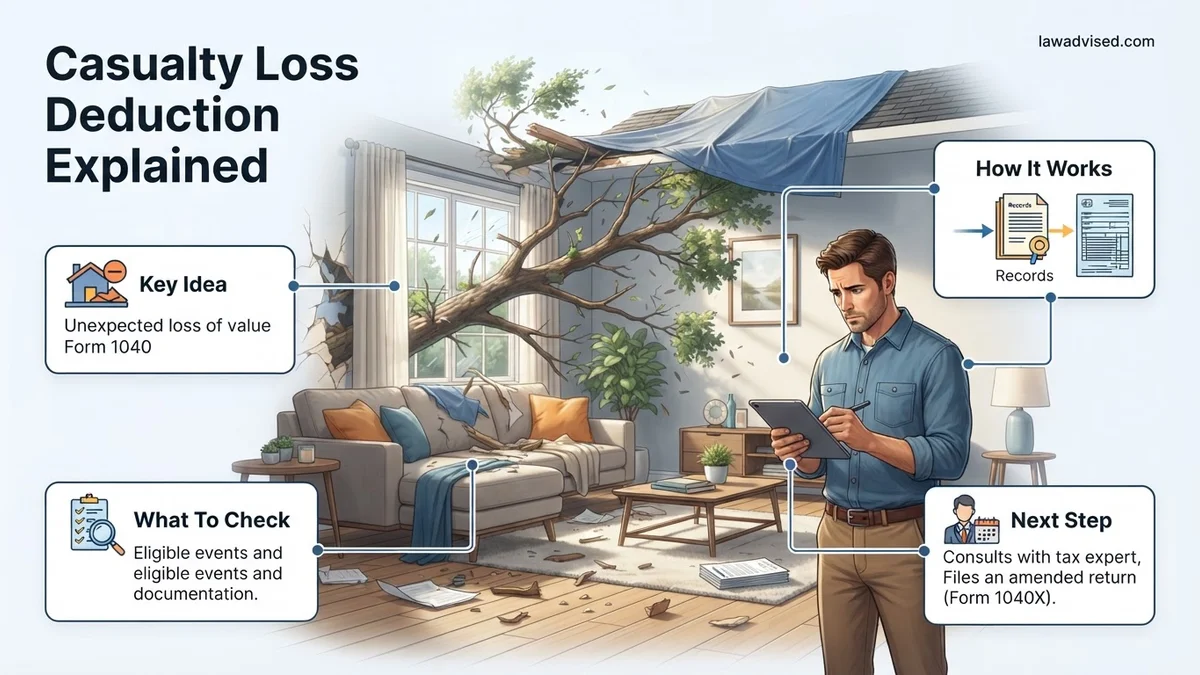
Casualty Loss Deduction Explained 2026 Step-by-Step Guide
A casualty loss deduction allows taxpayers to write off property damage caused by sudden, unexpected events. Under current 2026 tax laws, personal casualty losses are strictly limited to properties affected by federally declared disasters. Business property losses follow separate, broader eligibility rules.
A casualty loss tax deduction allows you to recover a portion of your financial losses when unexpected, sudden, and destructive events damage or destroy your property. Under current 2026 tax laws, claiming this deduction requires navigating a strict set of federal rules, particularly regarding whether the damage occurred in a federally declared disaster area.
Knowing how to accurately calculate your deduction and proving your eligibility can save you thousands of dollars at tax time. Whether a severe storm, a sudden fire, or an unexpected accident impacted your personal or business assets, understanding the precise IRS formulas ensures you maximize your claim while remaining fully compliant.
Key Takeaways
- Personal casualty losses require a federally declared disaster area designation to qualify.
- Damage must be sudden, unexpected, and unusual, excluding gradual wear and tear.
- You must subtract any insurance or reimbursement payouts before calculating your deduction.
- Personal losses face a mandatory $100 reduction per casualty event.
- Total personal losses must exceed 10% of your Adjusted Gross Income (AGI) to qualify.
What Causes a Tax-Qualifying Casualty Loss Under IRS Rules
The Requirement of Sudden and Destructive Events
The IRS defines a casualty as the complete or partial destruction of property resulting from an identifiable event of a sudden, unexpected, or unusual nature. Suddenness is the critical legal test for these claims. Gradual damage—such as termite infestations, wood rot over several years, or general wear and tear—does not qualify for the deduction.
- Qualifying events include sudden fires, storms, floods, vehicle accidents, and unexpected vandalism.
- Non-qualifying events include progressive erosion, structural settling, and damage from household pets or pests over time.
Personal Property vs. Business Property Rules
Your ability to claim a casualty loss depends heavily on whether the affected property belongs to your personal life or your business. For personal-use property, 2026 tax regulations dictate that the loss must stem directly from a federally declared disaster. If a severe storm damages your primary home, but the President does not issue a federal disaster declaration for your specific area, you cannot deduct the personal casualty loss on your federal return.
Property used in a trade or business, or income-producing property, operates under different provisions. Business casualty losses do not require a federal disaster declaration, meaning a sudden warehouse fire or accidental destruction of business equipment remains deductible regardless of regional disaster status.
How to Calculate Your Casualty Loss Deduction Step-by-Step
Determining the Decrease in Fair Market Value
Calculating your deduction starts with measuring the exact economic impact on your property. You must determine the lesser of two values: the adjusted basis of the property before the casualty, or the decrease in the fair market value (FMV) of the property caused by the event. The adjusted basis is typically what you paid for the property plus the cost of any permanent improvements.
- Assess the FMV of the property immediately before the casualty occurred.
- Assess the FMV of the property immediately after the casualty took place.
- Subtract the post-casualty value from the pre-casualty value to find the total loss in market value.
Professional appraisals or detailed repair cost estimates are usually necessary to substantiate these figures to the IRS. You cannot simply guess the numbers; documented proof of value is mandatory for an audit-proof return.
Applying Insurance Reimbursements and IRS Floors
Once you calculate the initial loss amount, you must reduce it by any insurance or other reimbursements you received or expect to receive. If your insurance company fully covers the damage, your deductible casualty loss is zero.
- Subtract all insurance payouts and disaster relief grants from your total loss amount.
- For personal property losses in 2026, you must subtract a $100 deductible per casualty event.
- After the $100 reduction, you must further reduce your total personal casualty losses by 10 percent of your Adjusted Gross Income (AGI) for the year.
Only the final remaining amount after the AGI threshold can be deducted on your itemized tax return. Business properties are exempt from the $100 and 10 percent AGI limits, allowing businesses to deduct the full un-reimbursed loss amount directly against their taxable income.
What to Do If Your Loss Crosses Tax Years or Requires Disaster Election
Timing issues often complicate casualty loss claims, especially when property damage occurs late in the calendar year or cleanup efforts stretch across multiple periods. According to IRS guidelines, you generally must deduct a loss in the year the casualty occurred. However, specific provisions alter this timeline for federally declared disasters.
Handling Multi-Year Expenses
When repairs extend across multiple tax years, tracking incremental costs becomes essential for accurate reporting. You cannot claim an estimated future repair cost; you must deduct expenses only in the year you actually incur them. Property owners receiving late insurance payouts in 2026 for a 2025 disaster must report those reimbursements in the year received, which may require amending prior returns if deductions were already claimed.
Making the Section 165(i) Disaster Election
If your property sits within a federally declared disaster area, tax code provisions offer valuable flexibility. You can choose to deduct the loss on your tax return for either the year the disaster occurred or the immediately preceding tax year.
- Verify that the President has declared your specific county or locality a federal disaster area eligible for individual assistance.
- Calculate your net casualty loss using the standard IRS Form 4684 methodology.
- Review both the current tax year and the prior year returns to determine which period yields the highest marginal tax savings.
- File an amended return for the prior year (using Form 1040-X) if electing to apply the loss backward to generate a faster tax refund.
What If Your Personal Loss Does Not Meet Federal Disaster Criteria
Navigating property destruction that lacks a federal disaster declaration requires understanding strict limitations. Under current 2026 tax regulations, personal casualty losses stemming from common household mishaps, gradual deterioration, or non-federal events face severe deductibility hurdles. Financial experts emphasize that standard wear and tear or termite damage never qualifies.
The Federal Disaster Requirement
For personal-use property, the Tax Cuts and Jobs Act provisions (extended through current legislative tracking) mandate that losses must be attributable to a federally declared disaster. If a severe storm damages your fence, but the event does not receive official federal disaster status, the deduction is entirely disallowed for personal residences.
Exceptions for Business and Income-Producing Property
Property used in a trade or business or held for investment enjoys broader rules. These business losses do not require a federal disaster declaration to qualify for a deduction.
- Assess whether the damaged asset serves a business, rental, or investment purpose rather than purely personal use.
- Calculate the decrease in fair market value or use the adjusted basis method, whichever is lower, without applying the $100 per-casualty floor required for personal losses.
- Subtract any insurance or salvage recoveries from the total loss amount.
- Report the remaining deductible amount on the appropriate business tax schedule, such as Form 4797 or Schedule C, depending on asset classification.
What If It Still Doesn’t Work?
If complex asset valuations, overlapping insurance claims, or changing 2026 tax thresholds stall your deduction process, systematic fallback steps can prevent costly filing errors.
- Hire a licensed certified public accountant (CPA) or a specialized tax attorney who focuses on property casualty loss recovery. Professional service fees typically range from $300 to $1,500 depending on the complexity of the asset valuation.
- Commission an independent certified property appraiser to establish accurate fair market values before and after the event if insurance estimates are contested.
- Contact the IRS Taxpayer Advocate Service if processing delays on amended disaster returns exceed standard statutory windows.
- Request a formal ruling or private letter ruling from the IRS if your business property loss involves unique capitalization or multi-state asset tracking challenges.
Conclusion
Claiming a casualty loss deduction requires meticulous adherence to strict IRS valuation formulas, adjusted basis tracking, and federally mandated disaster thresholds. By systematically calculating your decrease in fair market value, applying the necessary percentage floors, and utilizing disaster-year elections, you can maximize your tax relief. According to verified research and expert accounting sources, maintaining comprehensive photographic evidence and certified contractor estimates remains the single most effective safeguard against IRS audit adjustments. Take your next actionable step today by gathering all primary purchase receipts and official insurance settlement statements to initiate Form 4684 preparation.
❓ Frequently Asked Questions
How do I calculate the decrease in fair market value for my property?
You generally need a professional appraisal to determine the property’s fair market value immediately before and immediately after the casualty event. Alternatively, the cost of repairing the damage can sometimes be used if it restores the property to its exact pre-loss condition.
What is the $100 floor rule for personal casualty losses?
The $100 floor means you must reduce the total loss of each individual casualty event by $100 after factoring in any insurance reimbursements. This reduction applies to each event, not each individual damaged item.
How does the 10% AGI threshold work?
After subtracting insurance and the $100 floor from each event, you must add all your personal casualty losses together. If that final total is less than 10% of your Adjusted Gross Income (AGI), you cannot deduct any of the loss.
Can I deduct a casualty loss if insurance covers the entire damage?
No, if your insurance or other reimbursements completely cover the cost of the damage or replacement, you have no deductible loss remaining.
What are the rules for claiming a disaster loss in a prior year?
If you suffer a casualty loss in a federally declared disaster area, the IRS allows you to choose whether to deduct the loss on your tax return for the year the disaster occurred or elect to claim it on your return for the immediately preceding tax year.
Are business and investment property losses treated differently than personal property?
Yes, business and income-producing property losses do not require a federally declared disaster to qualify, and they are not subject to the $100 floor or the 10% AGI threshold restrictions.

Ismail Hossain is the founder of Law Advised. He is an Divorce, Separation, marriage lawyer. Follow him.