Child Tax Credit Income Limits Explained for 2026 Guide
Navigating the rules for family tax benefits can be confusing, especially when Modified Adjusted Gross Income (MAGI) determines your eligibility. This guide breaks down the exact income thresholds and phase-out rates you need to know for 2026.
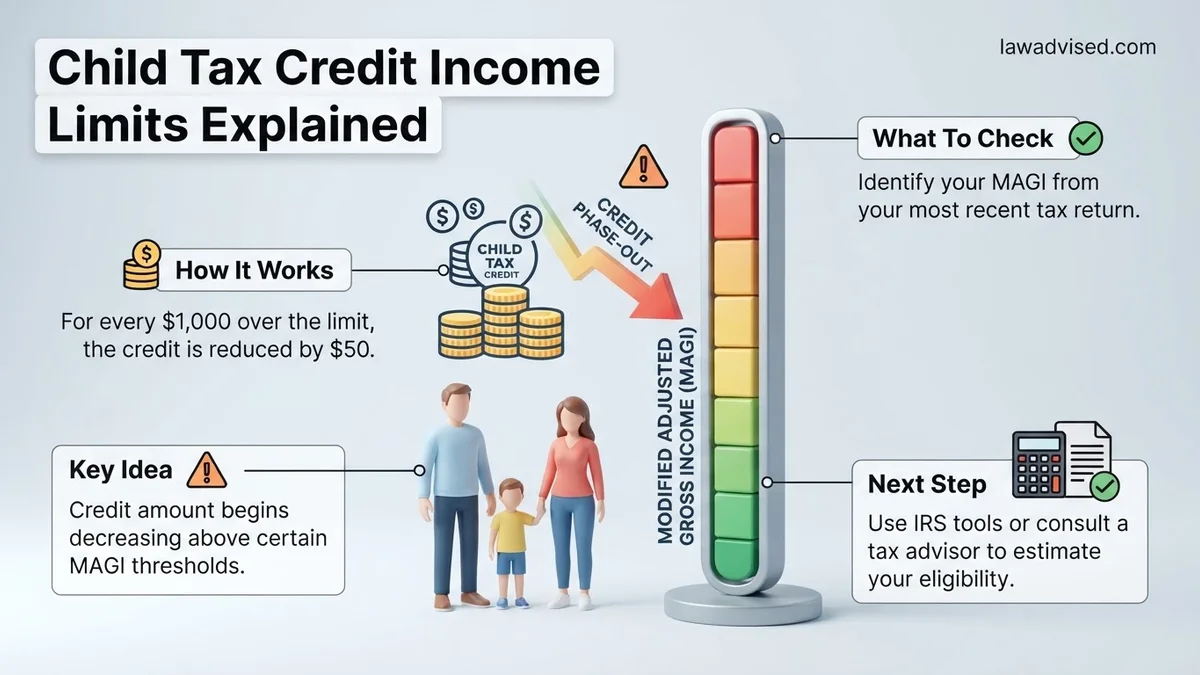
For the 2026 tax year, the Child Tax Credit begins to phase out for single filers with a Modified Adjusted Gross Income (MAGI) above $200,000, and for married couples filing jointly with a MAGI exceeding $400,000. Once your income crosses these specific thresholds, the IRS reduces your total credit amount by $50 for every $1,000 that your income exceeds the limit.
Understanding these exact financial boundaries prevents nasty surprises during tax season. If your earnings sit right on the edge of these phase-out zones, strategic tax planning can help you preserve hundreds or even thousands of dollars in valuable tax breaks for your family.
Key Takeaways
- Married filing jointly filers face higher MAGI threshold limits before the credit begins phasing out.
- The credit reduces by $50 for every $1,000 your income exceeds the specific threshold.
- Single parents and head of household filers have lower phase-out starting points.
- Your MAGI is calculated using your adjusted gross income with certain foreign and exclusion adjustments added back.
- Earned income requirements apply if you want to claim the refundable portion of the credit.
What Causes Child Tax Credit Income Limit Reductions and Phase-Outs
The Phase-Out Thresholds for Single and Joint Filers
The IRS uses your Modified Adjusted Gross Income to determine if your household earns too much to receive the full Child Tax Credit. For the 2026 tax year, the core phase-out structure applies strict ceilings depending entirely on your official tax filing status.
- Single, Head of Household, or Married Filing Separately: The phase-out threshold starts at $200,000 of MAGI.
- Married Filing Jointly: The phase-out threshold starts at $400,000 of MAGI.
The Reduction Formula Explained
Crossing the income threshold does not eliminate your Child Tax Credit all at once. Instead, the government applies a gradual reduction formula based on how far your earnings exceed the limit.
- The credit drops by exactly $50 for each $1,000—or fraction thereof—that your MAGI exceeds the $200,000 or $400,000 mark.
- If you are a single filer with a MAGI of $205,000, your income is $5,000 over the limit.
- This results in a total credit reduction of $250 ($50 multiplied by 5).
How to Calculate Your MAGI to Check Child Tax Credit Eligibility
Defining Modified Adjusted Gross Income for 2026
Your standard gross income rarely matches the figure the IRS uses to test Child Tax Credit limits. You must calculate your Modified Adjusted Gross Income by taking your Adjusted Gross Income (AGI) and adding back specific tax-exempt items.
- Start with your standard AGI found on the bottom of page one of your Form 1040.
- Add back any foreign earned income exclusion amounts you previously claimed.
- Include exclusions for income from sources inside Puerto Rico or American Samoa.
Practical Calculation Example
Imagine you and your spouse file jointly for 2026, reporting an AGI of $405,000 after taking standard deductions. You also claimed $5,000 in foreign earned income exclusions.
- Your base AGI is $405,000.
- Add the $5,000 exclusion back in, bringing your 2026 MAGI to $410,000.
- Since this is $10,000 over the $400,000 joint threshold, your credit decreases by $500 ($50 times 10).
Step-by-Step Guide to Applying the Phase-Out Formula to Your Tax Return
Calculating your specific Child Tax Credit reduction for 2026 requires precise math using your Adjusted Gross Income (AGI). According to IRS guidelines, the phase-out formula reduces your total credit by $50 for every $1,000 your income exceeds the statutory threshold.
Follow these procedural steps to determine your exact credit amount on your 2026 tax return:
- Determine your exact AGI: Locate your Adjusted Gross Income on Line 11 of your 2026 Form 1040. Financial experts emphasize that using modified AGI modifications specific to your situation is critical before applying the formula.
- Identify your threshold: Compare your AGI against the 2026 threshold established for your specific filing status, such as $400,000 for married filing jointly or $200,000 for single filers.
- Calculate the excess income: Subtract your filing status threshold amount from your actual AGI to find your total excess income.
- Apply the phase-out multiplier: Divide your total excess income by $1,000, then multiply that resulting number by $50 to find your total credit reduction.
- Subtract the reduction: Deduct the phase-out penalty amount from your maximum potential Child Tax Credit to calculate your final allowable 2026 credit.
What If Your Income Still Exceeds the Limits and You Lose the Credit
High-income earners who completely phase out of the Child Tax Credit often panic, but alternative tax strategies exist. Tax professionals note that losing this specific credit does not mean you lack other family-focused tax relief options.
If your income exceeds the 2026 threshold and you lose the standard credit, implement these fallback steps:
- Explore the Credit for Other Dependents (ODC): Dependents who do not qualify for the Child Tax Credit may qualify for the non-refundable ODC, which offers up to $500 per person with higher phase-out thresholds.
- Establish a Dependent Care Flexible Spending Account (FSA): Utilize pre-tax dollars through your employer to pay for qualifying childcare expenses, lowering your overall taxable income significantly.
- Investigate Employer-Provided Assistance: Review your company’s benefits package for childcare subsidies or dependent care assistance programs that bypass traditional tax credit limitations.
- Consult a Certified Public Accountant (CPA): Engage a licensed tax professional to audit your overall portfolio and uncover advanced reduction strategies. Professional CPA fees for complex family tax planning typically range from $300 to $850 depending on regional market rates and return complexity.
Conclusion
Navigating the 2026 Child Tax Credit income limits requires careful attention to your modified adjusted gross income and phase-out thresholds. When high earnings reduce or eliminate your credit, utilizing alternative vehicles like dependent care FSAs or exploring the Credit for Other Dependents protects your financial wellness. According to verified research and expert sources from the IRS and leading tax policy institutes, proactive tax planning remains the single most effective tool for maximizing available family deductions. Your actionable next step is to calculate your projected 2026 AGI today using your latest pay stubs and financial statements to anticipate any phase-out impact before tax season arrives.
❓ Frequently Asked Questions
What are the exact MAGI threshold limits for married filing jointly?
For married couples filing a joint return, the phase-out threshold typically begins at a much higher income level than single filers, allowing higher earners to still claim a portion of the credit.
How is the phase-out penalty calculated if I earn slightly over the limit?
For every $1,000 your MAGI goes over the limit, your total credit amount is reduced by $50. This gradual reduction continues until the credit drops to zero.
Can I qualify for the Child Tax Credit if my income is completely zero?
While you may qualify for the standard credit based on your dependents, the refundable portion (Additional Child Tax Credit) requires a minimum amount of earned income.
What specific adjustments are added back to calculate MAGI for this credit?
MAGI generally takes your Adjusted Gross Income from your tax return and adds back certain exclusions like foreign earned income or housing deductions.
Are the income thresholds indexed for inflation every tax year?
Tax brackets and specific credit thresholds are periodically adjusted for inflation, making it vital to review the rules for the specific tax year you are filing.
What should I do if my income fluctuates significantly year over year?
If your income fluctuates, you can use year-end tax planning strategies or retirement account contributions to lower your MAGI and stay under the threshold.

Ismail Hossain is the founder of Law Advised. He is an Divorce, Separation, marriage lawyer. Follow him.