Quarterly Estimated Taxes Explained Step-by-Step Guide 2026
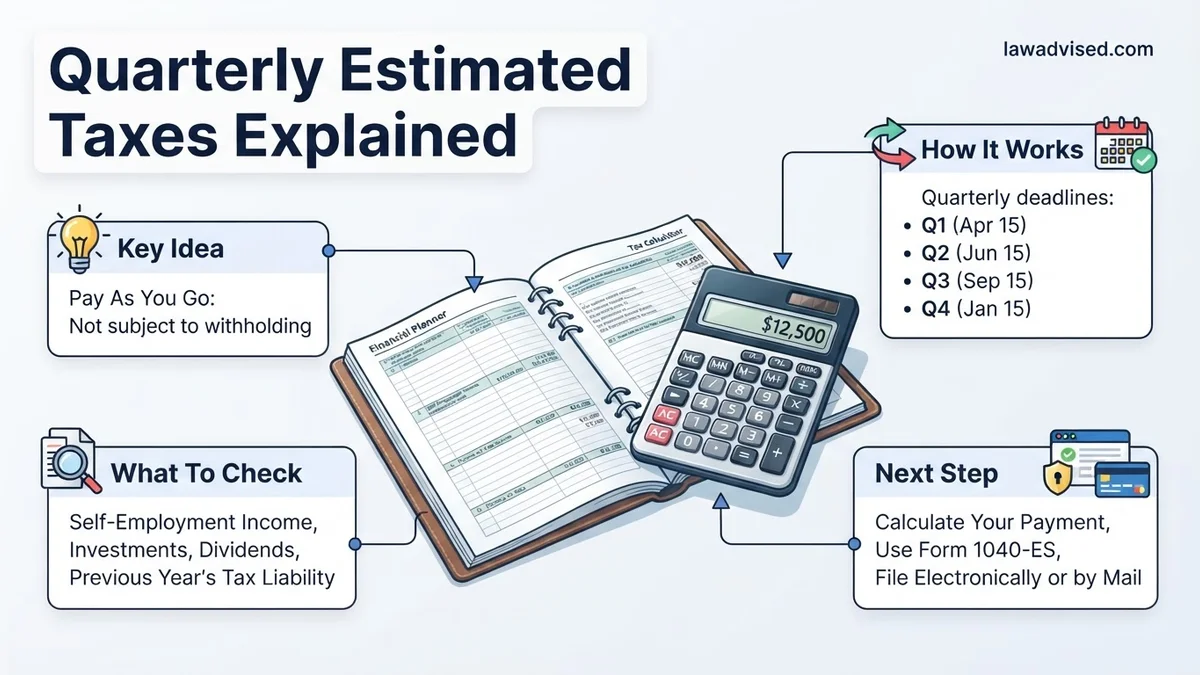
Quarterly estimated taxes are regular payments made to the IRS by individuals who do not have enough income tax withheld from their paychecks. Understanding this pay-as-you-go system is essential for freelancers and self-employed workers to avoid costly underpayment penalties.
Quarterly estimated taxes are periodic payments made to the IRS throughout the year to cover income tax, self-employment tax, and other levies that aren’t automatically withheld from a paycheck. If you work as a freelancer, independent contractor, gig worker, or small business owner, you are responsible for paying these taxes four times a year to keep your account current and avoid statutory penalties.
Managing your tax liability proactively in 2026 prevents the painful surprise of a massive lump-sum tax bill and steep underpayment penalties every April. Breaking down the process into clear, predictable steps ensures you stay compliant with federal and state tax authorities without guessing your liabilities.
Key Takeaways
- Pay quarterly taxes if you expect to owe $1,000 or more in annual taxes.
- Use IRS Form 1040-ES to calculate your expected adjusted gross income and deductions.
- Make payments four times a year using IRS Direct Pay, EFTPS, or mail.
- Avoid penalties by paying at least 90% of your current tax or 100% of last year’s tax.
- Keep accurate quarterly records to simplify your annual tax filing process.
What Causes Quarterly Estimated Tax Obligations
Who is Required to Pay
You must pay quarterly estimated taxes if you expect to owe at least $1,000 in federal tax when you file your 2026 annual return. This rule primarily affects individuals whose income is not subject to regular employer tax withholding. Common scenarios include:
- Operating as a sole proprietor, independent contractor, or single-member LLC
- Earning significant freelance, consulting, or gig economy income
- Receiving substantial investment dividends, capital gains, or rental income
- Working multiple jobs where employers do not withhold enough tax
The Safe Harbor Thresholds Explained
To avoid IRS underpayment penalties for the 2026 tax year, your total quarterly payments and withholdings must meet specific safe harbor minimums. You generally will not face a penalty if you pay at least:
- 90 percent of the total tax shown on your 2026 tax return, or
- 100 percent of the tax shown on your 2025 return (increased to 110 percent if your 2025 adjusted gross income exceeded $150,000)
How to Calculate and Pay Your Quarterly Estimated Taxes
Step 1: Estimate Your Adjusted Gross Income and Deductions
Start your 2026 calculation by projecting your total expected gross income for the entire year. Subtract your anticipated business expenses to determine your expected net profit. From that figure, subtract your above-the-line deductions, such as half of your self-employment tax, to arrive at your estimated Adjusted Gross Income (AGI).
Step 2: Calculate Income and Self-Employment Taxes
Next, subtract your standard deduction or itemized deductions to find your projected taxable income. Apply the 2026 federal income tax brackets to calculate your income tax liability. You must also calculate self-employment tax, which covers Social Security and Medicare, by multiplying your net self-employment earnings by 15.3 percent up to the statutory wage base limits.
Combine your projected income tax and self-employment tax, then subtract any expected tax credits. Divide the final annual total by four to determine your exact quarterly payment amount, and submit it using IRS Form 1040-ES by the quarterly deadlines.
Step-by-Step Fix for Missing Deadlines and Underpayment Penalties
Missing a quarterly tax deadline or paying less than you owe triggers IRS penalties. According to recent IRS data, the underpayment penalty rate sits at approximately 8% for the 2026 tax year, compounded daily until you settle the balance.
How to Rectify a Missed Payment
- Calculate the missed amount immediately using Form 2210 or your tax software.
- Submit the overdue payment as soon as possible via IRS Direct Pay to halt further daily interest accumulation.
- File your annual tax return on time, as filing late compounds penalties significantly faster than underpaying estimated installments.
Requesting Penalty Abatement
Tax experts note that the IRS offers a First-Time Penalty Abatement waiver for individuals with a clean compliance history over the prior three tax years. Contact the IRS directly or include specific penalty relief letters with your 2026 return if you qualify under reasonable cause provisions, such as a major natural disaster or serious illness.
What If Your Income Fluctuates Throughout the Tax Year
Freelancers and small business owners rarely earn identical income every quarter. Financial analysts emphasize that assuming a flat annual income leads to overpaying in lean quarters or underpaying during lucrative periods.
Utilizing the Annualized Income Installment Method
- Complete Schedule AI on IRS Form 2210 to calculate your actual earnings period by period.
- Determine your tax liability based on the exact revenue generated during specific months rather than splitting your projected yearly total into four equal chunks.
- Attach the completed form to your annual return to prove to the IRS why your earlier quarterly payments were lower.
Adjusting Future Projections
Financial planners recommend recalculating your net profit at the end of each quarter. If your revenue spikes in Q3 2026, bump up your September payment immediately to avoid unexpected shortfalls.
What If It Still Doesn’t Work?
If manual calculations, fluctuating revenue, and IRS notices still leave you confused, fallback steps ensure compliance:
- Use IRS-approved tax software with dedicated self-employed modules to automate quarterly projections.
- Engage a Certified Public Accountant (CPA) or Enrolled Agent (EA) to audit your quarterly structure. Professional tax preparation services typically cost between $300 and $600 for comprehensive quarterly advisory.
- Set up an automatic payment plan through the Electronic Federal Tax Payment System (EFTPS) to remove human error from future deadlines.
- Contact an IRS taxpayer assistance center or low-income taxpayer clinic if facing severe collection notices regarding past underpayments.
Conclusion
Navigating quarterly estimated taxes requires vigilance, accurate record-keeping, and strict adherence to IRS deadlines. Failing to address fluctuations or missed payments leads to compounding penalties that erode business profits. According to verified research and tax experts, automating your calculations and leveraging specialized software remains the most reliable defense against underpayment penalties. Take your next actionable step today by logging into IRS Direct Pay and scheduling your upcoming 2026 quarterly installment.
❓ Frequently Asked Questions
What happens if my income changes mid-year and I need to adjust my payments?
If your income goes up or down, you can recalculate your remaining estimated tax payments using Form 1040-ES for the next quarter. Adjusting prevents you from overpaying or underpaying by the end of the year.
Do I have to pay state and local estimated taxes as well?
Depending on where you live and whether your state has an income tax, you may also need to make separate quarterly estimated payments to your state tax agency. Always check local tax authority rules.
How can I avoid the IRS underpayment penalty completely?
You can completely avoid penalties by meeting a safe harbor rule: paying at least 90% of your current year tax liability or 100% of your prior year tax liability through withholding and estimated payments.
What forms do I need to file quarterly estimated taxes?
You will use IRS Form 1040-ES, which includes estimated tax worksheets and payment vouchers if you choose to pay by mail, though online payment methods eliminate the need for paper vouchers.
Are W-2 employees ever required to pay quarterly estimated taxes?
W-2 employees typically have taxes withheld automatically by their employers, but they may need to pay estimated taxes if they have significant side hustle income, capital gains, or dividend earnings.
What if I can’t afford to pay my quarterly tax bill on time?
You should still file your payment voucher and pay as much as you can to minimize interest and penalties. You can also explore payment plan options with the IRS for remaining balances.

Ismail Hossain is the founder of Law Advised. He is an Divorce, Separation, marriage lawyer. Follow him.