Depreciation on Rental Property Explained A 2026
Rental property depreciation allows landlords to deduct the cost of wear and tear on their real estate investment over time to lower taxable income. The IRS requires residential properties to be depreciated over a 27.5-year recovery period using the building’s cost basis, excluding land value.
Rental property depreciation is a powerful IRS tax deduction that allows you to recover the cost of purchasing and improving your investment property over time. Even if your property is increasing in market value in 2026, the tax code lets you deduct a paper expense every year for wear and tear, which directly offsets your rental income and lowers your tax liability.
To claim this deduction without triggering an IRS audit, you need to understand how to calculate your depreciable basis, separate the value of the land from the building, and correctly report these numbers on your Schedule E form come tax season.
Key Takeaways
- Land cannot be depreciated because it does not wear out or lose value over time.
- Residential rental properties use a strict IRS recovery period of 27.5 years.
- Your property’s depreciable basis is the purchase price minus the value of the land.
- Annual depreciation is claimed on IRS Schedule E to directly reduce taxable rental income.
- Depreciation recapture taxes must be paid on claimed deductions when you sell the property.
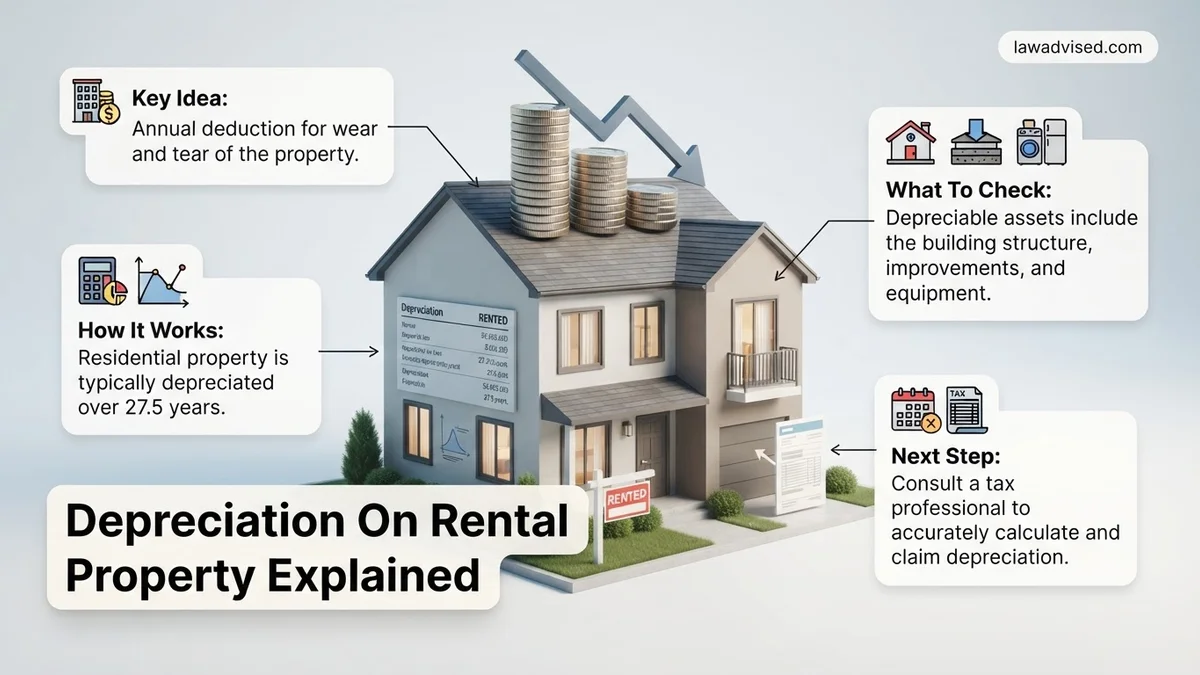
What Causes Taxable Income Stress: The Mechanics of Rental Property Depreciation
Understanding Your Tax Basis and Land Value
You cannot depreciate everything you bought when you acquired your rental property. Land does not wear out, get used up, or become obsolete according to the IRS. Therefore, you must separate the purchase price of your property into two distinct parts: the building and the land.
Your depreciable basis is the actual amount you can write off over time. It typically includes:
- The purchase price of the building structure itself
- Legal fees and settlement costs from the purchase
- Recording fees, title insurance, and transfer taxes
- Capital improvements made to the property before placing it in service
To find your starting basis, look at your property tax assessment or appraisal to determine the land-to-building ratio. If your local assessment shows the land is worth 20 percent and the building is worth 80 percent, you apply that exact percentage to your total purchase price.
Repairs Versus Capital Improvements
Landlords often confuse routine property maintenance with capital improvements, which impacts how you handle depreciation. Fixing a broken pipe or painting a living room wall is a deductible repair you can write off entirely in the year you pay for it. However, replacing a roof, installing a new HVAC system, or adding a room are capital improvements.
Capital improvements cannot be expensed all at once. Instead, you add their costs to your property basis and depreciate them over time alongside the main structure. This distinction keeps your 2026 tax filing compliant and maximizes your deductions legally.
How to Calculate and Claim Rental Property Depreciation Step-by-Step
The IRS 27.5-Year Recovery Period Formula
Residential rental property follows a specific IRS timeline known as the MACRS depreciation system. For residential real estate, the government mandates a recovery period of exactly 27.5 years. This means you deduct an equal fraction of the building’s depreciable basis every single year for nearly three decades.
To find your annual depreciation deduction, use this simple formula:
- Take your total property purchase price.
- Subtract the estimated value of the land.
- Divide that resulting building basis by 27.5.
The resulting number is the exact dollar amount you can deduct from your rental income each year on your federal tax return.
A Practical 2026 Numerical Example
Imagine you purchased a single-family rental home for $300,000 in early 2026. Your property tax assessment indicates that the land accounts for $50,000 of that value, leaving the building structure valued at $250,000.
Your depreciable basis is $250,000. To find your annual deduction, divide $250,000 by 27.5 years. This gives you an annual depreciation deduction of approximately $9,090.91.
When you file your taxes using Schedule E, you report your rental income, subtract your operating expenses, and then subtract your $9,090.91 depreciation amount. This paper loss significantly reduces your taxable rental income, often turning a cash-flowing property into a tax-sheltered investment for the year.
How to Differentiate Between Routine Repairs and Capital Improvements
Understanding the strict IRS boundary between routine maintenance and capital improvements is critical for accurate 2026 tax filing. Misclassifying these expenses can trigger an audit or derail your depreciation schedule. According to IRS Publication 527, a repair keeps your property in normal, efficient operating condition without adding significant value. Conversely, an improvement materially adds to the value of your property, prolongs its useful life, or adapts it to new uses.
Recognizing Capital Improvements
Capital improvements must generally be capitalized and depreciated rather than deducted immediately. To handle these assets correctly:
- Identify structural upgrades like a new roof, a complete HVAC system, or a paved driveway.
- Determine the correct asset class and recovery period, which is typically 27.5 years for residential property components.
- Add the improvement cost to your property’s basis and begin a separate depreciation schedule for that specific asset.
Handling Routine Property Repairs
Routine repairs are fully deductible in the year you incur the expense. When managing minor fixes:
- Verify the work maintains the current condition rather than upgrading it, such as fixing a leaky pipe or painting a single room.
- Deduct the total cost on Schedule E as a normal operating expense for the 2026 tax year.
- Maintain detailed invoices and receipts to prove the work was restorative rather than transformative.
What If Your Depreciation Claiming Fails: Handling IRS Adjustments and Recapture
Failing to claim proper depreciation or making errors on your tax returns can lead to complicated IRS adjustments. Under current tax rules, the IRS mandates that you claim allowable depreciation even if you forgot to do so on past returns. When you eventually sell your 2026 rental property, the IRS calculates depreciation recapture taxes based on the depreciation you should have taken, not just what you actually claimed.
Correcting Past Depreciation Mistakes
If you missed claiming depreciation in previous years, you cannot simply double up your deductions in 2026. Experts recommend the following corrective path:
- File IRS Form 3115, Application for Change in Accounting Method, to catch up on missed depreciation without amending prior-year returns.
- Calculate the cumulative adjustment amount for all prior years where depreciation was missed.
- Apply the Section 481(a) adjustment to current tax forms to recover the missed deductions legally.
What If It Still Doesn’t Work?
If self-managing your rental property depreciation leads to calculation errors or IRS notices in 2026, targeted fallback steps can resolve the issue before penalties accumulate:
- Perform a retroactive cost segregation study to properly reallocate building components into shorter 5-, 7-, and 15-year recovery periods.
- Consult a certified public accountant (CPA) or a specialized tax attorney who focuses exclusively on real estate taxation. Professional advisory fees typically range from $500 to $2,500 depending on portfolio size.
- Request a formal abatement of penalties from the IRS if the miscalculation stemmed from reasonable cause or ambiguous regulatory guidance.
- Utilize professional-grade 2026 tax software equipped with automated depreciation calculators to prevent future data-entry discrepancies.
Conclusion
Mastering rental property depreciation prevents costly tax errors and maximizes your annual cash flow. By accurately separating capital improvements from routine repairs and maintaining compliant schedules, you protect your investment returns. According to verified research and expert sources from the National Association of Realtors, proactive tax planning remains the single most effective way to lower an investor’s overall tax liability. Take the next actionable step today by auditing your current asset basis and scheduling a consultation with a qualified real estate CPA to review your 2026 filings.
❓ Frequently Asked Questions
How do I calculate the exact land value versus building value for depreciation?
You can use the property tax assessment ratio from your local county assessor’s office to determine what percentage of the total value is attributed to the land versus the building. Alternatively, a certified real estate appraisal at the time of purchase provides definitive proof of land value.
What happens to accumulated depreciation when I sell my rental property?
When you sell a rental property, the IRS requires you to pay taxes on the total depreciation you claimed (or could have claimed) through a mechanism called depreciation recapture. This recaptured amount is typically taxed at a maximum rate of 25%, regardless of your ordinary income tax bracket.
Can I skip taking depreciation now and take a larger deduction later?
No, the IRS mandates that you must recapture depreciation upon sale regardless of whether you actually claimed the deduction on your annual tax returns. If you fail to take the deduction, the IRS still reduces your cost basis by the allowable depreciation amount anyway.
Are major upgrades like a new roof depreciated over 27.5 years?
Major upgrades and capital improvements are considered separate assets and are depreciated over their own specific IRS recovery periods (typically 5, 7, or 15 years) rather than the standard 27.5-year residential building schedule.
Does a rental property have to be actively rented to claim depreciation?
Yes, the property must be ‘placed in service,’ meaning it is ready and available to be rented to tenants. If the property sits vacant while actively listed on the market for rent, depreciation can still be claimed during that vacancy period.
Can I depreciate personal property inside a furnished rental?
Yes, appliances, furniture, and carpets qualify as personal property and are depreciated much faster using a 5-year recovery period under IRS MACRS guidelines, separate from the building structure.

Ismail Hossain is the founder of Law Advised. He is an Divorce, Separation, marriage lawyer. Follow him.