Rental Property Expenses Deduction Guide for 2026
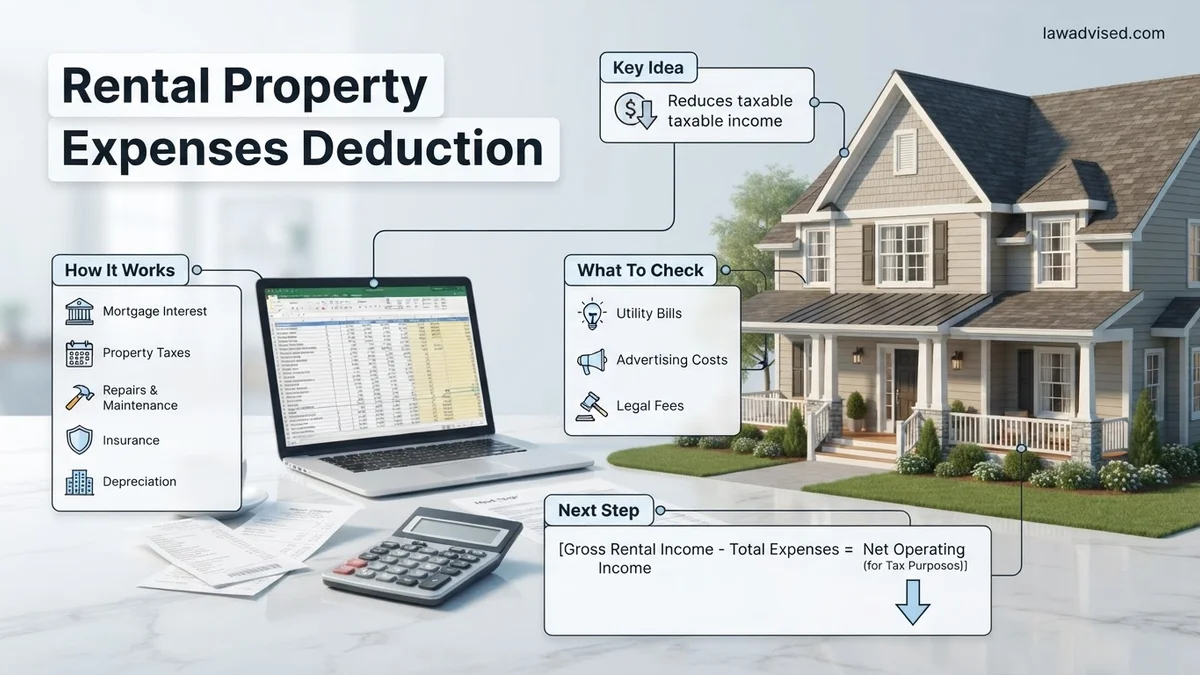
Navigating rental property expenses deduction rules is essential for lowering your taxable rental income and maximizing cash flow. Landlords can legally write off ordinary and necessary costs incurred to manage, maintain, and operate their real estate investments. Knowing the strict IRS boundaries between immediate operating expenses and long-term capital improvements prevents costly audit mistakes.
You can legally deduct ordinary and necessary expenses incurred to manage, maintain, and operate your rental property from your gross rental income. To significantly lower your tax liability for the 2026 tax year, you must master the distinction between immediate operating deductions and long-term asset depreciation.
Every dollar you spend on repairs, insurance, interest, and property management directly reduces your taxable rental income dollar-for-dollar. Knowing exactly which expenses qualify and how to properly categorize them prevents costly IRS audits while maximizing your annual cash flow.
Key Takeaways
- Deduct mortgage interest, property taxes, and hazard insurance as standard operating expenses.
- Separate routine repairs from capital improvements to determine immediate write-offs versus depreciation.
- Utilize MACRS rules to depreciate the building structure over 27.5 years.
- Track local travel expenses for property management to deduct mileage or actual vehicle costs.
- Apply passive activity loss limits correctly if your adjusted gross income exceeds certain thresholds.
What Causes Confusion in Rental Property Expenses Deduction Rules
Repairs Versus Improvements
Property owners constantly struggle to classify maintenance work correctly. A repair keeps your property in normal, efficient operating condition without adding significant value or extending its useful life. You can fully deduct the cost of repairs in the year you pay for them.
- Examples of deductible repairs: Fixing a broken window, patching a small roof leak, repainting a bedroom, or servicing the HVAC system.
- Examples of capital improvements: Replacing the entire roof, installing a brand-new built-in kitchen, or adding a room. These improvements must be depreciated over multiple years rather than deducted immediately.
Ordinary and Necessary Operating Expenses
Another major source of confusion involves separating personal expenses from business-related costs. The IRS requires that every claimed expense be both ordinary (common and accepted in the industry) and necessary (appropriate and helpful for your rental business).
- Mortgage interest payments on loans used to acquire or improve the property.
- Local property taxes assessed by your county or municipality for 2026.
- Landlord liability and property insurance premiums.
- Professional fees paid to property managers, attorneys, and certified public accountants.
How to Step-by-Step Claim Your Rental Property Expenses Deduction
Step 1: Categorize and Track Operating Expenses
Accurate record-keeping forms the backbone of a successful tax strategy. Begin by separating your personal bank accounts from your rental business accounts to maintain a clean paper trail for the 2026 tax year.
- Collect all receipts, invoices, and bank statements related to property maintenance and management.
- Sort expenses into standard IRS Schedule E categories, such as advertising, cleaning, insurance, and legal fees.
- Log mileage driven to inspect properties, meet contractors, or show units to prospective tenants at the standard IRS mileage rate.
Step 2: Calculate and Apply MACRS Depreciation
Unlike repairs, you cannot deduct the entire cost of purchasing a residential building in year one. Instead, you must recover the cost of the property through depreciation over its designated useful life.
- Residential Rental Property Rule: Under the Modified Accelerated Cost Recovery System (MACRS), residential rental buildings are depreciated non-linearly over a recovery period of 27.5 years.
- Excluding Land Value: You can only depreciate the cost of the building structure and permanent improvements, not the underlying land value.
- Reporting: File IRS Form 4562 along with your Schedule E to report your annual depreciation deduction accurately.
What If Your Deductions Trigger IRS Passive Activity Loss Limits
Maximizing your rental property deductions for 2026 can sometimes result in a net loss on your tax return. When your total rental expenses exceed your rental income, you trigger the IRS passive activity loss (PAL) rules. Understanding how these limits operate prevents unexpected tax liabilities.
The $25,000 Special Allowance
The IRS generally classifies rental real estate as a passive activity. This means passive losses can only offset passive income. However, a special rule allows active real estate participants to deduct up to $25,000 of losses against non-passive income, such as W-2 wages.
Phase-Out Rules for Higher Earners
This $25,000 allowance is not available to everyone. The deduction phases out completely when a taxpayer’s Modified Adjusted Gross Income (MAGI) reaches $150,000. Real estate professionals who meet specific IRS hourly requirements are entirely exempt from these passive loss limitations.
What If It Still Doesn’t Work?
Navigating complex rental property deductions can lead to stalled returns, calculation errors, or IRS audit flags. If standard deduction tracking methods fail to resolve your reporting issues, implement these verified troubleshooting steps:
- Reconcile bank statements: Match every line item on your Schedule E directly against verified business bank and credit card statements to catch missed receipts.
- Run diagnostic software checks: Utilize current 2026 tax preparation software error-checking tools to identify mismatched depreciation schedules or misclassified capital improvements.
- Engage a Certified Public Accountant: Consult a licensed CPA who specializes in real estate taxation to review your entire portfolio and rectify complex passive loss carryovers.
- Prepare for professional costs: Expect to pay a qualified tax professional between $400 and $1,200 for a comprehensive rental property return review and amendment.
Conclusion
Navigating rental property expense deductions requires meticulous record-keeping and a firm grasp of current tax codes to protect your cash flow. Properly categorizing operating costs versus capital improvements ensures you remain compliant while legally minimizing your tax burden. According to verified research and expert sources from the National Association of Realtors, utilizing dedicated property management software drastically reduces accounting errors and maximizes year-end write-offs. Your immediate next step is to audit your current 2026 expense logs and segregate all major capital improvements from daily operational costs before filing.
❓ Frequently Asked Questions
What common expenses are fully deductible in the year they are paid?
Common fully deductible expenses include mortgage interest, property taxes, landlord insurance, advertising for tenants, utilities paid by the landlord, and routine maintenance or minor repairs.
How does IRS depreciation work for rental properties?
Depreciation allows you to recover the cost of capital investments over time. For residential real estate, you deduct a portion of the building’s cost (excluding land value) each year for 27.5 years.
What are the rules regarding passive activity losses for landlords?
Generally, rental real estate activities are considered passive. If you actively participate, you may be able to deduct up to $25,000 of rental losses against non-passive income, subject to phase-outs based on your adjusted gross income.
Can I deduct personal labor if I fix up my own rental property?
No, the IRS does not allow landlords to deduct the value of their own labor or time spent repairing or maintaining their rental property. You can only deduct out-of-pocket costs for materials and supplies.
Are legal and professional fees related to the rental tax-deductible?
Yes, fees paid to attorneys for evictions or lease drafting, as well as fees paid to accountants or tax professionals specifically for preparing your rental property tax schedule, are fully deductible.
What happens to unused rental losses when I sell the property?
Any suspended passive losses that you were unable to deduct in previous years due to income limitations are generally fully unlocked and deductible in the year you dispose of the property in a fully taxable transaction.

Ismail Hossain is the founder of Law Advised. He is an Divorce, Separation, marriage lawyer. Follow him.