Dumb Laws in Arkansas Real 2027 Guide to Bizarre Statutes
Arkansas is home to some of the most bizarre and outdated laws in the United States. This guide separates local urban legends from the real funny statutes that have populated the state’s legal history.
Arkansas is home to some of the most bizarre, outdated, and downright hilarious legislation in the United States. If you dive into the Natural State’s historical legal codes, you will find rules about how to pronounce river names, strange restrictions on vehicle horns, and relics from centuries past that sound like absolute fiction.
Navigating these eccentric statutes is essential if you want to understand the quirky side of southern legal history. Whether you are planning a road trip through the Ozarks in 2027 or just updating your trivia knowledge, separating the genuine legislative oddities from internet myths saves you from spreading misinformation.
Key Takeaways
- Many viral internet laws regarding Arkansas are actually fabricated urban legends.
- Outdated statutes often remain on the books long after they are enforced.
- The Arkansas River has specific legal definitions regarding water levels.
- Old marriage and domestic laws have long since been repealed.
- Local municipal ordinances often feature the strangest minor restrictions.
What Causes Absurd Legislation to Exist in Arkansas Lawbooks
The Legacy of 19th and Early 20th-Century Morality
Many of the strangest laws in Arkansas were written during the Victorian era or the early 1900s. Lawmakers back then attempted to regulate public decorum, Sunday activities, and local behavior in ways that look completely absurd today. When you look at old statute books, you are seeing a snapshot of a completely different cultural mindset.
-
Historical panic over public nuisances
Attempts to legislate local etiquette and manners
Outdated technology restrictions that predate modern vehicles
Hyper-Local Municipal Ordinances Gone Wrong
Not all strange rules come from the state capitol in Little Rock. Many bizarre statutes originate at the county or city level to solve very specific, temporary local problems. A town might have banned a specific action because of a single incident in 1912, and the rule simply stayed on the books because nobody bothered to repeal it.
-
City councils passing knee-jerk reactions to local disputes
Lack of automatic sunset clauses on minor ordinances
Forgotten municipal codes that survived multiple state legal code overhauls
How to Fix Misconceptions About Real Versus Fake Arkansas Laws
Separating Urban Legends from Legislative Reality
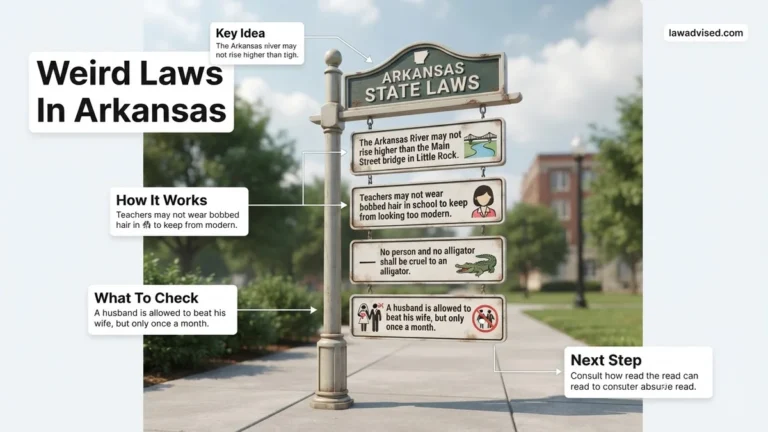
The internet loves to invent fake laws and attribute them to Arkansas. You have probably heard the viral myth claiming that a husband can beat his wife, provided he only does it once a month on the courthouse steps. This is completely false. It never existed as a statute, and it certainly has no place in modern 2027 jurisprudence.
-
Check state archives before believing viral social media posts
Recognize that viral legal myths often rely on shock value
Understand the difference between old English common law and actual Arkansas acts
Active Statutes Versus Repealed History
Just because an old law is physically printed in a historical archive does not mean it is enforceable today. Arkansas lawmakers routinely clean up the legal code, and courts routinely strike down unconstitutional or obsolete rules. Knowing whether a law was officially repealed or merely forgotten helps you separate active legal hazards from harmless historical trivia.
-
Look for official repeal dates in state legislative records
Remember that modern constitutional law overrides archaic local bans
Treat century-old statutes as history rather than current rules
Step-by-Step Guide to Verifying Outdated Southern Statutes
Navigating the complex world of antiquated legislation in Arkansas requires a systematic approach. Legal researchers and historians in 2027 rely on specific protocols to trace whether a bizarre local ordinance or state law remains officially on the books or has been quietly repealed.
1. Access Official State Repositories
Begin your investigation by consulting the official Arkansas General Assembly database. Do not rely on third-party trivia sites or social media posts, which often misrepresent or entirely fabricate local laws. Professional legal researchers utilize the Arkansas Code Annotated to check current legislative status.
2. Review Municipal Ordinances
Many bizarre rules, such as specific curfews or animal restrictions, originate at the city level rather than the state level. Contact the specific city clerk’s office or search their online municipal code library. According to municipal legal experts, cities frequently update their codebooks to remove unenforceable mandates, though forgotten ordinances can linger for decades.
3. Consult Legal Historians
When digital databases yield ambiguous results, reach out to university law libraries or state archives. Archivists can provide historical context on why a statute was enacted, whether it was invalidated by a higher court ruling, or if it simply expired naturally through a sunset clause.
What If It Still Doesn’t Work?
When primary state databases and municipal code searches fail to yield a clear answer regarding an obscure Arkansas law, researchers must pivot to alternative strategies. If conflicting interpretations or missing records stall your investigation, consider these fallback steps:
- File a Freedom of Information Act (FOIA) Request: Submit a formal FOIA inquiry to the Arkansas Attorney General’s office to obtain official advisory opinions on the statute’s enforceability.
- Consult a Licensed Attorney: Speak with a qualified member of the Arkansas Bar Association specializing in constitutional or municipal law. Professional legal consultation typically ranges from $150 to $350 per hour depending on the firm’s specialization.
- Review Appellate Court Precedents: Search state supreme court archives to determine if the specific statute has ever been challenged, enjoined, or ruled unconstitutional in past litigation.
- Contact the Legislative Reference Bureau: Utilize the research staff at the Arkansas Legislative Audit for objective assistance in tracking legislative history and amendment records.
Conclusion
Uncovering the truth behind quirky Arkansas laws demands patience, rigorous cross-referencing, and reliance on primary legal documents rather than internet myths. By systematically checking official state codes and municipal ordinances, researchers can easily separate modern urban legends from actual legislative history. According to verified research and legal experts, verifying the exact text of a statute remains the only foolproof method to understand current legal realities. Take the next step today by searching the official Arkansas Code database to verify any suspicious statute yourself.
❓ Frequently Asked Questions
What is the most famous dumb law in Arkansas?
The most famous is likely the Little Rock ordinance banning horn honking near sandwich shops after 9 PM, which was designed to prevent noise pollution near late-night diners.
How does Arkansas legally define the pronunciation of its name?
In 1881, the General Assembly passed a resolution declaring that the state name should be pronounced with a final ‘saw’ sound, spelling it out as ‘Ark-an-saw’.
Are most weird state laws active or repealed?
The vast majority of truly bizarre laws are either entirely fictional internet creations or dormant statutes that violate modern constitutional rights and cannot be enforced.
Why do states keep old laws on the books instead of deleting them?
Legislatures often focus on passing new bills rather than sweeping through centuries of old text to repeal unenforceable or obsolete municipal codes.
Did Arkansas ever ban teachers from wearing bobs?
No, the rumor that female teachers wearing bobbed hair were denied pay raises is a classic American folklore myth attributed to various states.
Where can someone read the actual current Arkansas code?
The complete, up-to-date Arkansas Code is publicly accessible online through the Arkansas State Legislature website and legal research databases.

Ismail Hossain is the founder of Law Advised. He is an Divorce, Separation, marriage lawyer. Follow him.