How to File Income Tax Return in USA Step-by-Step Guide 2026
Filing your US income taxes requires gathering essential documents like W-2s, selecting the right filing method such as IRS Free File or tax software, and submitting Form 1040 before the April deadline. Using the correct preparation tools and filing electronically ensures a faster refund and minimizes calculation errors. Getting started early prevents missed deadlines and simplifies the entire tax season process.
Filing your United States income tax return for the 2026 tax season requires gathering your income documents, choosing a filing method like IRS Free File or commercial software, and submitting your federal and state forms before the April deadline. Getting this right means avoiding costly IRS penalties and securing your maximum refund quickly.
Whether you are a W-2 employee or a freelance contractor, the process follows a predictable sequence. Taking it one step at a time keeps you organized, ensures you do not miss valuable deductions, and removes the stress from tax season.
Key Takeaways
- Gather all W-2s and 1099s before starting your return to avoid missing income.
- Check eligibility for IRS Free File to prepare and e-file federal taxes for zero cost.
- File electronically and choose direct deposit to receive your tax refund in weeks.
- Remember to file state income tax returns alongside your federal tax submission.
- Submit your tax return by the mid-April deadline to avoid failure-to-file penalties.
What Causes Tax Filing Confusion and Common Errors
Misunderstanding Your Filing Status and Income Documents
Many taxpayers struggle because they pick the wrong filing status or miss key tax documents. Your status determines your standard deduction and tax brackets for 2026. Choosing incorrectly triggers IRS delays.
- Single vs. Head of Household: Claiming Head of Household incorrectly is a major audit trigger.
- Missing 1099s or W-2s: Waiting for all forms prevents you from filing an amended return later.
- Forgetting 1099-NEC or 1099-K: Gig economy and side-hustle income must be reported even if issuers fail to send forms.
Overlooking Deductions and Math Mistakes
Manual calculations and rushed data entry cause most calculation errors. The IRS automated matching system catches these quickly, leading to processing holds.
- Transposing Social Security numbers: A single wrong digit halts your refund indefinitely.
- Ignoring the standard deduction: Itemizing requires meticulous receipt-keeping that many taxpayers fail to maintain.
- Failing to sign and date: Paper returns mailed without signatures are instantly rejected.
2026 Income Tax Return Expert Practical Guide
Navigating the United States federal and state tax system can feel intimidating, but breaking the process down into logical phases transforms a stressful chore into a manageable financial task. This comprehensive walkthrough guides you through every phase of filing your income tax return accurately, maximizing your eligible deductions, and ensuring compliance with the IRS to avoid costly penalties or delayed refunds.
Step 1: Gather Your Tax Documents and Personal Information
What you need: Social Security numbers for yourself, your spouse, and dependents; all income statements like W-2s, 1099s, and 1098s; and last year’s tax return for reference.
Instructions: Before touching any tax software, create a dedicated folder—either physical or digital—and collect every tax form issued to you by employers, banks, investment firms, and freelance clients. Typically, these forms arrive by late January or mid-February. Check your mail and online portals for Form W-2 (wage income), Form 1099 (independent contractor or interest income), and Form 1098 (mortgage interest or student loan interest). If you are missing a document, contact the issuer immediately. Having a complete set of documents prevents you from having to file an amended tax return later.
Pro Tip: Never file your taxes using your final year-end paystub instead of an official W-2 form, as the IRS matches reported numbers directly to what your employer officially submitted.
Step 2: Determine Your Filing Status
What you need: Knowledge of your legal marital status and household living arrangements as of December 31 of the tax year.
Instructions: Your filing status dictates your tax brackets, standard deduction amounts, and eligibility for specific credits. The IRS recognizes five distinct filing statuses: Single, Married Filing Jointly, Married Filing Separately, Head of Household, and Qualifying Surviving Spouse. If you are unmarried but paid more than half the cost of maintaining a home for a qualifying dependent child or relative, you likely qualify for Head of Household, which offers a significantly higher standard deduction and more favorable tax brackets than filing as Single.
Pro Tip: If you are legally married, carefully weigh the pros and cons of filing jointly versus separately, though note that filing separately disqualifies you from many valuable tax credits.
Step 3: Choose Your Method of Filing
What you need: A computer or mobile device with internet access, or the contact information for a certified public accountant (CPA).
Instructions: Select how you plan to prepare and submit your return. Taxpayers with straightforward W-2 income can often use IRS Free File software if their adjusted gross income falls below the annual threshold. For more complex situations involving self-employment, rental properties, or investments, commercial tax preparation software like TurboTax, H&R Block, or FreeTaxUSA offers step-by-step interview questions. Alternatively, if you prefer human oversight or have a deeply complex financial portfolio, hire a licensed CPA or Enrolled Agent to handle the submission for you.
Pro Tip: Read the fine print on commercial tax software platforms to ensure “free” versions actually cover your specific deductions, such as Schedule C for freelancers.
Step 4: Report All Sources of Income
What you need: All compiled W-2s, 1099s, cryptocurrency transaction summaries, and records of any other miscellaneous income.
Instructions: Input your data carefully into your chosen software or tax form. Start with earned income from jobs (W-2s), then add self-employment or gig economy income (1099-NEC), unemployment benefits (1099-G), capital gains from stock sales (1099-B), and interest or dividend earnings from bank accounts and investments (1099-INT/DIV). Every dollar of worldwide income must be reported to the IRS. Skipping a 1099 form is one of the fastest ways to trigger an automated IRS notice and delay any refund you might be expecting.
Step 5: Deductions: Standard vs. Itemized
What you need: Receipts and tracking records for charitable donations, medical expenses, state and local taxes (SALT), and mortgage interest.
Instructions: Decide whether to take the Standard Deduction or to Itemize your deductions using Schedule A. The standard deduction is a flat, fixed dollar amount that reduces your taxable income based on your filing status, and roughly 90 percent of taxpayers choose this route for its simplicity. However, if your total itemized deductions—such as mortgage interest up statutory limits, state property and income taxes up to $10,000, and out-of-pocket medical expenses exceeding 7.5 percent of your adjusted gross income—exceed the standard deduction threshold, itemizing will save you more money.
Pro Tip: Always calculate your taxes both ways if you are on the borderline to guarantee you choose the option resulting in the lowest tax liability.
Step 6: Claim Eligible Tax Credits
What you need: Documentation for childcare expenses, higher education costs (Form 1098-T), or energy-efficient home improvements.
Instructions: Unlike deductions that lower your taxable income, tax credits reduce your actual tax liability dollar-for-dollar, making them exceptionally valuable. Review eligibility requirements for major federal credits such as the Child Tax Credit, the Earned Income Tax Credit (EITC), the American Opportunity Tax Credit for college expenses, and green energy credits for installing solar panels or heat pumps. Tax preparation software usually prompts you for these, but reviewing them manually ensures you leave no money on the table.
Step 7: Review, Sign, and Submit Your Return
What you need: Your prior year Adjusted Gross Income (AGI) for electronic verification purposes, and your bank routing and account numbers for direct deposit.
Instructions: Before hitting submit, run a thorough review of your entire return. Check for typographical errors in Social Security numbers, home addresses, and spelling of names. If you are expecting a refund, opt for direct deposit rather than a paper check, as it reduces delivery time from weeks to roughly 21 days or less. Sign the return electronically using an Identity Protection PIN if you have one, or by entering your prior-year AGI. Once transmitted, retain a digital and printed copy of your final submitted return along with the electronic confirmation receipt.
Pro Tip: If you owe taxes and cannot pay immediately, submit your return on time anyway to avoid the failure-to-file penalty, and set up a payment plan with the IRS.
✅ Final Checklist
- All W-2 and 1099 forms have been accurately entered without typos in identification numbers.
- Filing status matches your legal household situation on the final day of the tax year.
- Bank routing and account numbers for direct deposit have been double-checked for accuracy.
- A complete copy of the submitted tax return and IRS e-file confirmation receipt has been safely saved.
- State tax returns have been prepared and filed alongside or immediately after the federal return.
Important Notes:
- The standard filing deadline is April 15, unless it falls on a weekend or holiday, though an automatic extension can be requested to push the deadline to October 15 (note that an extension to file is not an extension to pay taxes owed).
- Seek professional help from a CPA if you face complex audits, international tax issues, intricate small business setups, or inheritance tax situations.
- Filing yourself using modern software typically costs between $0 and $100 for federal and state returns, while hiring a professional generally ranges from $200 to over $600 depending on complexity.
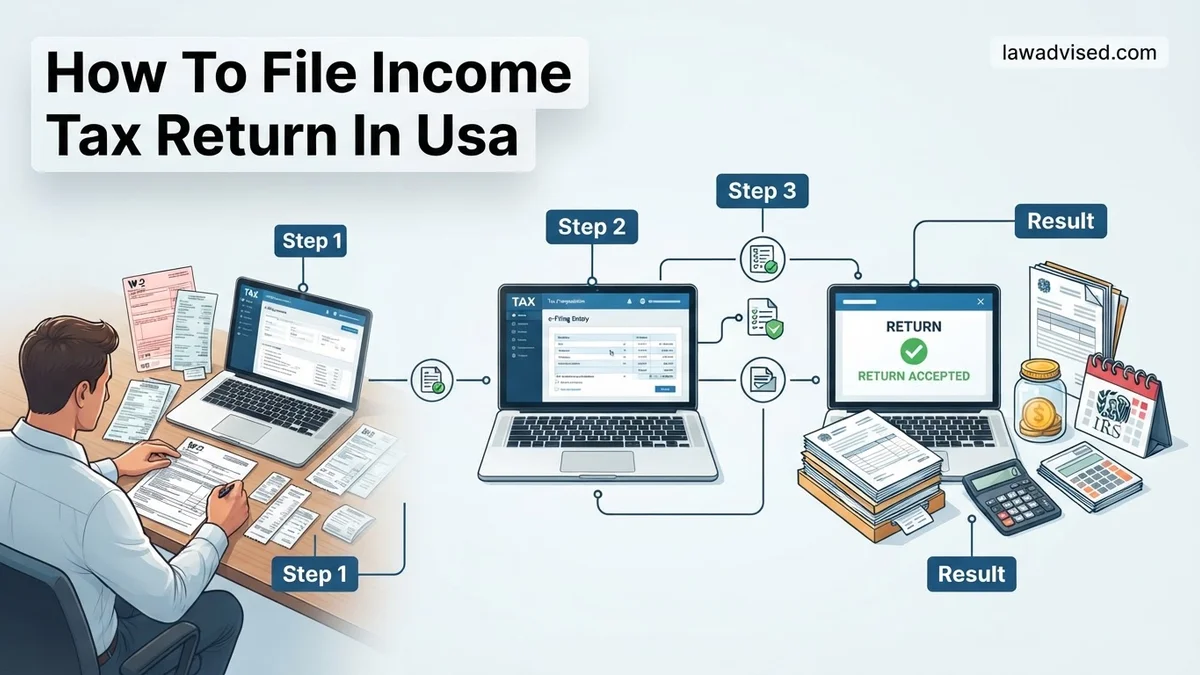
How to File Income Tax Return in USA Step by Step
Step 1: Gather Your Tax Documents and Personal Information
Before touching any software or IRS forms, collect your paperwork. You cannot complete a 2026 return accurately without the official documents reporting your earnings.
- Identification: Social Security numbers or Individual Taxpayer Identification Numbers (ITIN) for yourself, your spouse, and your dependents.
- Income Statements: W-2 forms from employers, 1099 forms for freelance or contract work, and 1099-INT or 1099-DIV for bank interest and investments.
- Deduction Records: Form 1098 for mortgage interest, student loan interest statements, and charitable donation receipts if you itemize.
Step 2: Choose Your Filing Method and Software
Select how you want to prepare and submit your return based on your income level and the complexity of your financial situation for 2026.
- IRS Free File: Available if your adjusted gross income (AGI) falls below the IRS threshold, offering free brand-name software guidance.
- DIY Tax Software: Platforms like FreeTaxUSA, TurboTax, or H&R Block walk you through questions and handle the math automatically.
- Tax Professional: Hiring a CPA or Enrolled Agent is ideal if you own a complex business, rental properties, or navigate intricate investment portfolios.
How to Choose the Right Filing Method and Software
Selecting the correct filing method depends on your financial complexity and comfort level with tax laws. For the 2026 tax season, taxpayers have three primary avenues: IRS Free File, commercial tax software, or a certified human preparer.
IRS Free File and Direct File
According to Internal Revenue Service guidelines, taxpayers with an adjusted gross income of $79,000 or less in 2025 qualify for brand-name guided tax software via IRS Free File. Furthermore, the expanded IRS Direct File program allows eligible residents in participating states to file federal returns directly on the government website at zero cost. Here is how to evaluate your options:
- Review your total income against the current IRS threshold for Free File programs.
- Check if your state participates in the IRS Direct File expansion for 2026.
- Compare commercial software tiers (such as TurboTax, H&R Block, or TaxSlayer) if your investments or freelance income require advanced schedules.
- Weigh the cost of paid software against potential deductions you might miss using basic filing tools.
What If Your Return Is Rejected or You Owe Money
Electronic tax returns are frequently rejected due to minor data entry errors, such as a mismatched Social Security Number or an incorrect Prior Year Adjusted Gross Income (AGI). If the IRS rejects your e-filed 2026 return, the issue is usually easy to resolve. If you owe taxes, prompt action prevents accumulating statutory interest and failure-to-pay penalties.
Steps to Resolve a Rejected Return
- Log into your tax software to read the specific rejection code provided by the IRS.
- Correct the inaccurate data field, such as a dependent’s date of birth or your Identity Protection PIN.
- Resubmit the electronic return through your software platform at no additional charge.
Steps If You Owe a Balance
- File your return on time by the April 2026 deadline, even if you cannot pay the full balance immediately.
- Set up an online payment agreement through the official IRS website to minimize late-payment penalties.
- Evaluate short-term payment plans (up to 180 days) or long-term installment agreements based on your budget.
What If It Still Doesn’t Work?
If software glitches persist, state tax discrepancies arise, or your financial situation involves complex multi-state or corporate assets, standard DIY methods may fail. When digital tools stall, consider these fallback actions:
- Contact the IRS customer support helpline or schedule an appointment at a local Taxpayer Assistance Center for direct guidance.
- Engage a Certified Public Accountant (CPA) or an Enrolled Agent (EA) to review and amend your return. Professional preparation fees typically range from $220 for simple itemized returns to over $600 for complex self-employment filings, according to National Society of Accountants data.
- Utilize IRS Volunteer Income Tax Assistance (VITA) sites for free in-person help if your household income falls below program limits.
- File for an automatic six-month extension using IRS Form 4868 to secure extra time for sorting out persistent filing errors.
Conclusion
Navigating the 2026 tax filing process requires careful preparation, accurate data entry, and the selection of a suitable digital or professional filing method. According to verified research and expert sources from the IRS and the National Taxpayer Advocate, filing electronically with direct deposit remains the fastest and most secure way to receive your refund. Take your next actionable step today by gathering your W-2s and 1099s to begin your filing process well before the statutory deadline.
❓ Frequently Asked Questions
Do I need to file a federal income tax return if I made very little money?
Whether you must file depends on your filing status, age, and gross income. However, even if you earned below the threshold, filing is necessary to claim certain refundable tax credits or get a refund on withheld taxes.
What is the difference between federal and state tax returns?
A federal tax return goes to the Internal Revenue Service (IRS) and follows national tax laws, while a state tax return is filed with your specific state tax agency and follows local tax regulations.
What should I do if I cannot finish my tax return by the April deadline?
You can request an automatic six-month extension to file by submitting IRS Form 4868 before the April deadline. Note that an extension to file is not an extension to pay any taxes owed.
How do I choose between standard deduction and itemized deductions?
Most taxpayers take the standard deduction because it reduces their taxable income by a fixed amount easily. You should only itemize if your total deductible expenses, such as mortgage interest and medical bills, exceed the standard deduction amount.
What happens if I make a mistake on my filed tax return?
If you discover an error after submitting, you can file an amended return using IRS Form 1040-X. It is best to wait until your original return has been processed before submitting an amendment.
Where can I get free in-person help with my taxes?
Programs like VITA (Volunteer Income Tax Assistance) and TCE (Tax Counseling for the Elderly) offer free tax help and electronic filing assistance to qualified individuals who meet income or age requirements.

Ismail Hossain is the founder of Law Advised. He is an Divorce, Separation, marriage lawyer. Follow him.