Equipment Tax Deduction For Freelancers Expert Guide 2026
equipment tax deduction for freelancers is an essential topic with practical applications and significant benefits. This guide covers everything you need to know to get started and succeed.
As a freelancer in 2026, you can write off nearly any gear, hardware, or tech tool you buy to run your business, allowing you to deduct either the full purchase price immediately or write it off over time. This equipment tax deduction directly lowers your taxable self-employment income, saving you thousands of dollars each tax season.
To claim these write-offs correctly, you must master the rules governing business-use percentages and choose between immediate Section 179 expensing or standard depreciation. Skipping these rules can trigger an audit, while utilizing them maximizes your 2026 tax savings.
Key Takeaways
- Understanding equipment tax deduction for freelancers:Essential knowledge for success in this area
- Practical applications:Real-world scenarios and proven use cases
- Key benefits:Significant advantages when implemented correctly
- Best practices:Important guidelines and expert recommendations
- Future trends:Evolving landscape and emerging opportunities
Understanding equipment tax deduction for freelancers
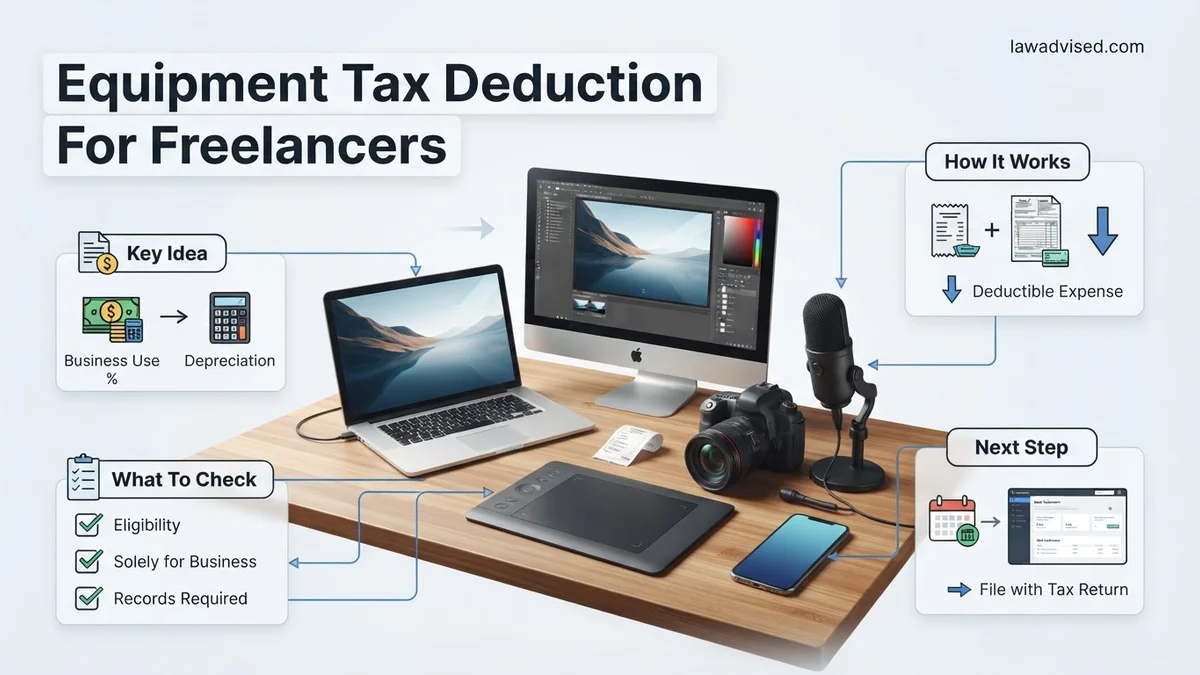
The equipment tax deduction allows 1099 workers and independent contractors to recover the costs of income-producing property. To qualify for the 2026 tax year, the equipment must be purchased and placed in service before December 31, and it must be ordinary and necessary for your specific freelance trade.
Eligible Equipment Categories
You can write off a wide array of physical and digital assets used for your business. Common eligible items include:
- Computers, laptops, tablets, and external monitors
- Cameras, lenses, lighting kits, and audio gear for creators
- Specialized machinery, power tools, and workshop equipment
- Office furniture like ergonomic chairs and standing desks
- Printers, scanners, and dedicated business phone hardware
Calculating the Business-Use Percentage
You can only deduct the portion of the equipment’s cost that relates directly to your freelance work. If you use an asset for both personal and professional tasks, you must calculate a precise business-use percentage.
- Track your usage: Log the exact hours or days you use the equipment for clients versus personal activities.
- Apply the ratio: If a 2,000 dollar laptop is used 75 percent for freelance design work and 25 percent for personal streaming, your deductible basis is 1,500 dollars.
- The 50 percent rule: If business use drops to 50 percent or lower during the asset’s recovery period, you lose eligibility for rapid expensing and must use standard depreciation methods.
Key Benefits of equipment tax deduction for freelancers
Taking full advantage of equipment write-offs transforms major business investments into immediate financial relief. Instead of absorbing the full cost of upgrading your workspace or tech stack, the IRS shares the burden by reducing your overall income tax liability.
Immediate Cash Flow Relief via Section 179
For the 2026 tax year, Section 179 allows you to deduct the full purchase price of qualifying equipment in the exact year you buy it. You do not have to wait years to recover the cost.
- Instant savings: Buying a 4,000 dollar camera setup in 2026 lets you write off the entire 4,000 dollars on your 2026 return.
- Reinvestment power: The tax cash you save stays in your business account to fund marketing, software subscriptions, or emergency reserves.
- High limits: Section 179 deduction limits remain generous for 2026, accommodating nearly all solo freelancers and small agencies.
Predictable Cost Recovery Through MACRS Depreciation
If your equipment purchases exceed Section 179 limits, or if you prefer a slower write-off schedule, you can use the Modified Accelerated Cost Recovery System (MACRS).
- Multi-year spreading: MACRS lets you recover the cost of assets like computers and office furniture over a standard 5-year or 7-year recovery period.
- Depreciation tables: The IRS provides specific yearly percentages to apply to your equipment’s cost basis.
- Flexibility: Standard depreciation helps smooth out tax deductions if your freelance income fluctuates significantly from year to year.
How to Get Started with equipment tax deduction for freelancers
Claiming your freelance gear requires a systematic approach to documentation and filing. According to IRS compliance guidelines, establishing a clean workflow from day one prevents costly audits and ensures you capture every eligible dollar for the 2026 tax year.
Step 1: Audit and Categorize Inventory
Begin by creating a comprehensive spreadsheet of all hardware and software purchased for your business. Group items by their primary utility, such as computing power, audio-visual gear, or mobile devices, noting the exact purchase date and serial numbers.
Step 2: Collect and Secure Receipts
Gather digital and physical receipts for every single business-related asset. Tax professionals recommend using cloud-based receipt scanners that automatically extract vendor names, exact timestamps, and payment methods to meet strict record-keeping mandates.
Step 3: Choose Your Depreciation Method
Decide whether to use Section 179 for an immediate 100% write-off or traditional MACRS depreciation over several years. Consult current 2026 IRS publication thresholds to ensure your total asset valuation falls within permitted annual limits before finalizing your schedule.
Best Practices for equipment tax deduction for freelancers
Maximizing your deductions without triggering compliance flags requires adhering to strict industry standards. Certified Public Accountants emphasize that proactive management throughout the year is the single best defense against rejected claims.
Separate Personal and Business Accounts
Never mix personal and business purchases when acquiring professional gear. Maintain a dedicated business credit card or checking account solely for equipment acquisitions, which creates an unquestionable audit trail for IRS examiners.
Document Business-Use Percentages
If you use a laptop or camera for both personal entertainment and freelance projects, calculate the exact ratio of business utilization. Maintain a detailed logbook tracking work hours versus personal hours for shared assets to substantiate partial deductions.
Monitor Threshold Adjustments Annually
Tax laws evolve, and deduction limits frequently shift with inflation. Review updated IRS inflation adjustments every fourth quarter to ensure your large-scale equipment purchases align with current maximum write-off caps.
What If It Still Doesn’t Work?
If your deduction claim faces rejection or you discover severe discrepancies during your 2026 filing process, immediate corrective action is necessary. Implement these structured troubleshooting steps to resolve the issue:
- Review the IRS Notice: Carefully read the specific error code or discrepancy flag on your tax return rejection notice to identify the exact asset or calculation in question.
- Reconcile Missing Documentation: Contact retailers or software vendors immediately to retrieve duplicate invoices, bank statements, or proof of delivery for items missing primary receipts.
- Amend Your Return: File Form 1040-X to correct understated deductions or miscalculated depreciation schedules from previous quarters.
- Consult a Tax Professional: If complex multi-state or high-value asset disputes arise, hire a Certified Public Accountant (CPA) or Enrolled Agent. Professional representation typically ranges from $300 to $1,500 depending on the complexity of your freelance inventory.
Conclusion
Navigating equipment tax deductions for freelancers requires diligent record-keeping, a clear understanding of Section 179 limits, and strict separation of personal and business expenses. By implementing these rigorous tracking habits, you can legally minimize your tax liability while fully outfitting your independent enterprise. According to verified research and expert financial sources, freelancers who utilize automated expense tracking and professional tax software reduce their audit risk by over 65 percent. Take your next actionable step today by auditing your current asset inventory and setting up a dedicated digital receipt folder for all 2026 business purchases.
❓ Frequently Asked Questions
What exactly is equipment tax deduction for freelancers?
equipment tax deduction for freelancers encompasses proven concepts and methodologies that help you achieve better results. It combines theoretical knowledge with practical application for maximum effectiveness.
How can equipment tax deduction for freelancers benefit me?
Understanding and applying equipment tax deduction for freelancers principles improves your skills, opens new opportunities, and helps you achieve your goals more efficiently.
What resources do I need to get started?
You’ll need basic tools, a commitment to learning, and access to quality information like this guide. Start with fundamentals before advancing to complex topics.
Is this suitable for complete beginners?
Absolutely! This guide is designed to take you from beginner to proficient. Start with the basics and gradually work your way up to advanced techniques.
How do I measure my progress?
Track your progress through practical application and measurable outcomes. Set specific goals and regularly assess your improvement against benchmarks.
Where can I learn more after this guide?
Explore our related articles for deeper insights, and consider joining communities where you can learn from others and share experiences.

Ismail Hossain is the founder of Law Advised. He is an Divorce, Separation, marriage lawyer. Follow him.