Taxes for Gig Workers Explained Step-by-Step Guide for 2026
Navigating taxes for gig workers requires understanding both self-employment taxes and income taxes since no employer withholds them automatically. This guide breaks down quarterly payments, essential forms like 1099-NEC, and proven deductions to lower your tax bill.
As a gig worker in 2026, you are considered a self-employed independent contractor, meaning no client or platform automatically withholds income or payroll taxes from your earnings. You are personally responsible for tracking your revenue, filing your own tax returns, and paying both standard income tax and the 15.3% self-employment tax on your net profits.
Ignoring these obligations leads to heavy penalties and unexpected tax bills come April. This step-by-step guide breaks down exactly how independent contractor taxes work, how to handle your quarterly payments, and how to maximize your write-offs.
Key Takeaways
- Gig workers must pay a 15.3% self-employment tax for Social Security and Medicare.
- File estimated quarterly taxes four times a year to avoid IRS penalties.
- Track every business mile driven to maximize your standard mileage deduction.
- Keep 25% to 30% of your gig earnings in a separate savings account for taxes.
- Use Schedule C to report income and write off legitimate business expenses.
Why Gig Workers Face Unique Tax Obligations
When you work a traditional W-2 job, your employer pays half of your Social Security and Medicare taxes while withholding the other half from your paycheck. As a gig worker driving for Uber, freelancing on Upwork, or delivering groceries on Instacart, you operate as your own boss. This classification shifts the entire tax burden directly onto your shoulders.
The Role of Schedule C
You report all your freelance and gig income using Schedule C (Profit or Loss From Business) when filing your federal tax return. This form subtracts your legitimate business expenses from your total gross income to determine your net profit. That final net profit number is what the IRS uses to calculate your actual income tax and self-employment tax.
Understanding Self-Employment Tax
The self-employment tax covers your contributions to Social Security (12.4%) and Medicare (2.9%), totaling 15.3% on your net earnings up to the 2026 wage base limits. While traditional employees only see half of this deducted, you must pay both the employer and employee portions. Fortunately, the IRS allows you to deduct half of your self-employment tax as an adjustment to your income.
- Traditional employees pay 7.65% for FICA; gig workers pay the full 15.3% via Schedule SE.
- The self-employment tax applies only to your net profit, not your gross earnings.
- You can deduct 50% of your self-employment tax liability on your Form 1040.
How to Calculate and Pay Quarterly Estimated Taxes
Because taxes are not withheld from your gig payouts throughout the year, the IRS expects you to pay as you go through quarterly estimated tax payments. If you expect to owe more than $1,000 in taxes when you file your 2026 return, skipping these quarterly payments will trigger underpayment penalties and interest charges.
The 2026 Quarterly Payment Deadlines
You must submit your estimated tax payments four times a year using IRS Form 1040-ES. Mark these critical 2026 deadlines on your calendar to avoid late fees:
- Q1 Payment (January 1 to March 31): Due April 15, 2026
- Q2 Payment (April 1 to May 31): Due June 15, 2026
- Q3 Payment (June 1 to August 31): Due September 15, 2026
- Q4 Payment (September 1 to December 31): Due January 15, 2027
How Much Should You Set Aside?
A safe rule of thumb for gig workers is to set aside 25% to 30% of every payment you receive into a separate business savings account. This percentage covers both your federal income tax bracket and the 15.3% self-employment tax. If you live in a state or city with local income taxes, bump your savings rate closer to 35% to prevent any nasty surprises.
- Use IRS Direct Pay online to make secure quarterly payments directly from your bank account.
- Base your current year payments on either 100% of your prior year tax liability or 90% of your current year liability.
- Adjust your quarterly amounts if your gig income fluctuates significantly during different seasons.
Step-by-Step Guide to Claiming Gig Economy Tax Write-Offs
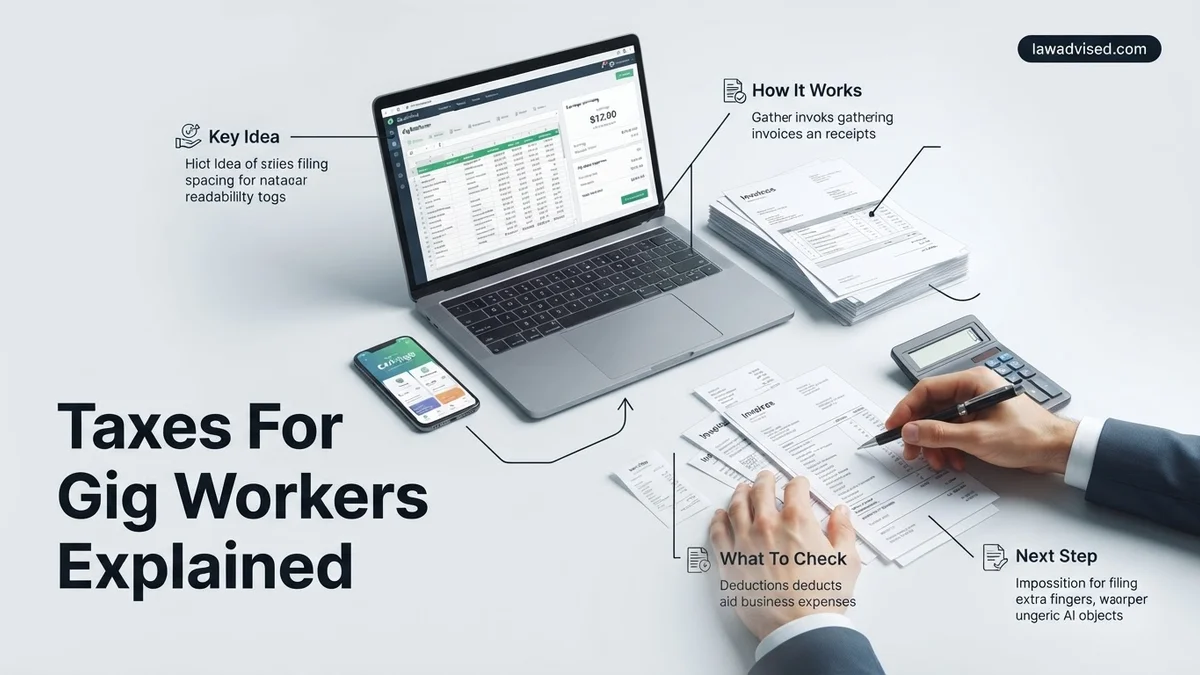
Maximizing deductions is the single most effective way to lower your 2026 tax liability as a rideshare driver, freelance writer, or independent contractor. The IRS allows you to deduct any ordinary and necessary expenses incurred while operating your business. To claim these write-offs legally and safely, follow this structured procedural framework:
1. Tracking and Categorizing Expenses
- Open a dedicated business bank account and credit card to keep personal and gig finances strictly separated.
- Use IRS-compliant digital accounting software or mileage-tracking apps to automatically log every business-related drive and receipt as they occur.
- Sort your expenses into standard IRS categories, such as vehicle expenses, home office usage, software subscriptions, and professional supplies.
2. Calculating and Reporting Deductions
- Choose your vehicle deduction method: multiply your total business miles by the standard IRS mileage rate for 2026, or calculate the actual operational costs of gas, maintenance, and insurance.
- Aggregate your categorized expenses for the entire calendar year to compute your total deductible business overhead.
- Transfer your final totals onto Schedule C (Profit or Loss From Business) when filing your Form 1040, ensuring you subtract these expenses from your gross gig income.
What If You Miss a Quarterly Tax Deadline or Owe Back Taxes
Missing a quarterly estimated tax payment or discovering you owe a massive balance in 2026 can feel overwhelming, but the IRS provides structured avenues to resolve these issues. Failing to act quickly will only compound your financial penalties over time.
Handling Missed Deadlines
- Calculate your missed payment amount and submit it through the IRS Direct Pay portal as soon as possible to halt the accrual of further failure-to-pay penalties.
- Expect a late-payment penalty and interest charge on the underpayment, which the IRS will calculate and bill to you automatically.
- File for an IRS installment agreement online if you cannot afford the lump-sum payment for your back taxes.
Navigating Payment Plans
- Determine if you qualify for a short-term payment plan (up to 180 days) or a monthly installment agreement based on your total debt.
- Submit Form 9465 (Request for Installment Agreement) or apply through the official IRS website to set up automatic monthly withdrawals.
What If It Still Doesn’t Work?
If self-managing your 2026 gig economy taxes leads to an audit notice, persistent calculation errors, or severe IRS debt, standard DIY methods may no longer suffice. Consider deploying these advanced fallback solutions:
- Hire a certified public accountant (CPA) or an Enrolled Agent (EA) specializing in independent contractor finances to review your past filings and communicate directly with the IRS. Professional tax representation typically costs between $300 and $1,000 depending on the complexity of your back taxes.
- Request First-Time Penalty Abatement from the IRS if you have a clean compliance history for the preceding three tax years.
- Submit an Offer in Compromise (OIC) if your financial hardship makes it impossible to pay your full tax liability, allowing you to settle the debt with the IRS for a lower, agreed-upon amount.
Conclusion
Navigating taxes as a gig worker requires strict organization, accurate quarterly filings, and a proactive approach to deductions to protect your hard-earned revenue. Missing deadlines or failing to log expenses can lead to costly penalties and avoidable stress. According to verified research and expert tax sources from the IRS, maintaining meticulous digital records is the single most reliable safeguard against audits and unexpected tax liabilities. Take your next actionable step today by downloading a verified mileage-tracking app and setting up a dedicated calendar reminder for the next quarterly tax deadline.
❓ Frequently Asked Questions
How do I calculate self-employment tax as an independent contractor?
Self-employment tax is 15.3% and covers Social Security (12.4%) and Medicare (2.9%). It is calculated on 92.35% of your net self-employment earnings on Schedule SE.
What is the difference between a 1099-NEC and a 1099-K?
A 1099-NEC reports direct non-employee compensation of $600 or more. A 1099-K reports payment card and third-party network transactions, though reporting thresholds vary by platform.
What common expenses can rideshare and delivery drivers write off?
Drivers can deduct vehicle expenses using either the standard mileage rate or actual expenses, along with phone mounts, hot bags, data plans, and tolls.
How do I set aside money for taxes throughout the year?
A best practice is to transfer 25% to 30% of every gross payout immediately into a separate savings account designated solely for tax payments.
Do I need to file a tax return if I made less than $400?
If your net self-employment earnings were under $400, you generally do not need to file a Schedule SE, but you may still need to file a federal income tax return based on other income.
Can I deduct a home office if I do administrative work for my gig business?
Yes, if you use a specific area of your home exclusively and regularly for conducting administrative or management activities for your business, you may qualify for the home office deduction.

Ismail Hossain is the founder of Law Advised. He is an Divorce, Separation, marriage lawyer. Follow him.