Vehicle Expenses Tax Deduction 2026 Expert Guide
Navigating the vehicle expenses tax deduction requires choosing between the standard mileage rate and actual expense methods. Proper documentation and strict adherence to IRS rules are essential to legally maximize your write-off and avoid audits.
Maximizing your vehicle expenses tax deduction for the 2026 tax year comes down to choosing between the standard mileage rate and the actual expense method, then proving your business use with an airtight log. If you use your car for business, independent contracting, or freelancing, this write-off is often one of your largest business deductions.
Choosing the right calculation method can mean a difference of thousands of dollars on your final tax bill. The IRS enforces strict rules on how you track miles, maintain receipts, and switch between calculation methods from year to year. Knowing these mechanics protects you from common calculation traps.
Key Takeaways
- Choose between standard mileage and actual expense methods carefully based on vehicle operating costs.
- Maintain a strict IRS-compliant mileage log including dates, miles, and business purpose.
- W-2 employees generally cannot claim the vehicle expense deduction under current tax laws.
- Track all gas, insurance, repairs, and depreciation if using the actual expense method.
- Understand strict IRS rules regarding when you can switch deduction methods year-over-year.
What Causes Tax Audit Red Flags in Vehicle Deductions
The IRS heavily scrutinizes vehicle deductions because inflated mileage claims are common among business owners. Triggering an audit often stems from predictable reporting mistakes that automated filters and tax auditors easily spot.
Common Audit Triggers to Avoid
- 100% Business Use Claims: Claiming your vehicle is used exclusively for business without personal use looks unrealistic to the IRS, especially if you only own one vehicle.
- Perfect Round Numbers: Submitting a mileage log that totals exactly 15,000 miles or features recurring daily increments signals a reconstructed log rather than contemporaneous records.
- High Mileage Discrepancies: Your total business mileage cannot exceed the total odometer reading difference for the entire year.
- Lack of Written Evidence: Relying on estimated guesses or credit card gas station receipts without a destination log fails basic IRS substantiation tests.
How to Substantiate Your Claims
To survive a 2026 tax audit, you must maintain a compliant mileage log that records specific data points for every single business trip. The IRS demands written proof created at or near the time of the actual travel.
- Record the exact date of the trip.
- Note your starting and ending destinations.
- Document the business purpose and client or project name.
- Log the total number of business miles driven.
How to Calculate Your Vehicle Expenses Tax Deduction Step by Step
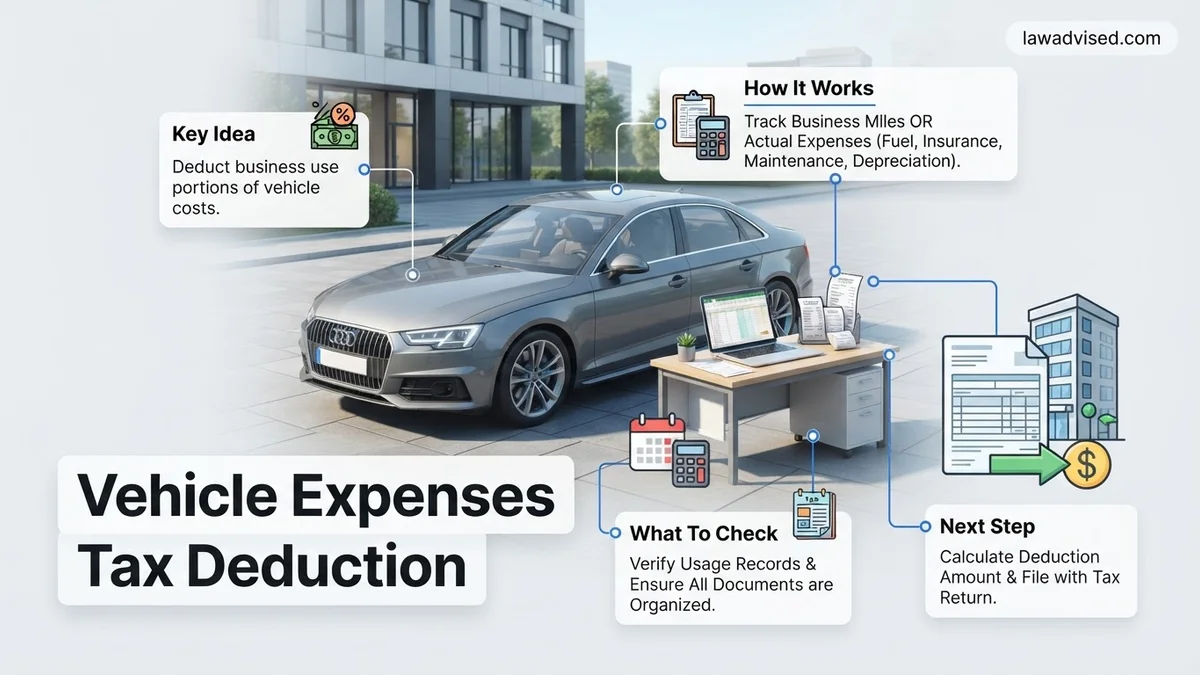
You must choose between two distinct methods to calculate your write-off: the Standard Mileage Rate or the Actual Expense Method. Each method follows rigid IRS eligibility rules that dictate your long-term choices.
The Standard Mileage Rate Method
The standard mileage rate multiplies your total business miles driven by the IRS-set per-mile rate for 2026. This method offers simplicity because you do not need to track gas, oil changes, or routine maintenance receipts.
- How it works: Multiply your annual business miles by the 2026 IRS mileage rate.
- Required tracking: You only need to track your total business miles and the vehicle’s annual odometer readings.
- Eligibility catch: If you want to use the standard rate, you generally must choose it in the first year the car is available for business use. If you start with actual expenses, you cannot switch to the standard rate for that specific vehicle later.
The Actual Expense Method
The actual expense method requires you to calculate the exact total cost of operating your vehicle for the entire year, then deduct the business-use percentage.
- Deductible expenses: Gas, oil, repairs, tires, insurance, registration fees, lease payments, and vehicle depreciation.
- The math formula: Divide your annual business miles by your total annual miles to find your business-use percentage. Multiply your total vehicle operating costs by this percentage.
- Record keeping: You must save every physical or digital receipt for gas, repairs, and insurance throughout 2026.
How to Fix Incomplete Mileage Logs and Missing Receipts
Reconstructing missing records can feel overwhelming during 2026 tax preparation, but the IRS allows secondary evidence to substantiate vehicle expenses. If your mileage log or gas receipts have gaps, you must rely on verifiable digital footprints to reconstruct your travel history.
Reconstructing Historical Data
According to IRS audit guidelines, taxpayers can use contemporaneous electronic data to support business deductions when traditional logs are incomplete. Follow these procedural steps to rebuild your mileage record:
- Pull historical calendar entries, meeting invites, and client emails to identify confirmed business appointments and destinations.
- Export location history data from your smartphone or navigation applications, cross-referencing timestamps with your calendar dates.
- Calculate the standard mileage distances between your office and each verified meeting location using standard mapping tools.
- Compile bank and credit card statements to locate missing fuel, maintenance, and insurance payment receipts.
- Assemble the reconstructed timeline into a chronological spreadsheet, noting the business purpose for every single reconstructed trip.
What If Your Deduction Method Choice Still Does Not Maximize Savings
Choosing between the standard mileage rate and the actual expense method sometimes yields lower tax savings than expected, particularly if vehicle depreciation rules shift. If your calculated deduction falls short of your actual cash outlay for vehicle ownership, alternative strategies must be evaluated immediately.
Advanced Optimization Strategies
When standard calculations fail to maximize your 2026 tax savings, consider these expert-backed financial adjustments:
- Calculate the Section 179 deduction and bonus depreciation limits for heavy SUVs or trucks utilized more than 50 percent for business purposes.
- Evaluate whether structuring a formal vehicle lease agreement through your business entity provides a more favorable deduction schedule than ownership.
- Consult a certified public accountant (CPA) or a licensed enrolled agent to review your asset classification and depreciation schedules. Professional advisory fees for complex business vehicle audits typically range from $300 to $800 depending on the complexity of your asset portfolio.
- Reallocate personal versus business usage percentages by implementing strict, automated GPS tracking software for the remainder of the tax year.
Conclusion
Navigating the complexities of the vehicle expenses tax deduction requires meticulous record-keeping and strategic method selection to prevent costly audit adjustments. Failing to properly document business miles or miscalculating actual expenses can result in significant financial disallowances by tax authorities. According to verified research and expert financial sources, implementing automated tracking tools and reviewing depreciation limits annually ensures maximum legal compliance and deduction yields. As an immediate next step, audit your current tracking procedures today and integrate a certified digital mileage log to safeguard your 2026 deductions.
❓ Frequently Asked Questions
How does the Standard Mileage Rate differ from the Actual Expense Method?
The Standard Mileage Rate multiplies your business miles driven by the IRS-set standard rate, covering gas, oil, and repairs automatically. The Actual Expense method requires tracking every individual operating cost, plus depreciation, and multiplying the total by your business-use percentage.
What specific vehicle expenses are included in the Actual Expense method?
You can deduct a business-use percentage of gas, oil, repairs, tires, insurance, registration fees, lease payments, and vehicle depreciation. Personal use expenses must be strictly separated and excluded.
What happens if I use my vehicle for both business and personal driving?
You must track total mileage and calculate the exact percentage of business-use versus personal-use. Your deduction, under either method, is strictly limited to the business-use percentage.
Can I deduct parking fees and tolls separately?
Yes, parking fees and tolls incurred directly during business travel are fully deductible in addition to either the standard mileage rate or actual expenses.
What constitutes adequate records in the eyes of the IRS?
The IRS requires a contemporaneous log showing the date, business destination, business purpose, and miles driven for every trip. Digital mileage-tracking apps are widely accepted and recommended.
Are electric or hybrid vehicles subject to different deduction rules?
The calculation methods remain the same for electric and hybrid vehicles, though owners using actual expenses may benefit from tracking electricity costs or specific clean-vehicle depreciation limits.

Ismail Hossain is the founder of Law Advised. He is an Divorce, Separation, marriage lawyer. Follow him.