What Happens If Tax Deadline Is Missed 2026 Real Fix Guide
Missing the tax deadline triggers severe financial penalties and interest charges, with failure-to-file penalties costing significantly more than failure-to-pay. Taking immediate action to submit your return and contact the IRS minimizes these mounting costs.
Missing the federal tax deadline in 2026 triggers an immediate wave of IRS penalties and interest charges that grow larger with every passing month. If you owe money and fail to file, you face a compounding financial hit that makes your original tax bill look manageable by comparison.
The good news is that you can stop the bleeding right now. Taking immediate action to file your return and communicate with the IRS will drastically reduce what you ultimately owe in late fees.
Key Takeaways
- Filing late incurs a much higher penalty than paying late.
- Submit your return as soon as possible to stop penalties from growing.
- No penalties apply if the IRS owes you a refund.
- You have up to three years to claim an unclaimed refund.
- Contact the IRS immediately to set up a payment plan if you owe.
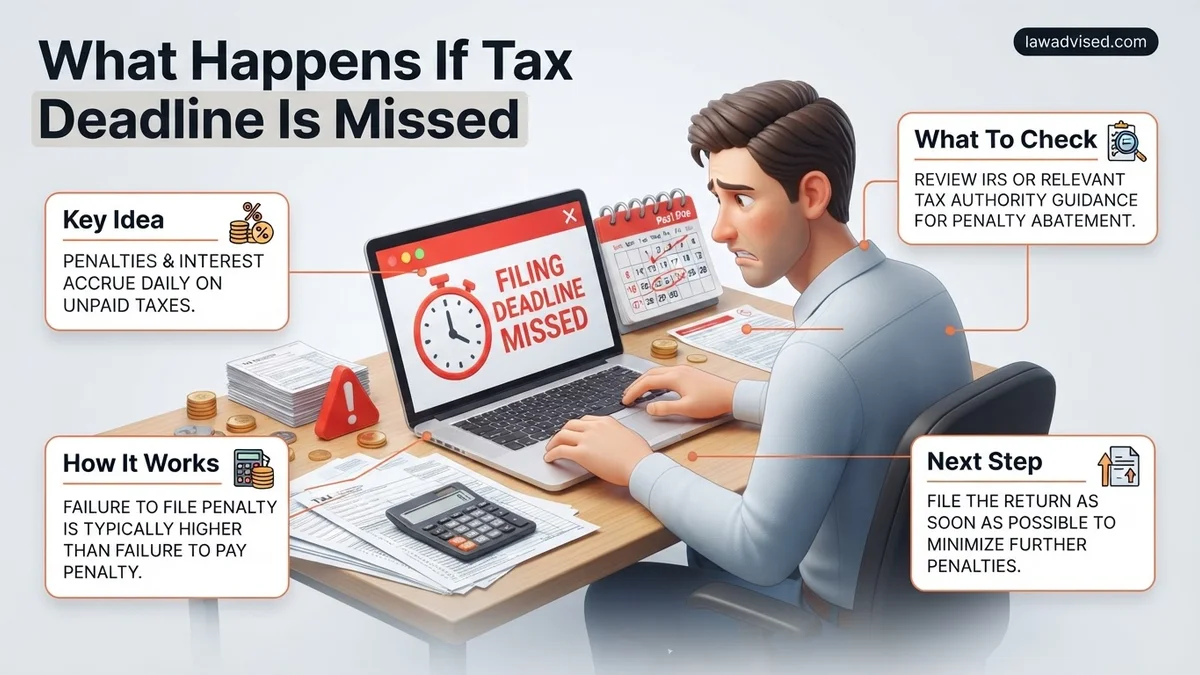
What Causes IRS Penalties When Tax Deadlines Are Missed
The IRS separates your punishment into two distinct categories: failing to file your paperwork on time, and failing to pay your actual tax liability. Understanding how these penalties stack up is critical for minimizing your financial damage in 2026.
The Failure-to-File Penalty (The Expensive Mistake)
Never make the mistake of hiding from the IRS just because you cannot afford to pay your taxes. The failure-to-file penalty is the most punishing charge the agency levies, costing you 5 percent of your unpaid taxes for each month your return is late.
- This penalty maxes out quickly at 25 percent of your total unpaid tax burden.
- If you file your return more than 60 days past the due date, the minimum penalty in 2026 is $510 or 100 percent of the tax due, whichever is smaller.
- Even if you have zero dollars to send the government, filing on time completely eliminates this massive fee.
The Failure-to-Pay Penalty and Interest Charges
If you filed your return on time but missed the payment deadline, or if you missed both, a separate fee applies. The failure-to-pay penalty is much cheaper, charging just 0.5 percent of your unpaid taxes per month.
- Interest compounds daily on both the unpaid taxes and the accumulated penalties until your balance hits zero.
- When both penalties apply in the same month, the failure-to-file penalty is reduced by the failure-to-pay amount, making the combined rate 5 percent per month.
- For example, if you owe $3,000 in unpaid 2026 taxes, your combined monthly penalties and growing interest will quickly add hundreds of dollars to your debt.
How to Fix a Late Tax Return Step-by-Step
Realizing you missed the deadline is stressful, but paralysis will only cost you more money. You need to execute an immediate damage control strategy to halt penalty accrual.
Step 1: File Your Return Immediately
Your absolute top priority is getting your completed tax return into the hands of the IRS, whether through electronic filing software or via mail. Every day you delay adds another fraction of a percent to your failure-to-file penalty.
- Use IRS Free File or commercial tax software to submit your return electronically as soon as possible.
- If you are missing a specific document like a W-2 or 1099, do not wait. Estimate the figures if necessary, or file an extension if the original deadline has not actually passed.
- Electronic filing provides an instant timestamp proving you stopped the clock on late-filing fees.
Step 2: Pay as Much as Possible Right Now
Even if you cannot cover your full tax liability, send every dollar you can scrape together to the IRS today. Reducing your principal balance immediately lowers the base amount upon which future penalties and daily interest are calculated.
- Use IRS Direct Pay online to make a same-day transfer straight from your checking or savings account for free.
- If you cannot pay the remaining balance, do not panic. File your return anyway and apply for a short-term payment plan or an installment agreement.
- Setting up a formal payment plan reduces the failure-to-pay penalty rate from 0.5 percent to 0.25 percent per month while you clear your debt.
How to Minimize Penalties and Request IRS Relief
If you missed the 2026 tax deadline, acting quickly is essential to stop compounding charges. The IRS offers specific administrative relief programs for taxpayers who have a history of compliant filing. Taking immediate corrective steps can significantly reduce your financial exposure.
First-Time Abate Penalty Relief
Taxpayers with a clean compliance record can often eliminate late-filing and late-payment penalties entirely through the IRS First-Time Abate (FTA) program. To qualify, you must meet strict statutory criteria established by tax authorities:
- You did not have to file penalties for the preceding three tax years.
- You have filed all currently required returns or filed a valid extension for 2026.
- You have paid or arranged to pay any tax currently due.
Reasonable Cause Exceptions
If you do not qualify for First-Time Abate, you may request relief based on reasonable cause. According to the IRS Policy Statement 5-133, penalties are waived if you exercised ordinary business care and prudence but were unable to file or pay due to exceptional circumstances. Acceptable grounds include serious illness, natural disasters, or the destruction of records. Documentation supporting the event must be submitted directly with a written request for abatement.
What If You Still Can’t Pay Your Tax Bill
Missing the deadline and owing money creates a dual problem of unfiled returns and unpaid balances. Failing to pay incurs an additional failure-to-pay penalty of 0.5 percent of your unpaid taxes per month. If you cannot afford your 2026 liability, structured payment options remain available.
Establish an Installment Agreement
An IRS installment agreement allows you to pay your tax liability over an extended timeframe, typically up to 72 months. Setting up a formal payment plan online reduces the failure-to-pay penalty rate to 0.25 percent per month while the agreement is active. Taxpayers owing less than $50,000 in combined tax, penalties, and interest can apply online through the IRS website without submitting detailed financial statements.
Offer in Compromise Programs
For individuals facing severe financial hardship, an Offer in Compromise (OIC) permits settling tax debt for less than the full amount owed. The IRS evaluates the taxpayer’s ability to pay, income, expenses, and asset equity. Acceptance rates depend entirely on proving that the total liability cannot be collected in full without causing economic destitution.
What If It Still Doesn’t Work?
If automated IRS portals reject your payment plan or you cannot resolve severe penalty notices independently, additional intervention strategies are required. When standard digital solutions fail, consider these targeted fallback steps:
- Contact the IRS Direct Phone Support: Speak with a customer service representative at 1-800-829-1040 to request a temporary hold on collection actions while your account is under manual review.
- Engage a Licensed Tax Professional: Hire a Certified Public Accountant (CPA), Enrolled Agent (EA), or tax attorney. According to industry data, professional representation for complex collection defenses typically ranges from $1,500 to $4,000 depending on the case severity.
- Consult a Low Income Taxpayer Clinic (LITC): Taxpayers meeting specific income thresholds can access free or low-cost representation through federally funded LITCs, which operate independently to assist individuals in disputes with the IRS.
- Request a Collection Due Process Hearing: File Form 12153 within 30 days of receiving a final notice of intent to levy, halting collection actions and granting rights to administrative review before the U.S. Tax Court.
Conclusion
Missing the tax deadline creates compounding financial penalties, but proactive measures can drastically limit the damage. Submitting overdue returns immediately stops further accumulation of late-filing fees, while statutory relief programs provide pathways to reduce or restructure debt. According to verified research and expert tax sources, addressing IRS notices promptly prevents aggressive collection actions like wage garnishments and property liens. Take the actionable step today of filing your past-due return or establishing an approved payment agreement to restore full compliance.
❓ Frequently Asked Questions
What is the penalty for filing my taxes late?
The failure-to-file penalty is typically 5% of the unpaid taxes for each month or part of a month that the return is late, capping out at 25%.
How much is the penalty for paying late?
The failure-to-pay penalty is much lower, generally charging 0.5% of your unpaid taxes per month, also capping at 25%.
What happens if I both fail to file and fail to pay on time?
If both penalties apply in the same month, the failure-to-file penalty is reduced by the failure-to-pay penalty amount, bringing the combined rate to 5% per month.
Can I qualify for a first-time penalty abatement?
Yes, if you have a clean compliance history for the past three tax years, you may be eligible to request a first-time penalty abatement from the IRS.
How long do I have to file and still claim a refund?
You have a three-year window from the original filing deadline to file a return and claim any tax refund owed to you before the money becomes government property.
Will missing the tax deadline trigger an IRS audit?
Simply missing a deadline does not automatically trigger an audit, but it does flag your account for automated penalty assessments and collection notices.

Ismail Hossain is the founder of Law Advised. He is an Divorce, Separation, marriage lawyer. Follow him.