Filing Status After Divorce Expert Guide for 2026
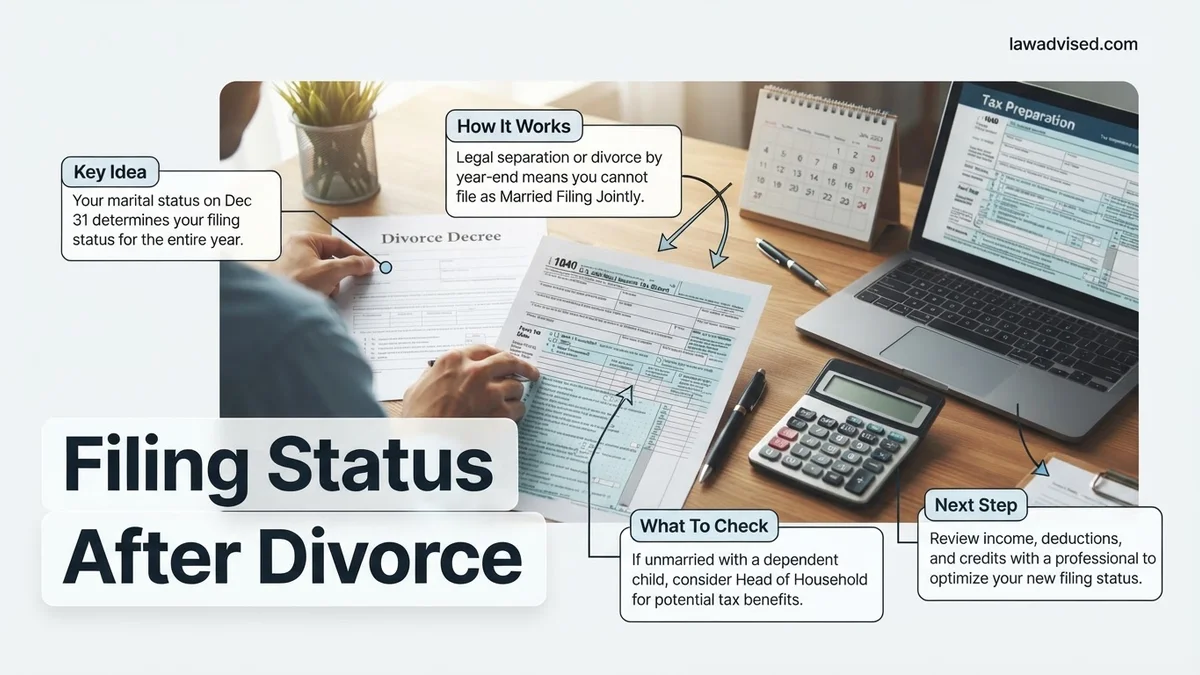
Your IRS filing status after divorce is determined entirely by your legal marital status on the last day of the tax year (December 31). If your divorce is finalized by December 31, the IRS considers you unmarried for the entire year, defaulting you to Single unless you qualify for Head of Household.
Your correct IRS filing status after a divorce depends entirely on a single milestone: the final legal date of your divorce decree. If your divorce is finalized by December 31, 2026, the IRS treats you as unmarried for the entire 2026 tax year, making your default filing status Single unless you qualify for Head of Household.
Getting this right immediately impacts your tax bracket, standard deduction amount, and overall liability. Filing under the wrong status triggers IRS processing delays, mathematical adjustments, or mandatory audits that complicate your post-divorce financial transition.
Key Takeaways
- Your marital status on December 31 dictates your tax filing status for the entire year.
- A divorce finalized on January 2 means you must file as Married Filing Separately for that tax year.
- Filing as Head of Household requires a qualifying dependent and paying over half of home upkeep costs.
- Legal separation alone does not qualify you to file as Single or Head of Household.
- Check your state laws and final decree dates carefully before submitting your tax return.
What Causes Tax Confusion Over Filing Status After Divorce
The December 31 Rule Trap
Many newly separated individuals assume their filing status changes the moment they move out, sign a separation agreement, or file court papers. The IRS operates under a strict calendar-year timeline. If your state court judge does not sign your final divorce decree by 11:59 PM on December 31, 2026, the IRS still considers you legally married for the 2026 tax year.
- Physical separation does not change your IRS status.
- Living apart for all twelve months of 2026 still leaves Married Filing Separately as your only alternative if the divorce isn’t final.
- State laws dictate when a divorce is officially final, not when you stopped living together.
Transitioning from Married to Unmarried Status
Shifting from joint finances to an individual tax return creates widespread confusion about income splitting and deduction allocation. When you file as Single in 2026, you can no longer combine your income with your ex-spouse, and you lose access to the higher Married Filing Jointly standard deduction.
- The 2026 standard deduction for a Single filer is significantly lower than the joint threshold.
- You must report only your individual earned income, investment yields, and retirement distributions.
- Dividing marital assets during the year generally does not create taxable income, but future earnings from those assets do.
How to Determine Your Correct IRS Filing Status Step-by-Step
Checking Your Final Decree Date
Your first step for the 2026 tax season is locating your official court-stamped divorce judgment. Look directly at the date the judge signed the final decree. If that date falls on or before December 31, 2026, your baseline filing status is Single.
- Pull your physical or digital copy of the final judgment of dissolution of marriage.
- Verify the timestamp on the court clerk file mark.
- Confirm no pending appeals or stays delay the finality of the ruling under state law.
Evaluating Head of Household Eligibility
If you are unmarried as of December 31, 2026, do not automatically default to the Single status. Check if you qualify for Head of Household, which offers a higher standard deduction and more favorable tax brackets than filing Single.
- You must pay more than half the cost of keeping up your home for the year.
- A qualifying dependent, such as your child, must live with you for more than half of 2026.
- You must be considered unmarried for tax purposes, meaning your ex-spouse did not live in your home for the last six months of the year.
How to Fix Incorrect Filing Status Errors on Your Return
Filing errors related to marital status can trigger IRS automated matching notices or trigger an audit. According to tax administration data, identity and status mismatches are among the leading causes of processing delays for newly separated taxpayers. If you realize you submitted your return with the wrong filing status for 2026, swift correction is necessary.
Submitting an IRS Form 1040-X
You cannot simply file a second original return to correct a status error. Instead, you must submit an amended return.
- Obtain Form 1040-X (Amended U.S. Individual Income Tax Return) for the appropriate tax year.
- Recalculate your income, deductions, and tax liability using your correct post-divorce filing status.
- Attach all supporting tax schedules and newly required forms, such as Form 8332 if dependents were reassigned by your decree.
- Mail the completed paper form to the designated IRS processing center or submit it electronically if your chosen software platform supports 2026 electronic amendments.
What If Your Divorce Decree Date Falls Near Year-End
The exact date your divorce judgment is finalized dictates your legal filing status for the entire tax year. Under IRS rules, if your final decree is signed by a judge on or before December 31, 2026, you are considered unmarried for the entire 2026 tax year. This rule catches many taxpayers off guard who spent the majority of the year separated.
Handling Borderline Timeline Scenarios
Delays in court docketing can alter your tax strategy significantly. If your final hearing occurs in late December, but the clerk does not enter the judgment until January 2027, your 2026 status defaults to Married Filing Separately.
- Verify the official stamp date on the court decree, not the date of the final settlement agreement or oral ruling.
- Consult your family law attorney immediately if a year-end judgment is stalled to request an expedited entry of judgment.
- Coordinate with your ex-spouse early if you are forced to file as Married Filing Separately for 2026, ensuring neither party claims conflicting exemptions.
What If It Still Doesn’t Work?
If your amended return is rejected, or if you and your ex-spouse disagree on exemption claims and filing statuses, standard software solutions will no longer suffice. When complex disputes stall your tax processing, expert intervention is required to resolve the discrepancy with the IRS.
- Gather all court documents, temporary orders, and the final stamped divorce decree to establish an unassailable timeline.
- Engage a Certified Public Accountant (CPA) or a Certified Divorce Financial Analyst (CDFA) specializing in post-marital tax compliance. Professional fees for resolving filing status audits typically range from $300 to $1,500 depending on complexity.
- Request formal IRS audit reconsideration if a math error or status mismatch notice has already resulted in an assessed tax deficiency.
- Contact the Taxpayer Advocate Service (TAS) if processing delays related to your marital status dispute cause severe financial hardship.
Conclusion
Navigating your filing status after divorce requires precise timing and strict adherence to IRS guidelines based on your December 31 marital status. Filing under the incorrect status can lead to prolonged processing delays, recalculation of tax liabilities, and potential audits. According to verified research and tax experts, proactive communication with the IRS and timely amendments minimize financial penalties. Take your actionable next step today by reviewing your final decree date and confirming your 2026 tax software inputs match federal guidelines.
❓ Frequently Asked Questions
How does the IRS ‘snapshot date’ rule impact my taxes after a divorce?
The IRS determines your tax filing status based on your legal marital status on December 31. If your divorce is finalized by this date, you cannot file jointly and must use an unmarried status for the entire 12-month period.
What happens if my divorce decree is finalized in January instead of December?
If the judge signs your final divorce judgment in January, you remain legally married for the entire previous tax year. Your filing options for that year will be limited to Married Filing Jointly or Married Filing Separately.
What exact criteria must I meet to file as Head of Household?
To use the Head of Household status, you must have paid more than half the costs of maintaining your home for the year, you must have been considered unmarried on the last day of the year, and a qualifying dependent must have lived with you for more than half the year.
Can I claim Head of Household if I have shared custody of my child?
Yes, if you are the custodial parent (the child lived with you for the greater part of the year) and you meet the financial support and marital status requirements, you may qualify even if your ex-spouse claims the child for the dependency exemption.
How does a legal separation agreement impact my filing options?
Under IRS rules, individuals living apart under a separation maintenance decree or legal separation agreement are still considered married unless a final decree of divorce or separate maintenance has been entered.
What should I do if I accidentally filed using the wrong marital status?
If you realize you filed under the wrong status, you must file an amended tax return (Form 1040-X) to correct your filing status, which may change your tax liability or refund amount.

Ismail Hossain is the founder of Law Advised. He is an Divorce, Separation, marriage lawyer. Follow him.