How Long Should Tax Records Be Kept A 2026 Expert Guide
Most taxpayers must keep their tax returns and supporting documents for at least three years from the date of filing. However, depending on your specific financial situation, underreported income, or property ownership, you may need to hold onto these records for six years or even indefinitely.
Under IRS guidelines, you generally need to keep your tax records for three years from the date you filed your return or the original due date. However, standard rules do not apply to every situation. Depending on your financial history and life events in 2026, you may need to hold onto your documents for six years, seven years, or even indefinitely.
Keeping these documents isn’t just about avoiding IRS penalties. Having your historical tax returns and W-2s readily available makes it much easier to secure a mortgage, apply for federal student aid, or resolve unexpected discrepancies. Let’s look at the exact timelines you need to follow.
Key Takeaways
- Keep standard tax returns and W-2s for three years after filing.
- Hold records for six years if you underreported income by more than 25 percent.
- Keep asset and property records until three years after selling the property.
- Retain records indefinitely if you filed a fraudulent return or failed to file.
- Securely digitize paper documents to save physical space while meeting IRS rules.
What Causes IRS Audit Triggers and Extended Record Retention Rules
The Standard Three-Year Rule and Why It Changes
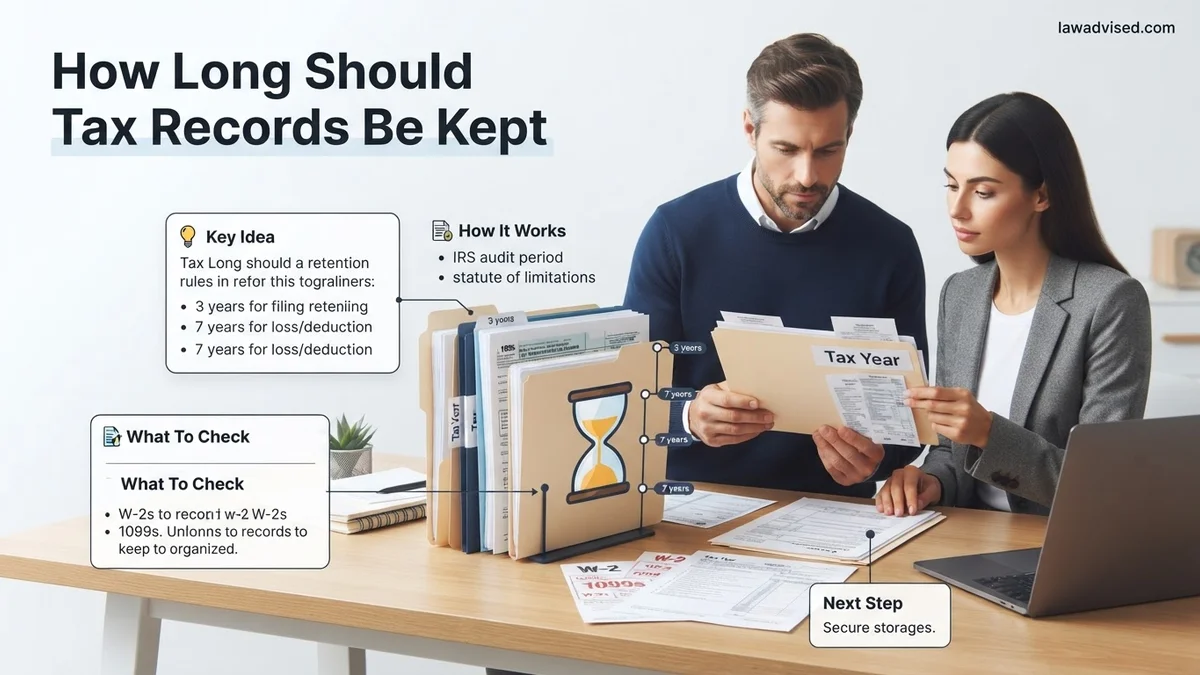
The baseline rule requires keeping returns and supporting documents for three years. This timeline applies if you filed your return on time and reported all your income. But the IRS can extend this window if certain red flags or complex financial situations arise.
- Filing a claim for a credit or refund: You must keep records for three years from the date you filed your original return or two years from the date you paid the tax, whichever is later.
- Filing a loss deduction: If you claimed a loss from worthless securities or bad debt deduction, you need to keep those specific records for seven years.
Income Omissions and Fraud Investigations
If you accidentally leave out a significant chunk of income on your return, the IRS gets more time to audit you. This changes your retention schedule instantly.
- The Six-Year Rule for Underreported Income: If you fail to report more than 25 percent of the gross income shown on your return, the IRS extends the audit period to six years. You must keep your tax records for that entire duration.
- Fraud and Non-Filing: If you commit tax fraud or fail to file a tax return entirely, there is no statute of limitations. The IRS can audit you at any time, meaning you should keep those records indefinitely.
Step-by-Step Guide to Calculating How Long Should Tax Records Be Kept
Evaluating Your Personal Return and Supporting Documents
To figure out your exact retention schedule for 2026, you need to review your filing dates and document types carefully. Follow these steps to map out your archive.
- Locate your official filing date: Find the exact date your tax return was accepted by the IRS, not just the date you drafted it.
- Check your income thresholds: Verify that you reported 100 percent of your taxable income to ensure you fall under the standard three-year rule instead of the six-year rule.
- Identify special asset documents: Separate any records related to real estate, investments, or business equipment, as these follow entirely different timelines based on when you dispose of the property.
Handling Property, Assets, and Employment Taxes
Some documents outlive the standard tax return windows because they impact future tax years when you sell or liquidate assets.
- Real Estate and Investments: Keep purchase receipts, improvement costs, and basis records until three years after you sell or dispose of the property. The IRS needs these to calculate your capital gains tax accurately.
- Employment Taxes: If you run a business or employ household help, you must keep all employment tax records for at least four years after the date the tax becomes due or is paid.
- W-2s and 1099s: Always keep these income verification forms attached to your tax return documents for the full duration of the primary retention period.
How to Fix Clutter and Securely Archive Tax Documents Digitally
Transitioning from a chaotic paper filing system to a streamlined digital archive protects your financial history heading into 2026. According to cybersecurity standards established by the National Institute of Standards and Technology (NIST), physical document digitization requires rigorous security protocols to prevent identity theft. Furthermore, the IRS officially accepts digital copies of tax records as long as they are exact replicas of the original documents and remain easily accessible.
Step-by-Step Digital Archiving Protocol
- Invest in a high-speed duplex scanner: Utilize a dedicated document scanner capable of processing at least 25 pages per minute to handle multi-page W-2s, 1099s, and receipts efficiently.
- Establish a standardized naming convention: Rename every digital file using a clear structure, such as “2025_Form1040_LastName” or “2025_Receipts_BusinessExpenses,” to ensure rapid retrieval during an audit.
- Implement the 3-2-1 backup rule: Maintain three total copies of your tax data across two different media types, with at least one copy stored securely off-site in an encrypted cloud repository.
- Apply military-grade encryption: Protect your master tax archive folder using AES-256 bit encryption software, ensuring unauthorized individuals cannot access your Social Security numbers and bank details.
What If It Still Doesn’t Work and You Lost Your Tax Records?
Realizing your essential tax documents are missing can trigger immediate anxiety, especially if an IRS notice arrives. Fortunately, several reliable fallback procedures exist to recover missing paperwork for the 2026 tax season.
- Request IRS transcripts online: Access the IRS “Get Transcript” portal to download tax return transcripts and wage-and-income transcripts covering up to the past ten years at no charge.
- Contact your employers and financial institutions: Reach out directly to human resources departments for missing W-2s or banks and brokerages for historical 1099 statements.
- Hire a certified public accountant (CPA) or Enrolled Agent (EA): If the IRS portals fail or your tax situation involves complex corporate filings, retain a licensed tax professional to interface directly with federal authorities on your behalf. Professional representation typically ranges from $200 to $500 per hour depending on complexity.
Conclusion
Retaining tax records for the appropriate duration—ranging from three years for standard filings to permanently for fraudulent or unfiled returns—is a critical component of sound financial management in 2026. Failing to maintain adequate documentation exposes taxpayers to prolonged audits, uncollected refunds, and severe financial penalties. According to verified research and expert sources from the American Institute of CPAs (AICPA), proactive digital archiving eliminates compliance risks and saves hours of administrative stress. Take action today by auditing your current document storage system and migrating all historical tax files into a secure, encrypted cloud repository.
❓ Frequently Asked Questions
How long should tax records be kept if I claimed a loss for worthless securities?
If you claimed a deduction for a bad debt or worthless security, the IRS requires you to keep those specific records for seven years from the date the return was due.
Are state tax record retention periods different from federal rules?
Most states align closely with the IRS three-year rule, but some states have a four-year or even five-year statute of limitations. Check your specific state department of revenue guidelines.
What supporting documents do I actually need to keep?
You should keep W-2s, 1099s, receipts, canceled checks, bank statements, charitable donation records, and any documentation supporting deductions or credits claimed on your return.
Can I throw away receipts once my refund has been deposited?
No, receiving your refund does not close the audit window. The IRS can still audit your return months or years later, so you must maintain your records through the full retention period.
How long should I keep home improvement and purchase records?
Keep records related to buying, improving, or selling a home for three years after the due date of the tax return for the year in which you sold the property to accurately calculate capital gains.
What is the best way to organize and store tax records long-term?
Use a scanner to create encrypted PDF files organized by tax year and category in a secure cloud storage service or external hard drive, while keeping physical copies in a fireproof safe.

Ismail Hossain is the founder of Law Advised. He is an Divorce, Separation, marriage lawyer. Follow him.