Qualified vs Ordinary Dividends Guide 2026 Tax Rules
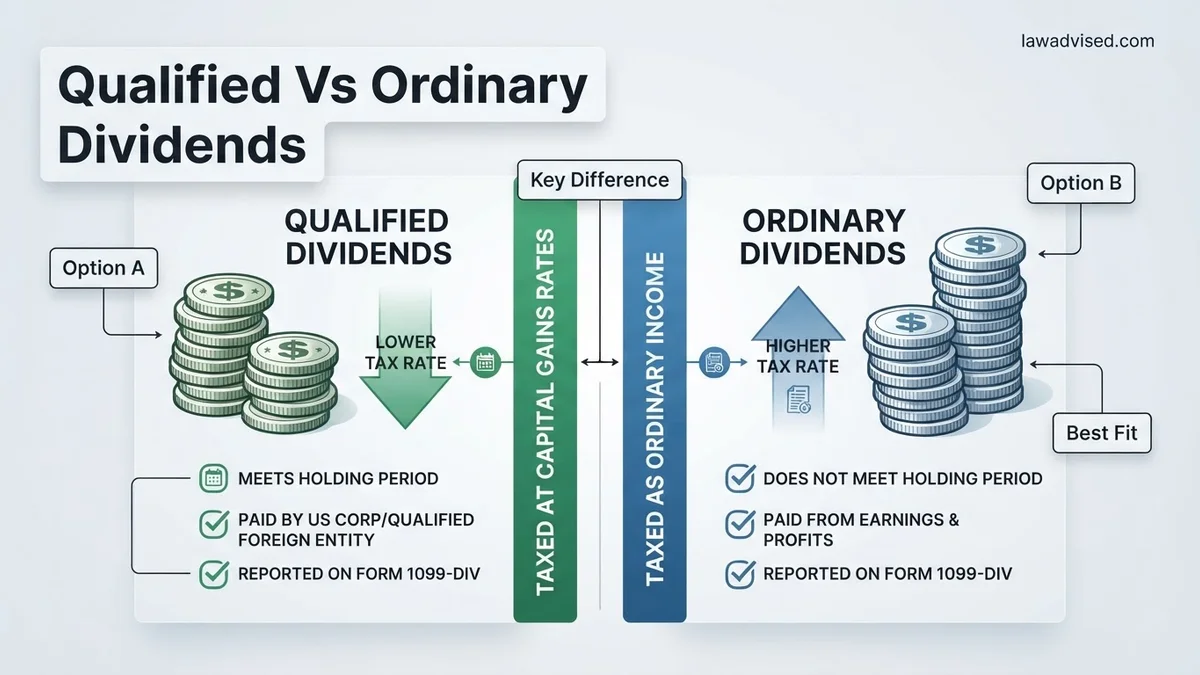
The main difference between qualified and ordinary dividends is how the IRS taxes them. Qualified dividends benefit from lower long-term capital gains tax rates, while ordinary dividends are taxed at higher standard income tax rates.
Dividend“>Qualified dividends are taxed at lower capital gains rates of 0%, 15%, or 20%, while ordinary dividends are taxed at your higher ordinary income tax rates, which can reach up to 37% for 2026. This tax classification fundamentally changes your net investment returns. A high earner holding ordinary dividend stocks could lose nearly double the tax amount on the exact same dollar payout compared to holding qualified dividend equities.
Maximizing your after-tax portfolio yield in 2026 requires understanding this distinction. The IRS does not tax all shareholder payouts equally, and ignoring these rules can lead to an unexpected tax bill when filing your return.
Key Takeaways
- Qualified dividends are taxed at favorable long-term capital gains rates of 0%, 15%, or 20%.
- Ordinary dividends are taxed at your standard marginal income tax rate.
- You must meet a strict 60-day holding period requirement to qualify for lower rates.
- Form 1099-DIV clearly separates your ordinary and qualified dividend earnings.
- High-income earners may also face an additional 3.8% Net Investment Income Tax.
What Causes the Tax Difference Between Qualified and Ordinary Dividends
The Mechanism of IRS Tax Brackets
The Internal Revenue Service separates dividend income to encourage long-term investing over short-term trading. Ordinary dividends (also called non-qualified dividends) are taxed as standard income from wages, salaries, or short-term capital gains. Your specific tax bracket dictates the exact percentage you surrender to the government. Qualified dividends, however, benefit from the preferential long-term capital gains tax brackets.
For the 2026 tax year, these rates correlate directly with your taxable income thresholds:
- 0% rate: Applies to single filers with income up to approximately $48,350 (or $96,700 for married filing jointly).
- 15% rate: Applies to the vast majority of middle-to-upper-income earners falling between the 0% and 20% thresholds.
- 20% rate: Reserved for high-income earners exceeding approximately $533,400 for singles or $600,050 for joint filers.
The Real-World Financial Impact
Imagine you earn 10,000 dollars in dividend payouts while sitting in the 32% ordinary income tax bracket for 2026. If those payments are classified as ordinary dividends, you owe 3,200 dollars to the IRS. If those exact same payments meet the criteria for qualified dividends, your tax rate drops to 15%. You suddenly owe only 1,500 dollars, instantly keeping 1,700 dollars more in your brokerage account.
This massive variance alters how you should structure your taxable versus tax-advantaged accounts. High-yield ordinary dividend payers like REITs or certain business development companies often belong inside an IRA or 401k where the immediate tax penalty is neutralized.
How to Determine IRS Qualification and Meet Holding Period Rules
The Critical 60-Day Holding Period Requirement
You cannot simply buy a stock the day before a dividend is declared and qualify for the lower tax rate. The IRS enforces strict holding period rules to prevent dividend capture strategies. To make a dividend qualified, you must hold the underlying stock for more than 60 days during a specific 121-day window.
This measurement window begins 60 days before the ex-dividend date and ends 60 days after it. If you sell the stock before clearing this timeline, the payout reverts to an ordinary dividend.
- Standard equities: Must be held for more than 60 days within the 121-day risk window.
- Preferred stock: Subject to a longer requirement of more than 90 days within a 181-day window if the dividends are in arrears.
- Risk of loss requirement: Days where you hold short positions or use certain hedging options typically do not count toward your holding period.
Corporate and Asset Class Restrictions
Beyond your personal holding timeline, the issuing entity itself determines qualification status. Most stocks trading on major U.S. exchanges automatically qualify. Foreign corporations can also qualify if they reside in a country with a comprehensive tax treaty with the United States, or if the stock is readily tradable on an established U.S. securities market.
Certain investment vehicles are strictly excluded from generating qualified dividends, regardless of how long you hold them:
- Real Estate Investment Trusts (REITs) typically pay ordinary income.
- Master Limited Partnerships (MLPs) distribute income that follows complex K-1 tax rules.
- Money market accounts, savings accounts, and certain employer-sponsored stock options generate interest or ordinary income, not qualified dividends.
Step-by-Step Guide to Reporting Dividends on Form 1099-DIV
Accurately reporting your dividend income on your 2026 tax return requires careful transcription from your brokerage-issued Form 1099-DIV. Brokerages issue this document by mid-February following the close of the tax year. Following a strict procedural workflow prevents calculation errors and ensures you pay the correct preferential tax rate.
Locating Ordinary and Qualified Amounts
Box 1a of Form 1099-DIV lists your total ordinary dividends, while Box 1b isolates the portion of those dividends that qualify for lower capital gains tax rates. According to Internal Revenue Service instructions, you must report both figures regardless of whether your total taxable income falls below the threshold for owing tax.
Entering Data Into Tax Software
- Navigate to the income section of your tax preparation software and select the subsection for investment income or Form 1099-DIV.
- Enter the Payer’s Federal Identification Number and name exactly as printed in the top left corner of the physical or digital 1099-DIV.
- Input the exact dollar amount from Box 1a (Ordinary Dividends) into the corresponding software prompt.
- Input the exact dollar amount from Box 1b (Qualified Dividends) into the designated field, noting that this figure can never exceed the amount entered in Box 1a.
- Review the summary page to verify that the software automatically applies the 0%, 15%, or 20% tax rate to your qualified dividend entry based on your projected 2026 tax bracket.
What If Your Dividends Are Misclassified on Your Tax Forms
Brokerage houses occasionally misclassify ordinary dividends as qualified, or vice versa, due to recalculations or missed holding period tracking. Realizing this discrepancy after tax documents arrive demands immediate administrative action to avoid paying excess taxes or triggering a mismatch notice from the IRS.
Corrective Actions for Discrepancies
- Verify your transaction history to ensure you met the required holding period of more than 60 days during the 121-day window surrounding the ex-dividend date.
- Contact your brokerage firm’s customer service department immediately to request a corrected tax document, known as a corrected Form 1099-DIV.
- Wait for the brokerage to issue the corrected form, which typically takes between 7 and 14 business days during the peak of the tax filing season.
- Consult a certified public accountant or enrolled agent if the brokerage refuses to issue a correction and the tax impact exceeds five hundred dollars. Professional tax preparation fees for handling complex asset restatements typically range from $300 to $850 depending on the volume of trades.
What If It Still Doesn’t Work?
If automated imports repeatedly fail, or your brokerage refuses to adjust a disputed dividend classification, structured fallback procedures protect your filing status.
- Attach a detailed statement of explanation to your paper tax return, or utilize the digital explanatory attachment feature if filing electronically.
- Manually override the tax software calculation using the verified figures from your trade confirmation records and monthly statements.
- File for an automatic six-month tax extension using IRS Form 4868 before the April deadline if corrected brokerage documentation remains delayed past mid-March.
- Engage a licensed tax professional or CPA to formally reconcile complex foreign dividend or Real Estate Investment Trust reclassifications. Professional advisory fees for advanced corporate tax resolution generally range from $400 to $1,200.
Conclusion
Understanding the distinction between qualified and ordinary dividends ensures you never overpay taxes on your investment income. The fundamental fix involves verifying your holding periods, reviewing Box 1a and Box 1b of your 1099-DIV, and applying the correct preferential rates. According to verified research and expert financial sources from the American Institute of Certified Public Accountants, proactive portfolio tracking prevents costly classification errors during tax season. One actionable next step is to log into your brokerage portal today to download your preliminary 2026 dividend summary and verify your year-to-date holding periods.
❓ Frequently Asked Questions
What exactly makes a dividend ‘qualified’ in the eyes of the IRS?
To be qualified, a dividend must be paid by a U.S. corporation or a qualified foreign corporation, and you must satisfy the mandatory holding period requirements for the underlying stock.
How does the holding period calculation actually work?
The holding period must span more than 60 days within a 121-day period that starts 60 days before the stock goes ex-dividend. Days in which you are protected from risk of loss are typically excluded from this count.
Are foreign corporation dividends eligible for qualified status?
Yes, if the foreign corporation is incorporated in a U.S. possession, is eligible for benefits under a comprehensive U.S. income tax treaty, or the stock is readily tradable on an established U.S. securities market.
What tax form reports qualified vs ordinary dividends?
Your broker will issue Form 1099-DIV at the end of the year. Box 1a shows total ordinary dividends, while Box 1b specifically details the subset of those that are qualified.
Do state taxes differentiate between qualified and ordinary dividends?
State tax treatment varies significantly. While the federal government offers preferential rates for qualified dividends, many states tax all dividend income at standard state income tax rates.
Can mutual funds and ETFs distribute qualified dividends?
Yes, mutual funds and ETFs pass through qualified dividends to shareholders, provided the fund itself met the necessary holding period requirements for the underlying portfolio stocks.

Ismail Hossain is the founder of Law Advised. He is an Divorce, Separation, marriage lawyer. Follow him.