
How Much Income Tax Do Americans Pay in 2026 Real Data
Americans pay federal income taxes that vary drastically based on income percentiles and effective tax rates rather than just marginal brackets. The average effective federal income tax rate sits significantly lower than top statutory brackets, while payroll and state taxes add substantially to the total burden. Examining real IRS data reveals the true distribution of tax payments across the United States.
The average American federal income tax burden varies dramatically based on earnings, with the typical full-time worker paying an effective rate between 10% and 15%. According to the latest IRS data projecting into 2026, the bottom half of all wage earners pay an average effective tax rate of roughly 3.5%, while the top 1% of earners shoulder an average effective rate exceeding 25%.
Knowing these figures helps you evaluate your own tax situation against national benchmarks. Whether you are planning your 2026 finances or simply curious about where your tax dollars go, looking past political rhetoric at hard IRS data reveals the true cost of funding the federal government.
Key Takeaways
- The top 50% of earners pay the vast majority of all federal income taxes.
- Effective tax rates differ greatly from official marginal tax brackets.
- Payroll taxes like FICA apply flat rates up to specific wage caps.
- Lower-income brackets often have a zero or negative federal income tax liability.
- State and local taxes significantly increase the total American tax burden.
What Causes Variations in How Much Income Tax Americans Pay
The Impact of Graduated Tax Brackets
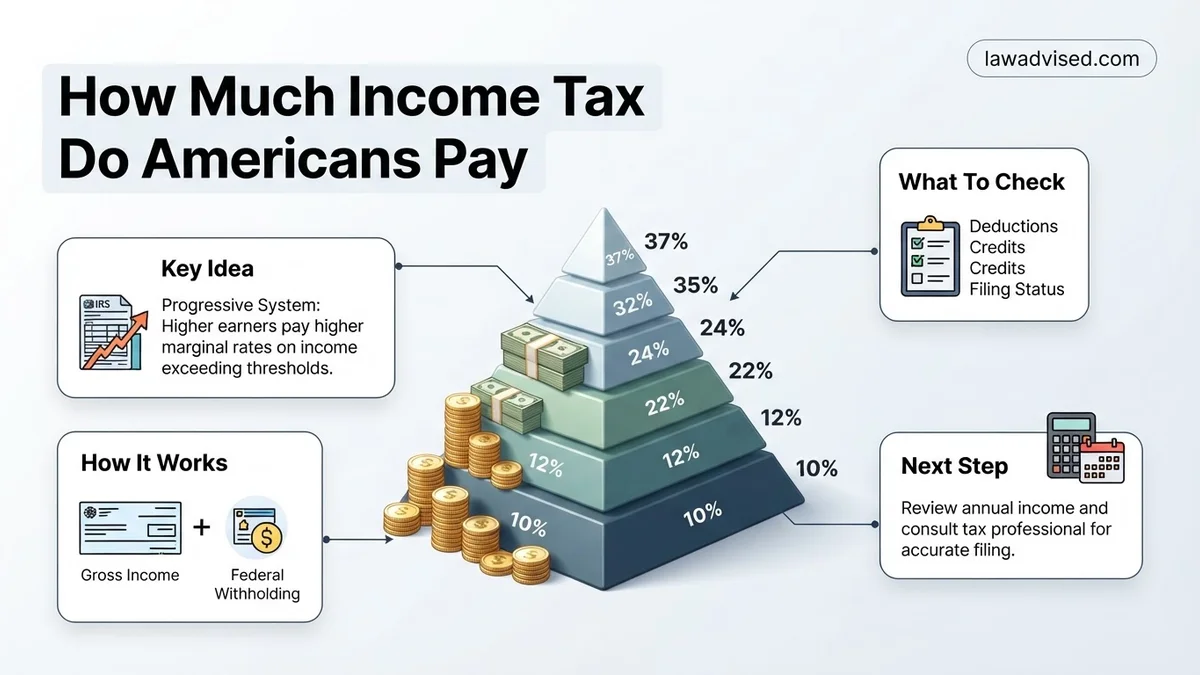
The United States uses a progressive tax system. This means your income is taxed in slices, or brackets, rather than at a single flat rate. As you earn more money, each new slice of income is taxed at a progressively higher percentage. For 2026, federal income tax brackets range from 10% for the lowest earners up to 37% for top earners. However, entering a higher bracket never means all your income is taxed at that rate.
Deductions, Exemptions, and Credits
Your final tax bill depends heavily on structural reductions that lower your taxable income. The standard deduction, which adjusts annually for inflation, shields a large portion of your earnings from taxation entirely. When you factor in common tax credits like the Child Tax Credit, many middle- and lower-income households see their net federal income tax liability drop close to zero or even turn negative.
- Standard Deduction: Shields the first baseline dollars you earn from federal income tax.
- Adjusted Gross Income (AGI): The starting point for calculations after specific deductions like retirement contributions.
- Tax Credits: Dollar-for-dollar reductions in your actual tax liability, carrying more weight than deductions.
2026 Income Taxing Mechanics: Your Essential Action Plan
Navigating the American tax system can feel like trying to solve a puzzle blindfolded. Because the United States uses a progressive tax structure combined with various deductions, credits, and state-level requirements, the exact amount an American pays depends heavily on individual circumstances. This comprehensive guide will take you through the exact methodology of calculating American income tax, ensuring you understand how brackets, filing statuses, and deductions interact to determine your final tax liability.
Step 1: Determine Your Filing Status
What you need: Your current marital status, household details, and the IRS Form 1040 instructions.
Instructions: Before you can figure out how much tax you owe, you must establish your legal filing status for the tax year. The IRS recognizes five distinct statuses: Single, Married Filing Jointly, Married Filing Separately, Head of Household, and Qualifying Surviving Spouse. Your status directly dictates your standard deduction amount and the tax brackets applied to your income. For example, a single filer has a different threshold than someone filing as Head of Household with a dependent. Review your life events on December 31 of the tax year; that snapshot determines your filing status for the entire year.
Pro Tip: If you are an unmarried parent paying more than half the cost of keeping up a home for a qualifying dependent, always check if you qualify for Head of Household. It offers a higher standard deduction and wider tax brackets than filing as Single.
Step 2: Calculate Your Gross Income
What you need: W-2 forms from employers, 1099 forms for freelance or contractor work, investment statements, and records of any other income sources.
Instructions: Gather all documents that report money paid to you over the calendar year. Gross income includes wages, salaries, tips, bonuses, unemployment compensation, business income, interest, dividends, and rental income. Sum all these revenue streams together to find your total gross income. If you have a traditional job, your primary document will be Form W-2 (Box 1). If you run a side hustle or freelance, you will aggregate your 1099s and self-employment ledgers. Accuracy here is vital because this number forms the baseline of your entire tax calculation.
Pro Tip: Keep a digital or physical folder throughout the year specifically for tax documents so you do not scramble to find a missing 1099-NEC in February.
Step 3: Subtract Adjustments to Income (Above-the-Line Deductions)
What you need: Receipts and statements for student loan interest, traditional IRA contributions, Health Savings Account (HSA) contributions, and educator expenses.
Instructions: Once you have your gross income, you can subtract specific adjustments—often called “above-the-line” deductions—to arrive at your Adjusted Gross Income (AGI). These adjustments do not require you to itemize your deductions; anyone can claim them if they qualify. Common adjustments include up to $2,500 in student loan interest, contributions made to a traditional IRA, qualifying moving expenses for active-duty military, and self-employment tax deductions. Subtracting these expenses lowers your AGI, which in turn reduces the total income subject to taxation.
Pro Tip: Maximize your HSA or traditional IRA contributions before the tax filing deadline if your income allows; it is one of the easiest ways to immediately lower your AGI.
Step 4: Choose Between the Standard Deduction and Itemizing
What you need: Your AGI, receipts for charitable donations, mortgage interest statements (Form 1098), and records of high medical expenses or state and local taxes (SALT).
Instructions: After finding your AGI, you must subtract a further deduction to find your Taxable Income. You have two choices: take the government-set Standard Deduction (which adjusts annually for inflation and varies by filing status), or Itemize your deductions by listing every eligible personal expense. You should calculate both totals and choose the higher one. Most Americans take the standard deduction because it requires zero receipt tracking and yields a higher deduction. However, homeowners with large mortgages and significant charitable giving often benefit more from itemizing on Schedule A.
Pro Tip: Never guess which is higher. Do the math on Schedule A for itemized deductions, and if it falls short of the standard deduction threshold, save yourself the paperwork and take the standard.
Step 5: Apply the Progressive Federal Tax Brackets
What you need: Your final Taxable Income number and the official IRS federal income tax bracket tables for the specific tax year.
Instructions: Many people misunderstand tax brackets, believing that entering a higher bracket means all their money is taxed at that higher rate. The U.S. uses a progressive tax system. Your taxable income is sliced into chunks, and each chunk is taxed at a specific marginal rate (e.g., 10%, 12%, 22%, 24%, 32%, 35%, or 37%). For instance, if you are a single filer, the first portion of your income is taxed at 10%, the next portion at 12%, and so on. Match your taxable income against the bracket thresholds for your filing status to calculate your preliminary federal income tax liability.
Pro Tip: Earning a raise that pushes you into a higher tax bracket will never result in you taking home less money overall. Only the dollars inside that new bracket are taxed at the higher rate.
Step 6: Subtract Tax Credits to Lower Your Tax Bill
What you need: Records proving eligibility for credits such as the Child Tax Credit, Earned Income Tax Credit (EITC), or American Opportunity Tax Credit for education.
Instructions: Unlike deductions, which lower the amount of income subject to tax, tax credits provide a dollar-for-dollar reduction of your actual tax liability. For example, a $1,000 tax credit reduces your final tax bill by a full $1,000. Review the qualifications for major federal credits. Some credits are non-refundable (they can reduce your tax liability to zero, but any leftover amount is lost), while others are refundable (meaning if the credit exceeds your tax liability, the IRS sends you the remaining balance as a refund). Subtract your total qualifying credits from the tax liability calculated in Step 5.
Pro Tip: Always screen for education and family-related credits; missing out on the Child Tax Credit or EITC is one of the most common ways Americans overpay on their taxes.
Step 7: Factor in State and Local Income Taxes (FICA)
What you need: Your pay stubs showing Social Security and Medicare withholdings, plus state and local tax calculation guidelines.
Instructions: Federal income tax is only part of the equation. Every working American also pays Federal Insurance Contributions Act (FICA) taxes, which consist of 6.2% for Social Security and 1.45% for Medicare (with an additional 0.9% for high earners). Furthermore, unless you live in a state with no income tax (like Texas, Florida, or Nevada), you must also calculate and pay state income tax, which uses its own set of brackets and deductions. Some cities (like New York City) also levy a local municipal income tax. Add these obligations to your federal tax total to see your comprehensive tax burden.
Pro Tip: Self-employed individuals must pay both the employer and employee portions of FICA taxes through the Self-Employment Tax (Schedule SE), effectively doubling their FICA rate to 15.3% on net earnings.
Step 8: Compare Withholdings and File Your Return
What you need: Your final calculated tax burden, total federal/state taxes already withheld from your paychecks (found on W-2 Box 2), and tax filing software or a CPA.
Instructions: Throughout the year, your employer has been withholding income tax from your paychecks based on the Form W-4 you submitted. Alternatively, if you are self-employed, you likely made quarterly estimated tax payments. Compare your total tax liability (Federal + State + FICA) against the total amount you already paid via withholdings. If you paid more than you owed, you are entitled to a tax refund. If you paid less than you owed, you must send a payment to the IRS and state tax authority by the April filing deadline to avoid penalties and interest.
Pro Tip: Use the IRS Tax Withholding Estimator tool mid-year to adjust your W-4 if you find yourself owing too much or getting an excessively large refund annually.
✅ Final Checklist
- Verified your correct filing status for the tax year
- Aggregated all W-2s, 1099s, and alternative income sources
- Maximized above-the-line adjustments and compared standard vs. itemized deductions
- Applied progressive marginal tax brackets accurately to your taxable income
- Subtracted all eligible federal and state tax credits
- Calculated FICA, state, and local tax requirements
- Compared total tax liability against actual withholdings to determine if you owe or get a refund
Important Notes:
- Filing taxes accurately and on time is a legal requirement; missing deadlines incurs failure-to-file and failure-to-pay penalties.
- Seek the assistance of a Certified Public Accountant (CPA) or Enrolled Agent if you manage complex investments, run a multi-tiered business, or undergo an IRS audit.
- Tax rules change annually; always cross-reference calculations with the current IRS publications or reputable tax software for the active filing year.
How to Fix Misconceptions by Comparing Effective vs Marginal Tax Rates
Understanding Your Marginal Tax Rate
People often panic when they hear they have entered a 22% or 24% tax bracket, assuming that percentage applies to their entire paycheck. Your marginal tax rate is simply the tax rate applied to your very last dollar of taxable income. It is the ceiling for your current earnings tier, not a flat tax on your total livelihood.
The Reality of Effective Tax Rates
Your effective tax rate is the true percentage of your total income that you pay to the IRS. Because of the progressive bracket system and the standard deduction, your effective rate is almost always significantly lower than your marginal rate. If you fall into the 22% marginal bracket, your effective tax rate might actually hover closer to 10% or 12%.
- Marginal Rate: The tax rate you pay on your highest marginal dollar of income.
- Effective Rate: Your total tax paid divided by your total taxable income.
- The Blended Effect: Lower brackets pull your overall average percentage down substantially.
Step-by-Step Guide to Calculating Your Real Total Tax Burden
Determining your exact financial obligation in 2026 requires looking beyond federal brackets and incorporating payroll and state requirements. Follow this structured process to uncover your true total tax burden.
Step 1: Calculate Your Adjusted Gross Income
Begin by gathering your W-2s, 1099s, and investment statements for 2026. Subtract above-the-line deductions—such as traditional IRA contributions or student loan interest—from your total gross earnings to find your Adjusted Gross Income (AGI).
Step 2: Apply the Standard or Itemized Deductions
Subtract your chosen deduction from your AGI to determine your taxable income. For the 2026 tax year, single filers use a standard deduction projected at roughly $15,000, while married couples filing jointly look at approximately $30,000, adjusted for inflation by the IRS.
Step 3: Factor in Federal, State, and FICA Taxes
Apply the 2026 marginal federal tax brackets to your final taxable income. Next, add the mandatory 7.65% FICA tax for Social Security and Medicare. Finally, layer on your specific state and local income tax rates to reveal your aggregate tax burden.
What If Your Income Tax Bill Still Feels Too High
If your calculated tax burden exceeds your financial comfort level, targeted adjustments can lower your liability before the filing deadline. Implement these strategic steps to optimize your tax position.
- Maximize pre-tax retirement accounts by increasing 401(k) or 403(b) contributions to directly lower your taxable income.
- Utilize a Health Savings Account (HSA) if you are enrolled in a high-deductible health plan, capturing a triple tax advantage.
- Harvest investment losses in taxable brokerage accounts to offset capital gains and up to $3,000 of ordinary income.
- Consult a certified public accountant (CPA) or a federally authorized enrolled agent for complex scenarios, with professional preparation fees typically ranging from $300 to $1,000+ depending on complexity.
Conclusion
Navigating how much income tax Americans pay in 2026 requires looking past federal marginal brackets to account for state levies, FICA contributions, and standard deductions. According to verified research and economic data from the Tax Foundation and the IRS, understanding these compounding factors is essential for accurate financial planning. Your immediate next step is to pull your latest paystub or earnings statement and calculate your current effective tax rate using the steps outlined above.
❓ Frequently Asked Questions
How does the IRS calculate average income tax percentages?
The IRS calculates average income taxes by dividing total income tax paid by total adjusted gross income (AGI) grouped by specific percentile brackets.
What percentage of Americans pay zero federal income tax?
Roughly 40% of American households have no federal income tax liability after accounting for standard deductions and federal tax credits.
How much do state and local taxes add to the average American’s tax burden?
State and local income, sales, and property taxes typically add another 8% to 12% to an average worker’s total tax burden.
Do high-income earners pay a higher effective tax rate?
Yes, progressive tax brackets ensure that effective tax rates rise as an individual’s taxable income increases.
What is the maximum federal income tax bracket in 2026?
The top federal marginal income tax bracket is 37%, applying to individual income exceeding specified high-earner thresholds.
How do deductions lower the amount of income tax Americans pay?
Deductions reduce the total amount of adjusted gross income subject to taxation, directly lowering the final tax liability.

Ismail Hossain is the founder of Law Advised. He is an Divorce, Separation, marriage lawyer. Follow him.