Leash Laws in Arizona 2027 Real Rules and Local Guide
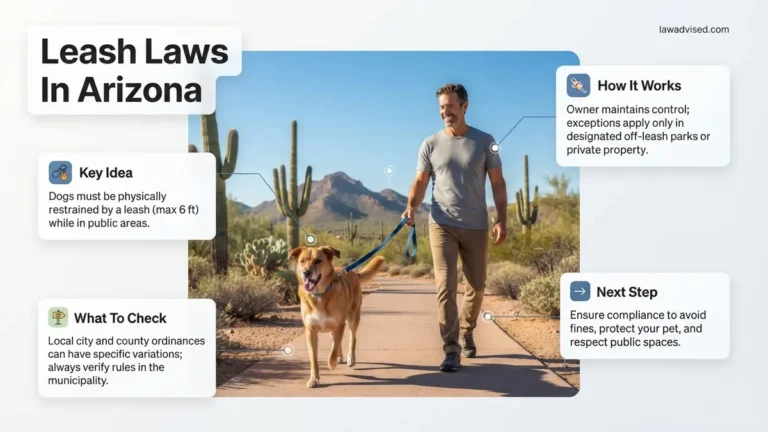
Arizona does not have a single statewide mandatory leash law, leaving regulations to individual counties and municipalities. Dog owners must navigate specific local ordinances that generally require pets to be restrained in public spaces to avoid hefty fines.
Arizona does not have a single, statewide mandatory leash law that applies uniformly across every acre of the Grand Canyon State. Instead, legal requirements are established at the county, city, and municipal levels, creating a patchwork of local ordinances that every pet owner must navigate carefully.
Whether you are walking your dog through a downtown Phoenix neighborhood or hiking a desert trail in 2027, knowing your exact local jurisdiction prevents costly citations and keeps your animal safe. Because enforcement and penalties vary significantly just by crossing a municipal boundary, you need to understand how these layered regulations actually work.
Key Takeaways
- Arizona relies on county and city ordinances rather than a strict statewide leash law.
- Maricopa County requires dogs to be restrained by a leash in all unincorporated public areas.
- Violating local animal control ordinances can result in expensive citations and municipal fines.
- Designated off-leash dog parks provide legal exceptions for unrestrained pets within fenced boundaries.
- Service animals and working dogs may have specific exemptions under state and federal guidelines.
What Causes Confusion Regarding Leash Laws in Arizona
The Myth of Statewide Legislation
Many new residents and visitors assume that states dictate uniform pet restraint rules. In Arizona, state statute primarily addresses livestock and rabies control, leaving the regulation of domestic dogs in public spaces entirely to local governments. This delegation is the primary source of confusion.
- State law sets baseline rabies vaccination requirements for all dogs over three months old.
- State statutes hold owners strictly liable for dog bites regardless of location.
- Actual physical restraint rules are delegated downward to counties, cities, and towns.
Conflicting Rules Between Cities and State Parks
Another major point of confusion stems from overlapping jurisdictions. A city park might allow off-leash areas under specific municipal codes, while a nearby county park or state trust land strictly enforces a six-foot maximum leash rule.
- City parks frequently feature designated fenced dog parks where leashes are optional.
- State parks and wildlife areas almost universally require physical leashes of six feet or less.
- Federal Bureau of Land Management (BLM) lands often require dogs to be under voice control or leashed depending on local nesting seasons.
How to Fix Compliance Risks by Checking Local Ordinances
Checking Maricopa, Pima, and Other County Rules
To eliminate compliance risks in 2027, you must identify your specific governing county. Maricopa County and Pima County enforce strict animal control codes that mandate physical restraint whenever a dog is off the owner’s private property.
- Maricopa County Animal Care and Control requires dogs to be restrained by a leash not exceeding six feet in public spaces.
- Pima County enforces similar county-wide leash mandates outside of designated off-leash dog parks.
- Unincorporated areas rely directly on county sheriff and animal control deputies for enforcement.
Navigating Specific Municipal Codes
County lines often blur into city limits, and municipal ordinances generally supersede county rules when they are more restrictive. You need to check the municipal code of the exact town you are visiting.
- Visit the official website of your city or town government.
- Search the municipal code for Title 6, which typically covers animals and fowl.
- Verify whether the city allows electronic collars or voice control as an alternative to physical leashes (note: very few Arizona municipalities permit voice control outside of designated dog parks).
Step-by-Step Guide to Navigating County and City Rules
Understanding leash laws in Arizona requires navigating a patchwork of overlapping county ordinances and municipal codes. Because rules shift drastically between state parks, federal Bureau of Land Management lands, and city sidewalks, dog owners must proactively verify local jurisdictions before heading out in 2027.
Step 1: Check Municipal Codes Before Traveling
Municipalities often enforce stricter regulations than their surrounding counties. For instance, while a county park might allow electronic collars under voice control, a specific city park may mandate a physical leash measuring no longer than six feet.
- Visit the official website of the specific city or town you plan to visit.
- Search the municipal code database for Chapter headings related to “Animals” or “At-Large Dogs.”
- Note specific leash length restrictions, which typically range from six to eight feet maximum.
Step 2: Verify Public Land Designations
Federal and state agencies manage vast portions of Arizona territory, each maintaining distinct pet policies. The Arizona State Parks system generally requires a physical leash of six feet or shorter at all times, while certain wilderness trails managed by the U.S. Forest Service permit voice control in remote areas.
- Consult the managing agency’s official portal—such as the National Park Service or Arizona State Parks—prior to departure.
- Identify designated off-leash zones or multi-use trails where dogs must remain tethered to protect local wildlife.
- Ensure you carry proper physical restraint gear even in voice-control areas, as park rangers can demand compliance at any time.
What If It Still Doesn’t Work and You Receive a Citation?
If you have already received an animal control citation or local fine for an alleged leash law violation in Arizona, standard informal appeals rarely resolve the matter. Verified legal guidelines and animal control protocols recommend a structured approach to resolve municipal infractions.
- Review the citation details carefully: Examine the exact municipal code violated, the stated time, and the geographic location. Errors in documentation can provide grounds for dismissal.
- Calculate potential financial impacts: Standard first-time leash violations in major Arizona counties typically incur civil fines ranging from $50 to $250, escalating sharply for subsequent offenses or if an un-leashed animal causes property damage or injury.
- Attend the administrative hearing: Do not ignore the notice. Appearing before the municipal hearing officer allows you to present mitigating evidence, such as improperly marked trail boundaries or signage issues.
- Seek professional legal representation: If the citation involves an animal bite or a dangerous dog declaration, consult an attorney specializing in Arizona animal law immediately. Legal defense fees for administrative hearings generally range from $500 to $1,500 depending on complexity.
Conclusion
Navigating Arizona leash laws in 2027 demands constant vigilance regarding where municipal, county, and federal boundaries intersect. Failing to secure your dog properly can trigger steep financial penalties and unnecessary legal stress. According to verified research and municipal enforcement data, proactive compliance and strict adherence to physical leash limits remain the most effective strategies for pet owners. Take the next step today by reviewing your local city animal control portal to ensure your gear and habits meet current standards.
❓ Frequently Asked Questions
Are there state-level statutes addressing stray or unrestrained dogs in Arizona?
While Arizona Revised Statutes govern overall rabies control and animal running at large liabilities, specific leash mandates are delegated entirely to local county boards of supervisors and city councils.
What are the specific leash requirements within Phoenix city limits?
Phoenix city code dictates that no dog shall be permitted to be at large on any public street, sidewalk, or park unless restrained by a solid leash held by a competent person.
How do Tucson and Pima County regulate dog leashes?
Pima County and Tucson ordinances require dogs to be securely restrained on a leash when off the owner’s property, except within designated off-leash recreation areas.
What happens if an unleashed dog causes property damage or injury in Arizona?
Arizona operates under strict liability statutes for dog bites, meaning owners of unleashed dogs can face severe civil and criminal liabilities if their pet injures someone.
Are hiking trails in Arizona state parks subject to leash laws?
Yes, almost all Arizona State Parks and National Parks require dogs to be kept on a physical leash, typically no longer than six feet, to protect local wildlife and trail users.
How can I report a stray or unleashed dog violation in my neighborhood?
You should contact your local county animal care and control department or local non-emergency police dispatch to file a report detailing the location and description of the animal.

Ismail Hossain is the founder of Law Advised. He is an Divorce, Separation, marriage lawyer. Follow him.