Electric Bike Laws in California 2027 Expert Guide
Navigating electric bike laws in California requires understanding the three distinct e-bike classes, speed limits, and strict age restrictions. Riders must follow specific rules regarding helmet requirements and where motorized bicycles are legally permitted to operate. Knowing these regulations prevents costly tickets and ensures safe riding on streets and bike paths.
Navigating electric bike laws in California requires understanding the three-tier classification system, specific speed caps, mandatory helmet rules, and strict age requirements for faster models. California law divides e-bikes into Class 1, Class 2, and Class 3 categories, each dictating where you can legally ride, how fast you can go, and who is allowed behind the handlebars.
As regulations evolve heading into 2027, local municipalities continue to crack down on illegal modifications and unauthorized trail riding. Knowing these rules protects you from hefty fines, keeps pedestrians safe, and ensures you choose the right model for your daily commute or weekend recreation.
Key Takeaways
- California classifies e-bikes into Class 1, Class 2, and Class 3 based on maximum motor assistance speed.
- Class 3 e-bike riders must be at least 16 years old and wear a fitted bicycle helmet.
- Helmets are mandatory for all e-bike riders and passengers under the age of 18.
- Class 1 and Class 2 e-bikes are generally allowed on multi-use paths and trails unless prohibited locally.
- Motorized bicycles cannot exceed 20 mph for Class 1 and 2, and 28 mph for Class 3.
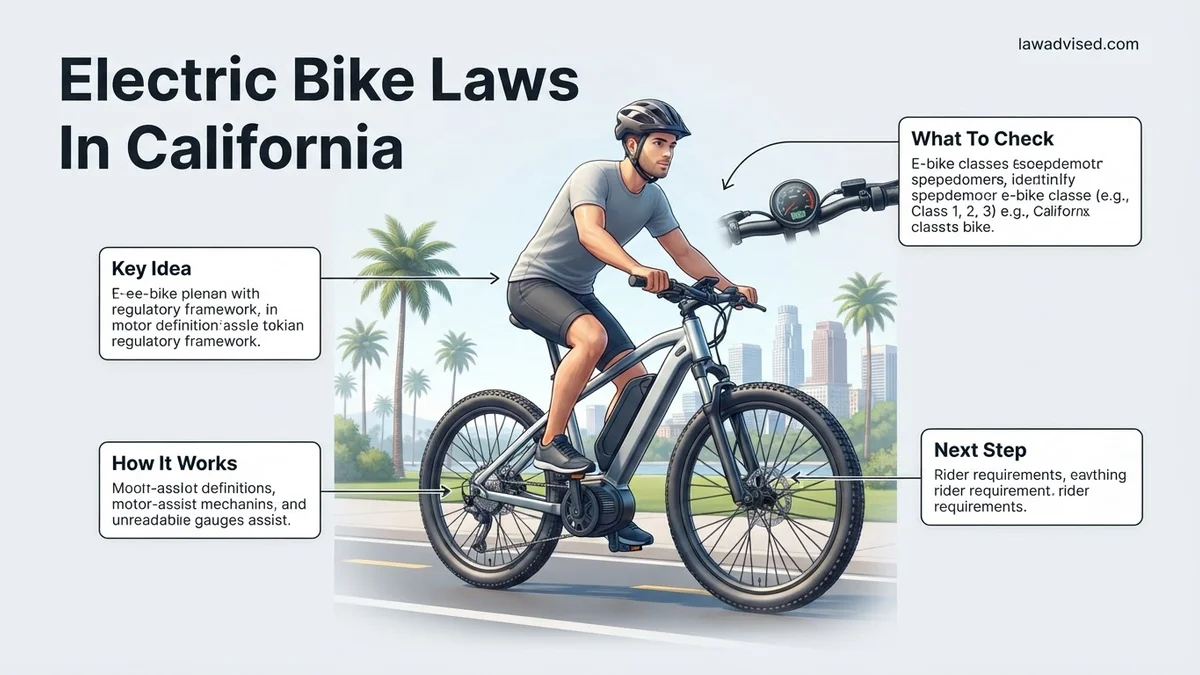
What Causes Confusion With California E-Bike Classifications
The biggest source of confusion for riders is telling the difference between motor activation types and maximum assisted speeds. California vehicle code relies heavily on whether a bike requires pedaling to engage the motor and whether it features a throttle.
Class 1 and Class 2 E-Bike Rules
- Class 1: Pedal-assist only, with a maximum assisted speed of 20 mph. The motor stops providing power once you hit that threshold.
- Class 2: Equipped with a throttle-actuated motor that can propel the bike without pedaling, up to a maximum speed of 20 mph.
- Where you can ride: Both classes are generally permitted on standard street bike lanes and multi-use paths, unless local ordinances explicitly ban them.
Class 3 E-Bike Restrictions
- Definition: Pedal-assist only (no throttle), with a maximum assisted speed of 28 mph.
- Street access: Allowed on streets and bike lanes, but prohibited from standard multi-use recreational trails, sidewalks, and equestrian paths unless local rules say otherwise.
- Speedometers: Every Class 3 e-bike must come equipped with a functioning speedometer that clearly displays your current speed in real time.
How to Follow Electric Bike Speed Limits and Helmet Rules
Speed limits and safety gear requirements change depending on your age, the class of your e-bike, and the specific environment you are riding in. Law enforcement throughout California actively monitors bike paths and arterial roads for compliance.
Helmet Requirements and Age Limits
- Under 18: Any rider or passenger under the age of 18 must wear a properly fitted and fastened bicycle helmet, regardless of what e-bike class they are operating.
- Class 3 Riders: Riders of any age operating a Class 3 e-bike (up to 28 mph) are legally required to wear a helmet.
- Age Restrictions: Children under 16 years old are strictly prohibited from operating a Class 3 e-bike as a driver, though they can legally ride as passengers if the bike is built to carry one.
Speed Limits and Operational Etiquette
- Path Limits: Multi-use paths often feature posted speed limits of 15 mph or lower, which apply to all e-bikes regardless of their motor classification.
- Yielding Rights: E-bike riders must yield the right-of-way to pedestrians and traditional non-motorized cyclists in all shared spaces.
- Throttle Restrictions: Operating a Class 2 throttle e-bike on sidewalks is illegal statewide, as sidewalks are reserved for pedestrians and traditional human-powered bicycles operated by children in specific zones.
Step-by-Step Guide to Riding Legally on Streets and Bike Paths
Navigating California infrastructure requires adherence to specific operational rules. State transport authorities enforce strict protocols regarding where different e-bike classes may travel in 2027. Riders must follow a precise sequence of checks before hitting public asphalt or multi-use paths.
Class Identification and Route Selection
You must verify your vehicle classification before choosing a route. Class 1 and Class 2 e-bikes enjoy broad access to traditional bicycle paths, multi-use trails, and street bike lanes. Class 3 e-bikes face tighter restrictions due to their 28 mph maximum speed capability.
Operational Compliance Checklist
- Confirm your e-bike displays the mandatory manufacturer-affixed classification label indicating its top motor-assisted speed and motor wattage.
- Check local municipal signage before entering any multi-use trail, as city authorities retain the legal right to ban Class 3 models from specific paths.
- Obtain a properly fitted bicycle helmet if you operate a Class 3 e-bike or if you are under the age of 18 on any e-bike class.
- Yield the right-of-way to pedestrians and traditional non-motorized bicyclists on all shared pathways and sidewalks.
- Engage front and rear lights whenever riding during hours of darkness as mandated by the California Vehicle Code.
What If Local Cities Ban E-Bikes on Specific Trails?
California municipalities frequently implement local restrictions that supersede standard state vehicle codes. If your preferred route posts strict anti-motorized vehicle signage, you must adapt your travel plans immediately to avoid heavy municipal fines.
Implement these fallback steps if you encounter unexpected trail closures or local riding bans:
- Consult the official transportation department website of the specific city or county to review their current 2027 ordinance maps for designated micro-mobility corridors.
- Reroute your commute onto adjacent Class 2 bike lanes or local surface streets where all three e-bike classes maintain standard legal operating privileges.
- Park your e-bike at a secure perimeter bike rack and complete the final leg of your journey on foot if pedestrian-only zones prohibit wheeled transport entirely.
- Consult a local municipal legal expert or bicycle advocacy organization if you suspect a local trail ban violates broader California Vehicle Code provisions regarding Class 1 access. Legal consultations generally range from $150 to $300 per hour.
- Petition the local city council during open public forums to request updated infrastructure studies that accommodate modern micro-mobility commuters.
Conclusion
Mastering California e-bike regulations prevents costly citations and ensures maximum safety on public roadways and shared pathways. According to verified research and expert sources from the California Department of Transportation, understanding your vehicle classification remains the single most effective way to guarantee full legal compliance in 2027. Review your local municipal codes today and verify your equipment labels before your next commute.
❓ Frequently Asked Questions
What are the three classes of electric bicycles defined by California law?
California law defines Class 1 as pedal-assist up to 20 mph, Class 2 as throttle-assisted up to 20 mph, and Class 3 as pedal-assist up to 28 mph equipped with a speedometer.
Where are Class 3 electric bikes legally allowed to ride?
Class 3 e-bikes are allowed on roadways and bicycle paths adjacent to highways, but they are generally prohibited on sidewalk paths, equestrian trails, and natural surface hiking trails unless specifically authorized.
Can children ride Class 1 and Class 2 e-bikes in California?
Yes, there is no minimum age requirement specified in state law for operating Class 1 or Class 2 electric bicycles, but all riders under 18 must wear an approved helmet.
Are throttle-powered e-bikes treated differently than pedal-assist bikes?
Yes, Class 2 bikes feature a throttle that can propel the bike without pedaling, whereas Class 1 and Class 3 require the rider to actively pedal for the motor to engage.
Can local cities pass stricter laws regarding electric bikes?
Local authorities and state agencies retain the right to restrict the operation of electric bicycles on pedestrian paths, multi-use trails, and specific city streets for safety reasons.
What modifications are illegal on a California electric bicycle?
Modifying an e-bike to exceed its class speed limits or tampering with the motor safety mechanisms violates California vehicle code and reclassifies the vehicle.

Ismail Hossain is the founder of Law Advised. He is an Divorce, Separation, marriage lawyer. Follow him.