Rental Loss Deduction Explained 2026 Expert Guide
Rental real estate losses are generally classified as passive activity losses and cannot automatically offset W-2 or business income. However, investors may qualify for the special $25,000 active participation allowance or Real Estate Professional Status (REPS) to deduct losses against ordinary income. Unused losses are never permanently lost and are instead carried forward indefinitely until offset against future passive gains or property disposition.
Under IRS tax rules, rental real estate losses are generally classified as passive losses, meaning you cannot automatically deduct them against your W-2 salary, business income, or investment dividends. However, you can offset up to $25,000 of non-passive income with rental losses if you actively participate in management and your modified adjusted gross income stays below $150,000. If your income exceeds those limits, or if you do not actively participate, those losses are suspended and carried forward indefinitely to offset future rental profits.
Navigating these tax restrictions matters practically because real estate depreciation often creates paper losses on your tax return even while your property generates positive cash flow. Knowing how to leverage the active participation allowance or qualify as a real estate professional determines whether you pay taxes on cash flow you never actually realized or keep that money in your pocket for 2026 tax planning.
Key Takeaways
- Rental losses are categorized as passive losses by default under IRS tax rules.
- Active participants with an AGI under $100,000 can deduct up to $25,000 in losses.
- The $25,000 deduction phases out completely when modified AGI reaches $150,000.
- Qualifying for REPS allows you to deduct unlimited rental losses against active income.
- Suspended passive losses roll forward indefinitely and offset gains when you sell the property.
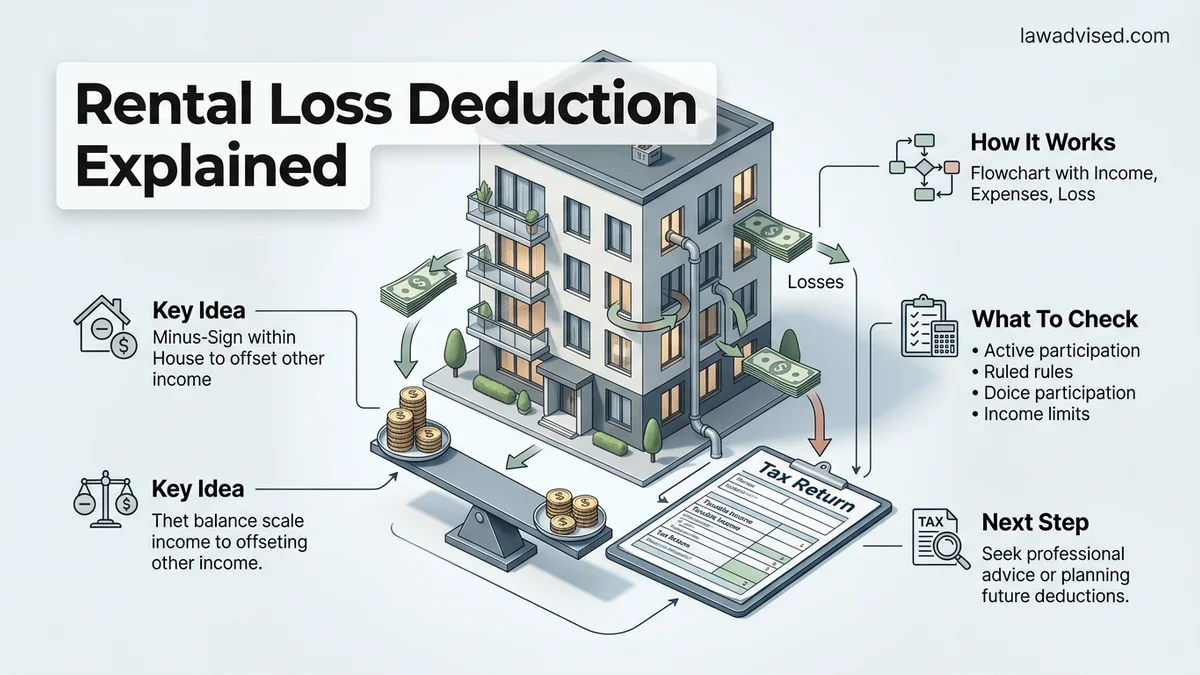
What Causes Rental Loss Deduction Restrictions Under IRS Rules
The IRS treats almost all rental activities as passive by default. This classification creates a major hurdle when your rental expenses, mortgage interest, and depreciation exceed your rental income.
The Passive Activity Loss Trap
Congress enacted the passive loss rules under Section 469 to prevent high-income earners from using artificial paper losses from tax shelters to offset their active wages. Because the IRS views rental real estate as inherently passive, any net loss generated by your property is automatically trapped inside the passive bucket. You cannot deduct these passive losses against your active W-2 job, business profits, or portfolio interest, even if your property lost money in reality.
Suspended Losses and Carryforwards
When your passive losses exceed your passive gains, the excess does not simply disappear. Instead, the IRS labels them as suspended passive losses and carries them forward to future tax years. You can finally release and deduct these accumulated losses in two specific scenarios:
- When your modified adjusted gross income drops into an eligible phase-out range for a specific allowance.
- When you completely dispose of or sell the entire rental property to an unrelated third party in a fully taxable transaction.
How to Fix Passive Loss Limits Using the $25,000 Allowance and AGI Thresholds
Fortunately, the tax code provides a vital safety valve for everyday real estate investors who take an active role in managing their properties.
The Active Participation Standard
To qualify for relief from the strict passive loss rules, you must pass the active participation test. This requirement is much easier to meet than the material participation standard required for full-time professionals. To be considered an active participant:
- You must own at least a 10% value stake in the rental property.
- You must make genuine management decisions, such as approving new tenants, deciding on repair terms, and setting rental rates.
- You can hire a property manager, but you must still retain ultimate decision-making authority.
The $25,000 Allowance and AGI Phase-Out Rules
If you meet the active participation test, the IRS allows you to deduct up to $25,000 of rental real estate losses against your active or portfolio income. However, this special allowance phases out quickly based on your modified adjusted gross income (MAGI).
- Full Deduction: If your MAGI is $100,000 or less, you can deduct the full $25,000 loss against your active income.
- Phase-Out Range: For every dollar your MAGI rises above $100,000, you lose 50 cents of the deduction. For example, if your MAGI is $120,000, your maximum allowance drops to $15,000.
- Complete Elimination: Once your MAGI hits $150,000 or higher, the special allowance drops to zero, and all your rental losses become strictly passive for the 2026 tax year.
How to Apply Real Estate Professional Status to Bypass Loss Caps
High-income earners often find their rental losses trapped by the standard passive activity rules. Real Estate Professional Status (REPS), defined under Internal Revenue Code Section 469(c)(7), provides the primary mechanism to bypass these restrictive deduction caps entirely.
Meeting the statutory requirements demands significant time and careful documentation. The Internal Revenue Service applies strict oversight to these claims, making precision vital for 2026 tax filings.
The Two-Part Statutory Test
Qualifying as a real estate professional requires satisfying two distinct time thresholds during the tax year. First, you must perform more than 500 hours of personal services in real property trades or businesses. Second, these hours must constitute more than 50 percent of the total personal services you performed across all trades or businesses.
Married taxpayers filing jointly cannot combine their hours to meet these tests. One spouse must independently qualify to unlock the active participation benefits for the marital unit.
Material Participation in Your Rentals
Qualifying for REPS does not automatically make your rental losses active. You must still establish material participation for each individual rental property unless you elect to treat all interests as a single activity. According to tax compliance guidelines, material participation requires meeting at least one of several tests, such as working more than 500 hours in that specific property.
- Track all working hours contemporaneously using digital time-tracking software or detailed daily logs.
- Ensure your combined real estate trade or business hours exceed 750 annually and outpace any non-real estate employment hours.
- File a formal election with your 2026 tax return to aggregate all your rental real estate interests into a single activity.
- Review property management contracts to confirm you retain substantive decision-making authority over operations.
What If It Still Doesn’t Work: Managing Suspended Losses and Property Dispositions
If income limits block your deductions and Real Estate Professional Status remains out of reach, your passive losses do not disappear. Instead, the tax code places these amounts into a holding category known as suspended passive losses, carrying them forward indefinitely to offset future passive income.
When standard strategies fail to yield immediate tax relief, several fallback measures help protect your financial position and prepare for future deductions.
- Calculate your exact cumulative suspended losses by reviewing Form 8582 from all prior tax years.
- Plan for the ultimate property disposition, as selling the rental asset to an unrelated party in a fully taxable transaction unlocks all suspended losses associated with that specific property against non-passive income.
- Consult a certified public accountant or licensed tax attorney specializing in real estate taxation if your portfolio generates more than $50,000 in annual passive losses. Professional advisory fees typically range from $1,500 to $4,000 depending on portfolio complexity.
- Evaluate strategic property refinancing or portfolio restructuring to alter your passive income-to-loss ratios before the end of the tax year.
Conclusion
Navigating the complex restrictions of the rental loss deduction requires rigorous record-keeping and strategic planning to avoid trapped tax savings. While standard income phase-outs limit immediate write-offs for middle- and upper-income earners, mastering rules like the $25,000 allowance or pursuing Real Estate Professional Status unlocks substantial financial relief. According to verified research and tax policy experts, proactive timing of property dispositions and meticulous hour tracking remain the most reliable defenses against passive loss limitations. Take your next actionable step today by auditing your current year participation hours and consulting a qualified tax professional to optimize your 2026 real estate portfolio strategy.
❓ Frequently Asked Questions
How do passive activity loss rules apply to rental real estate?
Under IRS rules, rental real estate is considered a passive activity by default. This means any net losses generated by the property can typically only offset passive income, such as income from other passive investments, rather than active income like a W-2 job or business profits.
How does the $25,000 active participation rental real estate allowance work?
If you actively participate in managing your rental property—such as approving new tenants or arranging repairs—and your modified adjusted gross income falls below certain thresholds, you can deduct up to $25,000 of rental losses against ordinary income.
What are the AGI phase-out limits for the $25,000 rental loss deduction?
The full $25,000 deduction is available if your modified AGI is $100,000 or less. For every dollar your AGI rises above $100,000, the deduction is reduced by 50 cents, phasing out completely once your AGI reaches $150,000.
How do married couples file for the active participation allowance?
Married filing jointly couples combine their incomes to determine the $100,000 to $150,000 AGI phase-out range. Married filing separately taxpayers who live apart at any time during the year have a $50,000 phase-out threshold, while those living together generally cannot claim the allowance.
What qualifies someone for Real Estate Professional Status (REPS)?
To qualify as a real estate professional, you must meet two strict statutory tests: perform more than 750 services in real property trades or businesses during the year, and those hours must represent more than 50% of the total personal services you performed in all trades or businesses.
What does material participation mean for real estate professionals?
Simply qualifying for REPS is not enough; you must also materially participate in your rental activities. This requires meeting one of several IRS tests, such as working more than 500 hours on your rental properties during the tax year.

Ismail Hossain is the founder of Law Advised. He is an Divorce, Separation, marriage lawyer. Follow him.