Social Security Tax Calculation Explained Step-by-Step 2026
Your social security tax calculation is determined by applying a fixed 6.2% tax rate to your gross earnings up to the annual maximum wage base limit. For self-employed individuals, this rate doubles to 12.4%, though half of the tax can be deducted on federal income returns.
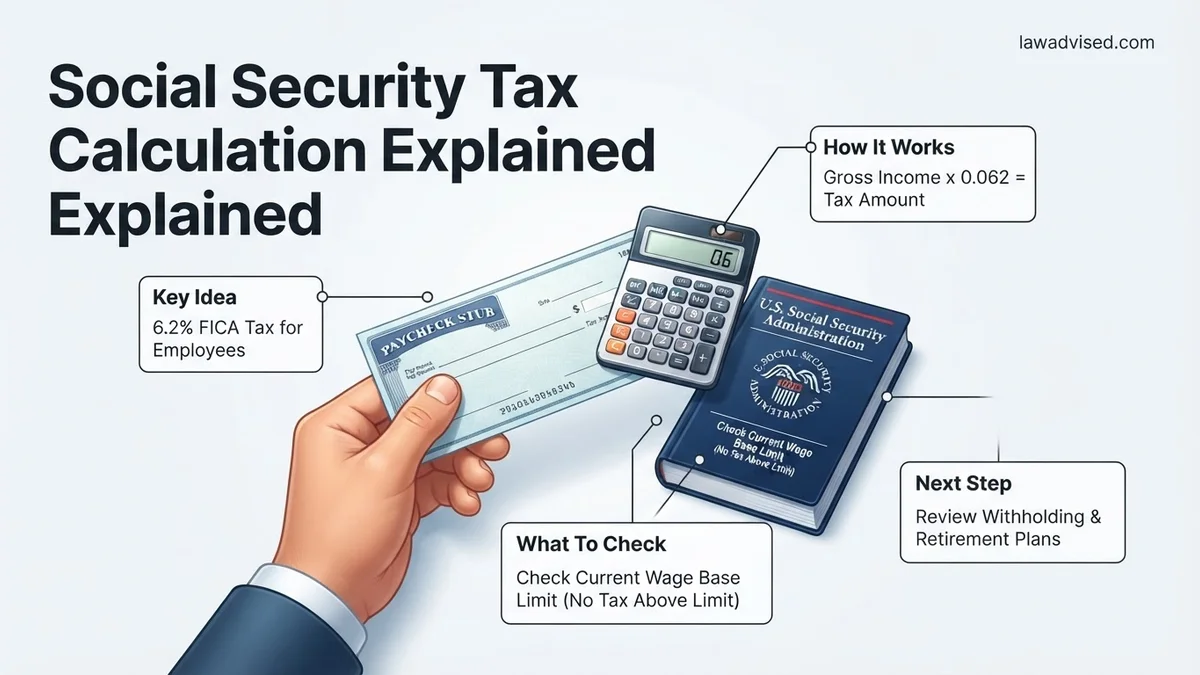
Social Security tax is calculated using a flat 6.2% rate applied to your gross earnings up to the annual maximum wage base limit of $176,100 for 2026. If you are a W-2 employee, your employer matches this 6.2% contribution, bringing the total tax to 12.4%. Self-employed individuals must pay the entire 12.4% themselves through the Self-Employment Contributions Act (SECA) tax.
Knowing exactly how this deduction hits your paycheck helps you spot payroll errors, plan your annual budget, and accurately project your net take-home pay. Whether you earn a modest salary or pull in income well above the 2026 wage ceiling, understanding these calculations ensures you never pay a penny more in Social Security taxes than the federal government requires.
Key Takeaways
- Employees pay a flat 6.2% Social Security tax withheld directly from each paycheck.
- Employers match the employee 6.2% contribution, bringing total contributions to 12.4%.
- The Social Security wage base limit caps taxable earnings annually.
- Self-employed workers pay 12.4% via the Self-Employment Contributions Act (SECA).
- Medicare tax (1.45%) is calculated alongside Social Security without a wage cap.
What Causes Incorrect Social Security Tax Withholdings
Mid-Year Job Changes and Wage Caps
The Social Security wage base limit applies per employer, not per individual worker. If you switch jobs in 2026 and your combined earnings exceed $176,100, both employers will continue withholding the 6.2% tax until you hit the cap with each specific company. Your total tax withheld will technically exceed the annual maximum. You can claim this excess back as a refundable credit when you file your federal income tax return in early 2027.
Payroll Software Glitches and Bonus Handling
Payroll departments occasionally miscalculate Social Security tax when processing irregular compensation like performance bonuses, commissions, or retroactive pay bumps. Common software errors include:
- Failing to stop the 6.2% deduction the exact pay period you cross the $176,100 threshold
- Applying the tax to non-taxable fringe benefits or certain employer-provided health contributions
- Incorrectly classifying independent contractor payments as W-2 wages or vice versa
How to Calculate Your Social Security Tax Step-by-Step
Calculating Employee Withholding Under the 2026 Limit
For standard W-2 employees earning below the wage ceiling, the math is straightforward. Multiply your gross taxable wages per pay period by 0.062. For example, if your gross biweekly pay is $3,000, your Social Security withholding calculation looks like this:
- Gross Pay: $3,000
- Tax Rate: 6.2% (or 0.062)
- Calculation: $3,000 x 0.062 = $186 withheld for Social Security
This deduction continues every single pay period until your cumulative year-to-date earnings surpass $176,100. Once you cross that exact dollar amount, your employer stops withholding the tax for the remainder of the calendar year.
Calculating Tax for High Earners Above the Wage Base
If you earn more than the 2026 maximum wage base limit, your Social Security tax caps out. Assume you earn a yearly salary of $200,000. Because the tax only applies to the first $176,100 you make, your maximum annual Social Security tax liability is fixed at $10,918.20 ($176,100 x 0.062). Any earnings you accumulate past $176,100 are completely exempt from the 6.2% Social Security deduction.
How to Apply the Maximum Wage Base Limit to High Earners
High-income earners face a specific constraint when calculating their annual Social Security tax liability: the contribution and benefit base limit. According to the Social Security Administration, this cap restricts the maximum amount of earnings subject to the 6.2% Old-Age, Survivors, and Disability Insurance (OASDI) tax. For the 2026 tax year, keeping track of this threshold prevents accidental overwithholding.
Step 1: Identify the 2026 Wage Base Cap
You must compare your year-to-date gross earnings against the official government threshold. For 2026, the projected maximum taxable earnings cap sits at an estimated $176,100 (subject to final cost-of-living adjustments). Any dollar earned beyond this exact numerical ceiling is exempt from the employee portion of the Social Security tax.
Step 2: Calculate Excess Withholdings Across Multiple Employers
If you switch jobs mid-year or hold multiple concurrent positions, each employer will independently withhold Social Security tax until your wages at that specific company cross the limit. To compute your true liability, use the following procedure:
- Sum the gross wages reported on all of your Year-End Form W-2 statements.
- Subtract the 2026 wage base limit ($176,100) from your total combined earnings to find your excess wage amount.
- Multiply that excess wage figure by the 6.2% tax rate to determine your exact overpaid tax amount.
- Claim this exact overpayment as a refundable credit on your individual federal income tax return using Schedule 3 (Form 1040).
What If Your Self-Employment Social Security Tax Calculation Still Fails
Self-employed individuals must navigate Schedule SE, which frequently introduces calculation errors due to the net earnings adjustment. If your manual computation does not align with IRS guidelines or software outputs, systematic troubleshooting is required.
Fallback Steps for Self-Employed Filers
When self-employment tax calculations yield unexpected results, execute these diagnostic steps:
- Verify that you multiplied your total net earnings from self-employment by the statutory conversion factor of 92.35% before applying the 12.4% OASDI tax rate.
- Check whether your combined net self-employment earnings and any W-2 wage income exceed the 2026 maximum wage base of $176,100, which requires prorating the taxable self-employment amount.
- Reconcile your Schedule SE calculations directly against the Self-Employment Tax Deduction worksheet found in the IRS instructions for Form 1040.
- Consult a certified public accountant (CPA) or enrolled agent if complex multi-state or entity structures obscure your net earnings baseline. Professional tax preparation fees typically range from $300 to $800 depending on business complexity.
Conclusion
Calculating your Social Security tax requires precise application of the 6.2% rate, adherence to maximum wage caps, and accurate handling of self-employment multipliers. Resolving discrepancies involves systematic tracking of year-to-date earnings and utilizing correct IRS schedules. As an immediate next step, audit your most recent pay stub or business ledger against the 2026 thresholds to confirm accurate withholding. According to verified research and expert sources from the Congressional Research Service, proactive payroll monitoring remains the most effective defense against tax year adjustments and delayed refunds.
❓ Frequently Asked Questions
How is the Social Security tax calculated on a standard paycheck?
To calculate the tax, multiply your gross taxable wages for the pay period by the 6.2% employee tax rate. This amount is automatically deducted by your employer before you receive your net pay.
What happens when an employee’s earnings exceed the annual wage base limit?
Once your cumulative earnings for the year surpass the maximum wage base limit, Social Security tax withholding stops for the remainder of that calendar year. However, Medicare tax withholding continues regardless of income level.
Can self-employed workers deduct any portion of their Social Security tax?
Yes, self-employed individuals can claim an above-the-line income tax deduction for half of their self-employment tax liability. This adjustment reduces their overall adjusted gross income.
Are bonuses and overtime subject to Social Security tax calculation?
Yes, supplemental wages such as bonuses, commissions, and overtime pay are considered taxable earned income and are subject to the standard 6.2% Social Security withholding rate.
Does the Social Security tax rate change every year?
The 6.2% tax rate for employees and 12.4% for self-employed workers are set by federal law and rarely change, but the maximum wage base limit is adjusted annually to account for national wage index changes.
What should I do if my employer calculates my Social Security tax incorrectly?
Review your pay stubs and W-2 form to identify discrepancies, then notify your payroll or human resources department immediately. If unresolved, you can address overpayments when filing your annual federal income tax return.

Ismail Hossain is the founder of Law Advised. He is an Divorce, Separation, marriage lawyer. Follow him.