Tax Benefits for Parents Expert Guide to Credits 2026
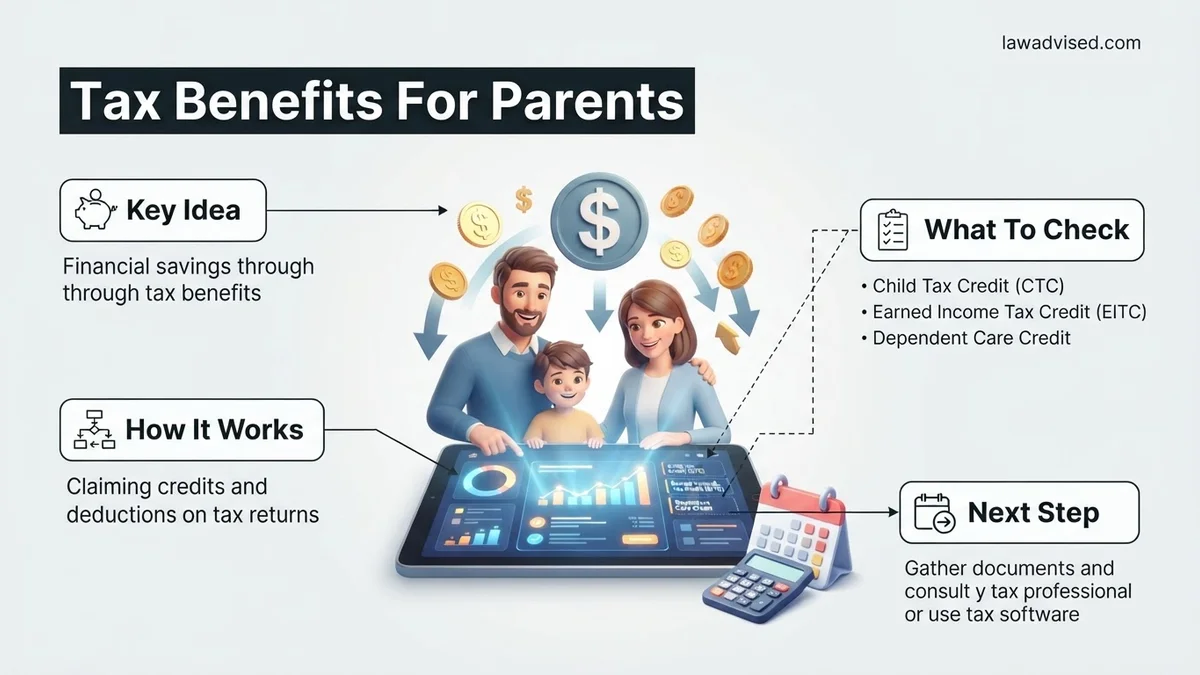
Navigating tax benefits for parents can significantly lower your liability and boost your refund. This expert guide breaks down major federal credits, savings accounts, and eligibility rules to help you claim every dollar you deserve.
Raising children is expensive, but the tax code offers substantial relief designed to lower your overall liability and put money back in your pocket. As you prepare your 2026 tax strategy, you need to look beyond standard deductions and target specific federal credits, dependent care provisions, and education savings accounts that actively reduce what you owe.
Navigating these rules successfully requires knowing exact income thresholds, phase-out limits, and qualifying criteria. Failing to leverage these programs properly means leaving thousands of dollars on the table every filing season. This guide breaks down the exact credits and accounts you must utilize this year.
Key Takeaways
- Claim the Child Tax Credit to reduce your tax liability directly dollar-for-dollar.
- Utilize Dependent Care FSAs to pay for childcare with pre-tax dollars.
- Check income phase-out thresholds carefully before filing your annual tax return.
- Fund 529 college savings plans early to maximize state and future tax advantages.
- Track all qualified childcare and adoption expenses throughout the calendar year.
What Causes Tax Penalties and Missed Credits for Parents
Filing Status Errors and Dependency Rules
Many parents miss out on maximum refunds simply by choosing the incorrect filing status or misinterpreting who qualifies as a dependent. If you are unmarried and pay more than half the cost of maintaining your home for a qualifying child, you should file as Head of Household instead of Single. This status grants you a significantly larger standard deduction and more favorable tax brackets.
- The Support Test: You must provide more than fifty percent of your child’s total financial support for the calendar year.
- Residency Requirements: The qualifying child generally must live with you for more than half of 2026.
- Age Limits: Pay close attention to age caps, as many credits apply differently to toddlers versus teenagers.
Income Phase-Out Miscalculations
Another major reason parents lose out on credits is failing to anticipate income phase-outs. Federal tax benefits for parents frequently include Adjusted Gross Income (AGI) limitations. When your income exceeds specific thresholds, your credit amounts begin to reduce or disappear entirely.
- Threshold Tracking: Monitor your Modified Adjusted Gross Income closely throughout 2026.
- Pre-Tax Adjustments: Utilize workplace retirement accounts or health savings accounts to lower your taxable AGI and stay beneath phase-out limits.
How to Fix Your Filing Strategy with Major Federal Tax Credits
Maximizing the Child Tax Credit
The Child Tax Credit (CTC) remains your most powerful tool for reducing tax liability. For the 2026 tax year, qualifying parents can claim substantial per-child amounts, though you must carefully verify eligibility rules based on the child’s age and citizenship status at the end of the tax year.
- Age Limit: The child must be under the age of seventeen at the end of 2026.
- Refundability Rules: Understand the Additional Child Tax Credit limits if your total tax liability is lower than the total credit value.
- Phase-Outs: High-income earners face phase-outs beginning at specific thresholds depending on joint or single filing status.
Claiming the Child and Dependent Care Credit
If you pay for daycare, babysitters, preschool, or summer day camps so that you can work or look for work, the Child and Dependent Care Credit provides vital relief. This is distinct from the CTC and directly reimburses a percentage of your employment-related care expenses.
- Expense Caps: You can claim up to three thousand dollars in expenses for one qualifying dependent, or up to six thousand dollars for two or more.
- Percentage Sliding Scale: Depending on your 2026 AGI, the IRS covers between twenty and thirty-five percent of these eligible expenses.
- Work Requirement: Both you and your spouse (if filing jointly) must have earned income during the year to qualify.
Step-by-Step Guide to Utilizing Tax-Advantaged Dependent Care Accounts
Maximizing tax-advantaged accounts like a Dependent Care Flexible Spending Account (DCFSA) significantly lowers childcare costs for working parents in 2026. According to IRS guidelines, families can contribute pre-tax dollars through their employer to pay for qualified expenses like daycare, preschool, and after-school programs.
Enrolling and Funding Your Account
- Calculate your projected annual dependent care expenses during your employer’s open enrollment period or following a qualifying life event.
- Set your annual payroll deduction amount, keeping in mind the current statutory limit of $5,000 for married filing jointly or single filers, and $2,500 for married filing separately.
- Submit itemized receipts and provider identification numbers to your plan administrator throughout 2026 to receive tax-free reimbursements.
Optimizing Savings With Employer Plans
- Coordinate your DCFSA contributions with your partner to avoid exceeding the combined household cap mandated by federal tax law.
- Review your employer’s plan document to check for grace periods or carryover provisions, ensuring you do not forfeit unspent funds at the end of the plan year.
- Combine your DCFSA utilization with employer-sponsored backup care programs for a comprehensive approach to reducing out-of-pocket expenses.
What If Your Income Exceeds Credit Limits and You Need Alternative Savings Options
High-earning parents often phase out of direct child tax credits and standard dependent care benefits. Financial planners recommend shifting focus to alternative tax-advantaged vehicles that support long-term family wealth and education goals without strict income caps.
Alternative High-Income Savings Vehicles
- Open a 529 College Savings Plan, which allows after-tax contributions to grow tax-free and permits federal tax-free withdrawals for qualified higher education expenses.
- Utilize custodial accounts under the Uniform Gifts to Minors Act (UGMA) or Uniform Transfers to Minors Act (UTMA) to build assets for children while leveraging the kiddie tax rules.
- Fund a Roth IRA for older teenagers with earned income, creating a flexible asset pool that can eventually help fund higher education or first-time home purchases.
What If It Still Doesn’t Work?
Navigating complex 2026 tax codes can result in missed deductions or rejected credits despite careful planning. If your standard filing software flags errors or you face an unexpected audit, follow these fallback steps to resolve the issue:
- Gather all dependent verification documents, including Social Security numbers, Form 1098-T, and daycare provider EINs, to verify data accuracy.
- Run a diagnostic check using advanced tax preparation software to isolate where calculation discrepancies or phase-out thresholds occurred.
- Consult a certified public accountant (CPA) or enrolled agent who specializes in family taxation. According to the National Society of Accountants, professional tax advisory fees for complex family returns typically range from $400 to $900 depending on regional market rates and return complexity.
- File an amended return using Form 1040-X if you discover eligible credits or deductions were missed during the initial 2026 filing window.
Conclusion
Navigating family tax benefits in 2026 requires strategic planning around income phase-outs, accurate credit claims, and proper utilization of dependent care accounts. According to verified research and expert financial sources, proactive optimization of these provisions yields substantial annual household savings. Your actionable next step is to audit your anticipated 2026 childcare expenses and employer benefit elections this week to ensure maximum pre-tax utilization.
❓ Frequently Asked Questions
How does the Child Tax Credit work and who qualifies?
The Child Tax Credit is a valuable federal benefit for parents with dependent children under 17 at the end of the tax year. To qualify, the child must have a valid Social Security number, be claimed as a dependent on your tax return, and live with you for more than half the year. A portion of this credit may be refundable as the Additional Child Tax Credit if your liability is lower than the credit amount.
What expenses are covered under the Child and Dependent Care Credit?
This credit covers expenses paid for the care of a qualifying individual—such as a child under 13—to enable you and your spouse to work or actively look for work. Eligible expenses include daycare centers, before- and after-school programs, and babysitters. Payments made to relatives can also qualify, provided they are not your dependents.
How do Flexible Spending Accounts (FSAs) for dependent care save money?
A Dependent Care FSA allows you to set aside pre-tax dollars directly from your paycheck to pay for qualified childcare services. Because these contributions are deducted before federal income taxes are calculated, your overall taxable income decreases, resulting in immediate tax savings.
What are the tax advantages of 529 college savings plans?
While contributions to 529 plans are not deductible at the federal level, many states offer state income tax deductions or credits for residents who contribute. Furthermore, any earnings grow tax-free, and withdrawals are entirely tax-free when used for qualified higher education expenses.
How does the Earned Income Tax Credit (EITC) benefit working parents?
The EITC is a refundable tax credit designed to assist working individuals and families with low to moderate income. The credit amount varies significantly depending on your earned income level and the number of qualifying children you have, drastically increasing potential refund amounts.
Are there lesser-known tax deductions parents should know about?
Yes, parents can often leverage deductions such as the student loan interest deduction, the adoption tax credit for qualifying adoption expenses, and medical expense deductions that exceed specific adjusted gross income thresholds.

Ismail Hossain is the founder of Law Advised. He is an Divorce, Separation, marriage lawyer. Follow him.