Tax Lien Explained 2026 A Step-by-Step Guide
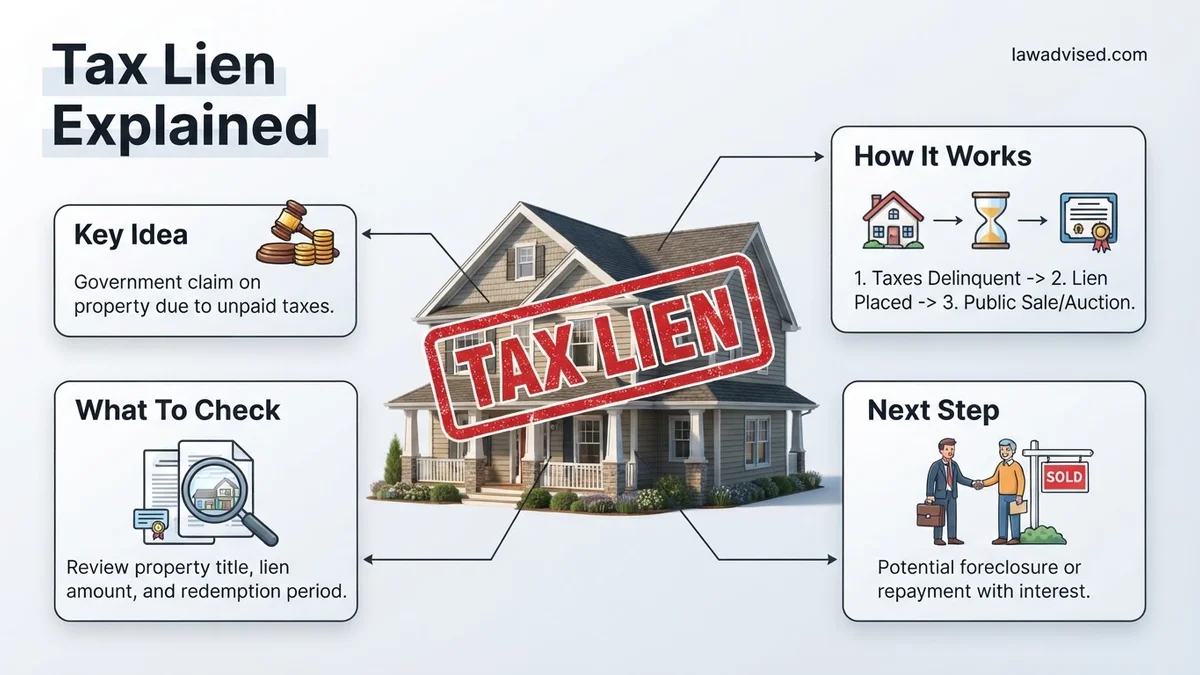
A tax lien is a legal claim placed by a government entity against a property when the owner fails to pay property taxes. This guide covers how liens are issued, the lifecycle of a tax lien, and the implications for both homeowners and investors.
A tax lien is a legal claim placed by a government agency against your property when you fail to pay your taxes on time. Whether issued by the IRS for federal income taxes or by your local municipality for unpaid property taxes, this public notice acts as a security interest to ensure the government eventually gets paid. For homeowners, it is a serious financial warning that restricts your ability to sell or refinance your home.
Understanding this process matters because ignoring a tax lien can escalate quickly to asset seizure or foreclosure. By the time 2026 economic conditions place tighter squeezes on household budgets, knowing how these liens function helps you protect your real estate equity or spot unique investment opportunities without falling into costly traps.
Key Takeaways
- A tax lien acts as legal security for unpaid property taxes owed to the local government.
- Governments issue liens to recover lost public revenue without seizing property immediately.
- Property owners face mounting interest, penalties, and eventual risk of foreclosure.
- Investors can purchase tax lien certificates to earn interest on delinquent debt.
- Tax liens differ from tax deeds, which involve buying the actual property rather than the debt.
What Causes a Tax Lien and Why Governments Issue Them
Governments rely on consistent tax revenue to fund public services like schools, roads, and emergency response. When you fall behind on your obligations, authorities use tax liens to secure their right to your funds before any other creditors get paid.
Triggers for Federal and Municipal Tax Liens
- Failing to file your annual income tax returns while owing a balance to the IRS.
- Accumulating overdue local property taxes, often remaining unpaid for six months to a year.
- Ignoring official warning notices and final demand letters sent by tax authorities.
- Disputing a tax assessment without filing the proper formal appeals paperwork on time.
The Primary Purpose Behind the Claim
The government does not actually want to manage or sell your real estate. Instead, issuing a tax lien serves primarily as leverage. It instantly attaches to all your current and future assets, clouding your title and forcing you to address the debt if you ever want to sell, buy, or refinance.
How to Handle a Tax Lien: Step-by-Step Resolution Process
If you discover a tax lien attached to your name or property, you must take immediate action to prevent further escalation. Ignoring the notice will only lead to mounting interest, severe penalty fees, and potential forced liquidation of your assets.
Immediate Steps to Verify and Respond
- Request a copy of the official Notice of Federal Tax Lien or the local municipal assessment to verify the exact debt amount.
- Contact the issuing agency immediately to discuss your repayment eligibility and request a complete payoff quote.
- Evaluate your financial capacity to either pay the balance in full or negotiate an alternative resolution program.
Formal Resolution Options Available
- Full Payment: Paying the balance entirely removes the lien within 30 days of clearance.
- Installment Agreement: Setting up a structured monthly payment plan, which may allow for lien withdrawal after consistent on-time payments.
- Offer in Compromise: Negotiating a lower settlement amount if you can prove paying the full balance causes severe financial hardship.
What If the Property Owner Still Does Not Pay the Debt
When a property owner fails to clear their delinquent taxes within the statutory redemption period, the investor holding the tax lien certificate gains enforceable legal remedies. The exact timeline and foreclosure process vary significantly by jurisdiction, generally falling into two distinct legal pathways for 2026.
Understanding the Foreclosure Pathways
States typically structure post-redemption enforcement as either a tax deed sale or a judicial foreclosure. In a tax deed state, the certificate holder applies for a deed directly through the county once the redemption window expires. Conversely, lien-state investors must file a lawsuit in court to foreclose on the property title, incurring additional legal fees and procedural steps.
Steps to Claim the Property
- Verify the expiration of the statutory redemption period with the local county tax collector’s office.
- Submit a formal application for a tax deed or initiate a quiet title lawsuit through a real estate attorney.
- Pay any remaining subsequent taxes or administrative transfer fees required by the municipality.
- Attend the public auction or receive the newly issued deed, ensuring all interested parties received proper legal notification.
How Investors Can Safely Navigate Tax Lien Certificates
Maximizing returns while minimizing risk requires a disciplined, research-backed methodology. Industry experts emphasize that successful tax lien investing is fundamentally an exercise in meticulous due diligence rather than passive speculation.
Key Risk Mitigation Strategies
Unforeseen liabilities can rapidly erode potential profits. Investors must thoroughly investigate physical assets and financial encumbrances before committing capital to any certificate auction.
Actionable Investment Steps
- Perform comprehensive physical drive-bys or utilize satellite imaging to assess the actual condition and occupancy status of the target property.
- Conduct a thorough title search to identify senior mortgages, federal tax liens, or environmental hazards that survive tax foreclosure.
- Establish a strict maximum bidding limit that accounts for potential interest rate bidding downs at competitive auctions.
- Maintain a diversified portfolio across multiple municipalities to spread geographic and economic risk.
What If It Still Doesn’t Work?
Even with careful planning, investors sometimes encounter complications such as unexpected bankruptcy filings or properties with hidden environmental liabilities. When standard collection or foreclosure methods stall, consider the following troubleshooting steps:
- File a formal motion for relief from the automatic stay through a bankruptcy attorney if the property owner declares Chapter 13 bankruptcy.
- Engage a local real estate litigator to untangle complex title defects or contested probate issues, with legal fees typically ranging from $1,500 to $5,000 depending on court complexity.
- Write off the uncollectible certificate or pursue alternative administrative remedies through the county if the municipal lien proves legally invalid.
- Consult a certified public accountant (CPA) to properly structure bad-debt tax deductions for any severely impaired or defaulted investments.
Conclusion
Navigating tax lien certificates involves balancing attractive statutory interest rates against complex local foreclosure laws and property risks. According to verified research and expert sources from the National Tax Lien Association, disciplined due diligence remains the single most reliable predictor of long-term investment success. To take your next actionable step, review the upcoming 2026 auction calendar for your target county and request the official delinquent tax list today.
❓ Frequently Asked Questions
How long does a property owner have to pay off a tax lien?
The redemption period varies significantly by state, typically ranging from one to three years, during which the owner can pay the back taxes plus interest to clear the lien.
What happens after a tax lien certificate is purchased by an investor?
The investor pays the delinquent taxes to the municipality, and in return, the property owner must pay the investor the back taxes plus a high rate of interest.
Can federal IRS tax liens be treated the same as municipal property tax liens?
No, IRS tax liens apply to all of a taxpayer’s assets for unpaid federal income taxes, whereas municipal property tax liens are specific to real estate and take priority over most other claims.
What steps should a homeowner take immediately after receiving a tax lien notice?
The homeowner should contact the local tax collector’s office immediately to determine the exact payoff amount, including accrued interest and penalties, and settle the debt or request a payment plan.
What are the primary risks for investors buying tax liens?
Risks include bankruptcy filings by the property owner, environmental hazards on the property, and the potential need to go through a lengthy foreclosure process to recover funds.
Do all states use the tax lien certificate system?
No, states operate under different laws; some use tax lien certificates, others use tax deed sales, and some utilize a hybrid system combining elements of both.

Ismail Hossain is the founder of Law Advised. He is an Divorce, Separation, marriage lawyer. Follow him.