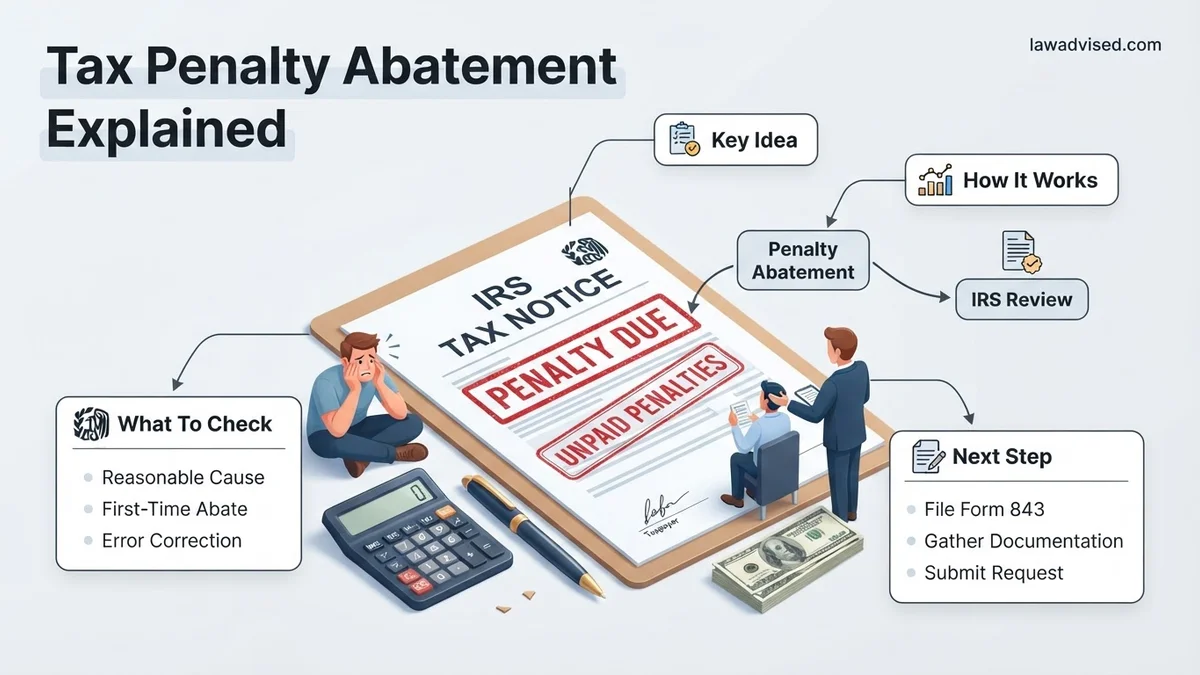
Tax Penalty Abatement Explained A Step-by-Step Guide 2026
Tax penalty abatement is an IRS process that allows taxpayers to have certain penalties removed from their accounts. Qualifying requires meeting specific criteria like reasonable cause or first-time abatement policies. Taking prompt action can save you hundreds or thousands of dollars in avoidable fees.
Tax penalty abatement is the IRS process of forgiving late-filing, late-payment, or failure-to-deposit penalties if you meet specific administrative criteria or prove extenuating circumstances. Navigating tax obligations in 2026 means understanding that while you generally cannot escape statutory interest, you can successfully wipe out thousands of dollars in accumulated penalty charges through specific statutory relief pathways.
Getting your IRS penalties removed requires matching your exact situation to established relief programs. You do not have to accept financial penalties passively when unforeseen life events disrupt your finances, or when you have a clean compliance history with the IRS.
Key Takeaways
- First-Time Abatement (FTA) is the easiest way to remove failure-to-file and failure-to-pay penalties.
- Reasonable cause requires proof that circumstances beyond your control prevented compliance.
- Interest usually cannot be abated unless the underlying tax or penalty is forgiven.
- You can request abatement over the phone, in writing, or by filing IRS Form 843.
- Always pay your underlying tax liability or set up a payment plan before applying.
What Causes IRS Penalties and Which Ones Can Be Abated
Common IRS Penalties
The IRS imposes several standard financial penalties for non-compliance. The failure-to-file penalty hits you at 5% of your unpaid taxes per month, while the failure-to-pay penalty is much lighter at 0.5% per month. If you run a small business, failure-to-deposit penalties for payroll taxes can also scale up rapidly. In 2026, these percentages remain steep, quickly compounding your overall balance due.
Penalties Eligible for Relief
Fortunately, the IRS allows you to request penalty abatement for the most common infractions. You can successfully remove failure-to-file, failure-to-pay, and failure-to-deposit penalties. However, audit-related penalties like fraud or accuracy-related assessments are rarely removed unless you overturn the underlying tax adjustment completely. Interest charges also generally remain because the IRS views interest as compensation for the use of money, not a punishment.
How to Qualify for First-Time Abatement and Reasonable Cause
First-Time Penalty Abatement (FTA)
First-Time Abatement is your easiest route to relief if you have a clean compliance record. To qualify for FTA in 2026, you must meet three strict conditions:
- You did not have to file the same return type, or you had no penalties for the preceding three tax years.
- You have filed all currently required tax returns or filed a valid extension.
- You have paid, or arranged to pay, any tax currently due.
FTA acts as a one-time administrative pass. If you qualify, you do not need to prove a hardship; the IRS grants the waiver automatically upon request.
Reasonable Cause Guidelines
If you do not qualify for FTA, you must rely on the reasonable cause exception. The IRS evaluates these requests based on whether you exercised ordinary business care and prudence but were still unable to comply. Accepted reasons typically include:
- Serious illness, hospitalization, or incapacitation of you or an immediate family member.
- Natural disasters, fires, or structural destruction of your records.
- Inability to obtain necessary records despite reasonable efforts.
- Relying on explicit, written bad advice from an IRS representative or tax professional.
Your reason must directly explain why you missed the filing or payment deadline. General financial hardship alone rarely satisfies reasonable cause standards.
Step-by-Step Guide on How to Request Tax Penalty Abatement
Requesting tax penalty abatement in 2026 requires strict adherence to IRS procedures. Accuracy and supporting documentation dictate whether the agency approves or rejects the application. Tax experts recommend gathering all financial records before initiating contact.
Filing via Phone or Written Notice
Taxpayers can request relief through two primary channels depending on the penalty type. Minor penalties often qualify for rapid adjustment over the phone. Major penalties demand formal written correspondence.
- Identify the specific penalty: Review the IRS notice to find the exact penalty code and the tax year in question.
- Contact the IRS directly: Call the toll-free number listed on your notice if the penalty stems from a first-time offense or minor calculation error. Mention First-Time Abatement explicitly if eligible.
- Submit Form 843 for formal requests: Mail Written Claim for Refund and Request for Abatement to your designated IRS service center. Attach detailed evidence supporting reasonable cause, such as medical bills or disaster declarations.
- Wait for the formal response: The IRS typically processes written abatement requests within 60 to 90 days. Keep tracking numbers for all mailed documents.
What If Your Penalty Abatement Request Is Denied
An initial denial from the IRS does not close the door on relief. According to tax resolution data, roughly 30 percent of rejected penalty abatements succeed upon secondary review or appeal. Taxpayers must act quickly within strict statutory deadlines to preserve their rights.
Next Steps After a Rejection
- File a formal appeal: Submit Form 12113, Request for Appeal of Examination Action, within 30 days of receiving the rejection letter to contest the decision with the IRS Independent Office of Appeals.
- Engage a qualified professional: Hire a Certified Public Accountant (CPA), Enrolled Agent (EA), or tax attorney specializing in resolution. Professional representation significantly improves compliance navigation and negotiation outcomes.
- Evaluate service costs: Expect to pay professional retainer fees ranging from $1,500 to $4,000 depending on case complexity and the total penalty amount disputed.
- Explore alternative relief: Apply for an Offer in Compromise (OIC) or a Currently Not Collectible (CNC) status if the penalty debt stems from legitimate inability to pay.
Conclusion
Navigating tax penalty abatement demands precision, timeliness, and robust documentation of your financial situation. Ignoring IRS notices only escalates interest charges and aggressive collection actions. According to verified research and expert sources, addressing penalties proactively through First-Time Abatement or reasonable cause claims saves taxpayers billions annually. Take action today by reviewing your latest IRS notice and verifying your eligibility for relief.
❓ Frequently Asked Questions
What qualifies as ‘reasonable cause’ for the IRS?
Reasonable cause includes events like serious illness, natural disasters, destruction of records, or the death of an immediate family member. You must show that you exercised ordinary business care and prudence but were still unable to comply.
How far back can I claim tax penalty abatement?
Generally, you can request a refund of penalties paid within the statutory period of limitations, which is usually three years from the date the return was filed or two years from the date the tax was paid.
Does requesting penalty abatement stop interest from accruing?
No, interest continues to accrue on unpaid taxes and penalties until the entire balance is paid in full, even while your abatement request is under review.
Can businesses apply for First-Time Abatement?
Yes, businesses and corporations are eligible for First-Time Abatement if they meet the clean compliance history requirement for the prior three tax periods.
What documentation should I include in a penalty abatement letter?
Include your name, Social Security number or EIN, tax year, a clear explanation of what happened, supporting documents like medical bills or insurance claims, and your signature.
What should I do if the IRS rejects my reasonable cause claim?
If your initial request is denied, you can file an appeal using IRS administrative appeal procedures or request a conference with the IRS Independent Office of Appeals.

Ismail Hossain is the founder of Law Advised. He is an Divorce, Separation, marriage lawyer. Follow him.