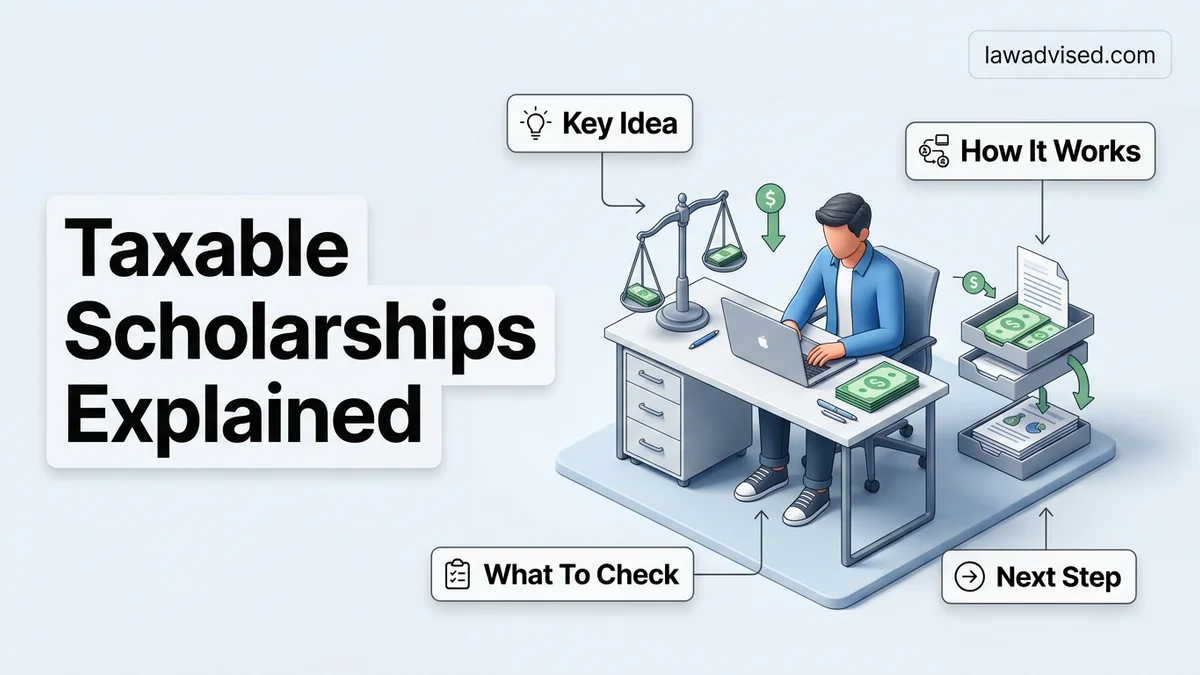
Taxable Scholarships Explained Step-by-Step 2026 Guide
Many students mistakenly assume all financial aid is tax-free, but portions of scholarships used for living expenses, room and board, and travel are subject to federal and state income taxes. Understanding IRS rules on qualified versus non-qualified expenses prevents costly penalties and ensures accurate tax filing.
Scholarships, fellowships, and grants are generally tax-free only if you use the money for qualified tuition and related expenses like required books, supplies, and equipment. Any portion of your financial aid that pays for room, board, travel, or optional gear is fully subject to federal and state income taxes.
Navigating this distinction is critical for your 2026 tax filings. Misreporting these funds can trigger automated IRS notices, unexpected penalties, or lost deductions. This guide breaks down exactly which dollars are taxable, how to calculate your liability, and how to report everything correctly.
Key Takeaways
- Qualified expenses like tuition and required textbooks are completely tax-free.
- Funds used for room, board, and travel are strictly taxable income.
- Service-required stipends and teaching fellowships are taxed as earned income.
- Report taxable scholarship amounts on IRS Form 1040 as part of your gross income.
- Form 1098-T helps reconcile your eligible payments against received financial aid.
What Causes Scholarships to Become Taxable Under IRS Rules
Qualified Expenses Versus Personal Living Costs
The IRS draws a sharp line between academic necessities and personal living costs. If you receive a scholarship, the tax-free portion is strictly limited to amounts you spend on:
- Tuition and enrollment fees required for enrollment or attendance at an eligible educational institution
- Course-related expenses, such as books, supplies, and equipment required for specific courses
Once your award covers these qualified items, any leftover money is considered taxable income. For instance, if you use a grant to pay for off-campus housing or your meal plan, that specific amount must be reported on your 2026 tax return.
Service Required Awards and Stipends
Some scholarships and fellowships require a service commitment as a condition of receiving the funds. Teaching assistantships, research stipends, and institutional service grants are classic examples. Even if you immediately turn around and use that stipend money to pay your tuition bill, the IRS treats service-required payments as taxable earned income. Because these amounts compensate you for services rendered, they are subject to standard income withholding rules and must be reported differently than traditional merit awards.
How to Calculate Your Taxable Scholarship Amount Step-by-Step
Gathering Your Financial Documents
Calculating your taxable scholarship requires a side-by-side comparison of your total aid against your actual qualified expenses. Start by pulling your Form 1098-T from your university’s billing portal. This form lists the qualified tuition and related expenses billed to your account during the 2026 calendar year. Next, collect all notification letters for scholarships, grants, and departmental awards you received throughout the year. Do not rely solely on your Form 1098-T, as box 5 may not reflect the full picture of private or external scholarships paid directly to you or your school.
Running the Calculation
To find your exact taxable scholarship amount, follow this straightforward calculation process:
- Add up all scholarship, fellowship, and grant funds received and applied to your education during 2026.
- Subtract the total amount of qualified education expenses (tuition, fees, and required books) that you actually paid for using those funds.
- The remaining balance represents your taxable scholarship income.
For example, if you received $15,000 in total grants, but your qualified tuition and book expenses totaled only $11,000, you must report $4,000 as taxable income on your federal return.
How to Report Taxable Scholarship Income on Your Tax Return
Filing your 2026 tax return requires careful reporting of any taxable portion of your scholarships or fellowships. The Internal Revenue Service mandates that you report this unearned income even if you did not receive a Form 1098-T from your educational institution.
Reporting on IRS Form 1040
- Locate the taxable scholarship amount that exceeds your qualified education expenses for the 2026 tax year.
- Enter this specific figure on Form 1040, Schedule 1, line 8z, designating it as “SCH” alongside the exact dollar amount.
- Transfer the total from Schedule 1 directly to your main Form 1040 to ensure it is correctly factored into your adjusted gross income.
Special Considerations for Dependents and W-2 Workers
According to IRS guidelines, if you are claimed as a dependent on another taxpayer’s return, your taxable scholarship is still subject to the “kiddie tax” rules if unearned income thresholds are crossed for 2026. Furthermore, if your scholarship required a W-2 service component like teaching or research, that portion is treated as earned wages rather than standard unearned scholarship income.
What If Your Form 1098-T Doesn’t Match Your Records
Discrepancies between your personal financial ledger and the figures reported on your Form 1098-T are common for the 2026 tax cycle. This often occurs because Box 1 tracks payments received within the calendar year rather than the academic semester dates.
Reconciling Timing Differences
- Pull your university student account billing statement for both the spring and fall 2026 terms to verify exact transaction dates.
- Identify any tuition payments made in December 2025 that apply to the spring 2026 semester, as this shifts how the institution reports the funds.
- Maintain a detailed, written ledger linking every scholarship disbursement to an approved qualified education expense for your personal tax files.
What If It Still Doesn’t Work?
If reconciling your 1098-T records and calculating your taxable scholarship remains ambiguous, taxpayers can implement several fallback procedures to ensure compliance for 2026.
- Contact your university’s bursar or financial aid office immediately to request a corrected or itemized Form 1098-T statement.
- Utilize IRS Free File or commercial tax preparation software designed to automatically prompt you through scholarship and fellowship calculations.
- Consult a Certified Public Accountant (CPA) or Enrolled Agent (EA) who specializes in higher education tax credits and student reporting guidelines. Professional tax advisory fees typically range from $200 to $500 depending on the complexity of your overall return.
- File for an extension on your 2026 tax return if documentation delays persist, ensuring you estimate and pay any potential tax liability beforehand to avoid penalties.
Conclusion
Navigating taxable scholarships requires distinguishing between qualified education expenses like tuition and non-qualified costs like room and board. According to verified research from tax education authorities, meticulous record-keeping prevents costly IRS discrepancy notices and audit triggers. Your actionable next step for the 2026 tax season is to gather your Form 1098-T and institutional billing statements today, cross-referencing every scholarship dollar against your actual out-of-pocket academic expenses before you file.
❓ Frequently Asked Questions
What specifically counts as a qualified educational expense for tax purposes?
Qualified expenses include tuition, enrollment fees, and required books, supplies, and equipment needed for your courses. Equipment is only qualified if it is explicitly required by the instructor for an enrolled class.
How do W-2 forms impact fellowship or graduate assistantship recipients?
If your scholarship or fellowship requires you to perform teaching, research, or other services as a condition of receiving the funds, the institution will typically issue a Form W-2, withholding payroll taxes directly from your stipend.
How should international students report taxable scholarship income?
International students generally receive Form 1042-S instead of a 1098-T and must file Form 1040-NR, depending on their tax residency status and applicable tax treaties between the US and their home country.
Do I have to pay self-employment tax on scholarship stipends?
Generally, scholarship and fellowship grants reported on Form 1040 are not subject to self-employment tax unless the payments are compensation for services rendered outside of standard degree requirements.
What happens if I use scholarship money to buy a computer for school?
If the computer or software is a mandatory requirement for your course enrollment as stated by the school syllabus or department, it is considered a tax-free qualified expense.
Where exactly on Form 1040 do I report taxable scholarship amounts?
Taxable scholarship portions not reported on a W-2 are typically added to line 1r of Form 1040 as ‘Sch’ with the corresponding taxable amount included in your total household income.

Ismail Hossain is the founder of Law Advised. He is an Divorce, Separation, marriage lawyer. Follow him.