Taxes for Freelancers Explained A Step-by-Step Guide 2026
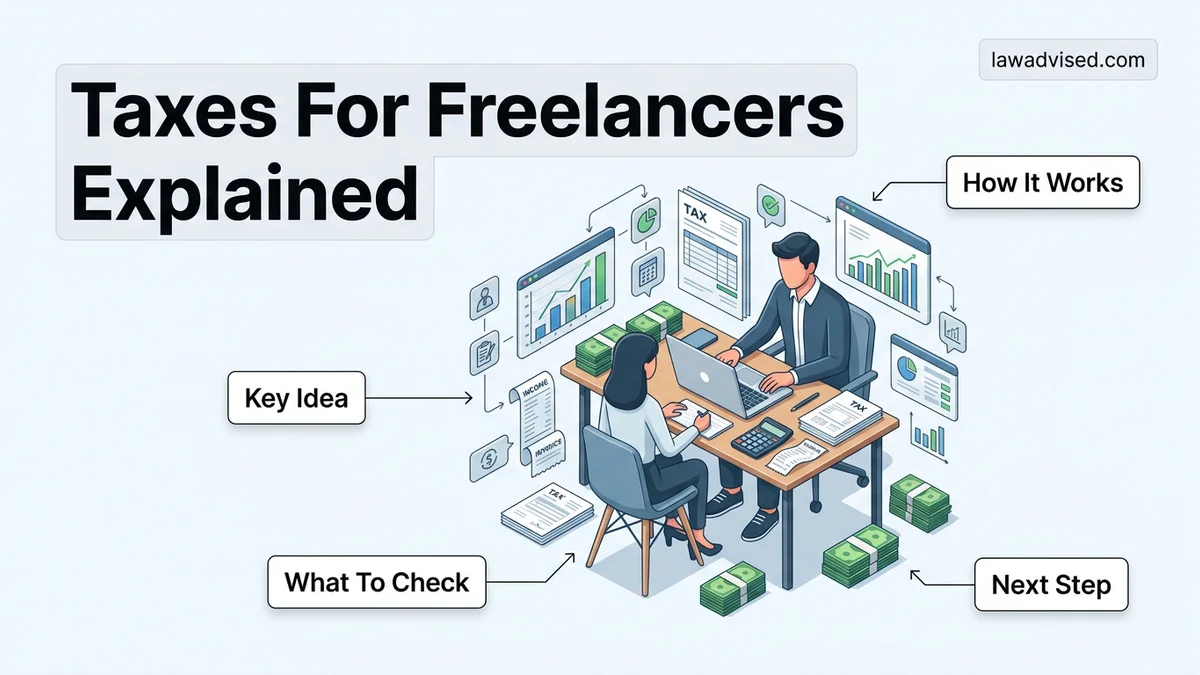
Navigating taxes for freelancers requires managing your own self-employment taxes, quarterly estimated payments, and business deductions. Without an employer withholding taxes automatically, you must track your income and pay what you owe directly to the IRS to avoid penalties. This guide breaks down exactly how to calculate, file, and minimize your tax burden.
When you work as a freelancer, nobody withholds taxes from your paycheck. You are legally responsible for paying both income tax and a hefty 15.3% self-employment tax directly to the IRS, alongside your state and local tax obligations.
Managing your 2026 freelance taxes effectively requires staying on top of quarterly estimated payments and tracking deductible business expenses. Failing to plan for these obligations results in surprise tax bills, cash flow crunches, and IRS underpayment penalties at the end of the year.
Key Takeaways
- Freelancers pay a 15.3% self-employment tax to cover Social Security and Medicare obligations.
- Quarterly estimated taxes must be paid four times a year to avoid IRS underpayment penalties.
- You can deduct half of your self-employment tax from your overall adjusted gross income.
- Tracking standard business expenses like software and home offices directly lowers your taxable income.
- Independent contractors file their business earnings using Schedule C alongside Form 1040.
What Causes High Tax Bills and Confusion for Freelancers
Traditional employees only pay half of their Social Security and Medicare taxes because their employers pay the other half. As a freelancer, you wear both hats, which triggers the double-whammy of self-employment tax.
The Reality of the 15.3 Percent Self-Employment Tax
The self-employment tax rate sits at 15.3% on your net earnings up to the annual Social Security wage base limit for 2026. This breaks down into two distinct parts:
- 12.4 percent goes toward Social Security.
- 2.9 percent goes toward Medicare.
If you earn a net profit of 80,000 dollars in 2026, you will owe over 12,000 dollars in self-employment taxes alone, before you even calculate your standard income tax bracket.
The Silver Lining: Deducting Half of Your SE Tax
Fortunately, the tax code offers a slight cushion to offset this heavy burden. You are allowed to deduct half of your self-employment tax liability from your gross income before calculating your adjusted gross income.
- This deduction lowers your overall income tax liability.
- It applies automatically when you file Schedule SE with your Form 1040.
- It does not reduce your self-employment tax itself, only your income tax.
How to Calculate and Pay Quarterly Estimated Taxes
The IRS expects you to pay as you go. If you wait until April 2027 to pay your 2026 taxes, you will trigger severe underpayment penalties and interest charges.
Deadlines for 2026 Quarterly Payments
To avoid IRS penalties, you must calculate your projected annual income and submit payments four times a year. Mark these mandatory 2026 payment deadlines on your calendar:
- April 15, 2026 for Q1 earnings (January through March)
- June 15, 2026 for Q2 earnings (April and May)
- September 15, 2026 for Q3 earnings (June through August)
- January 15, 2027 for Q4 earnings (September through December)
How to Estimate Your Quarterly Payments
The safest method to avoid penalties is the safe harbor rule. You can base your 2026 quarterly payments on either 100% of your total 2025 tax liability or 90% of what you will actually owe for 2026.
- Calculate your net freelance income after subtracting legitimate business expenses.
- Set aside roughly 25 to 30 percent of every client payment into a separate savings account immediately.
- Pay your estimated taxes online using the IRS Direct Pay system to ensure fast processing.
Step-by-Step Guide to Claiming Freelance Business Deductions
Maximizing legitimate deductions is the most effective way to lower your 2026 tax liability as a self-employed professional. The IRS permits you to write off ordinary and necessary expenses incurred directly while operating your freelance business.
1. Identify Qualified Business Expenses
Review your bank and credit card statements to isolate standard freelance write-offs. Common categories include software subscriptions, home office space, specialized equipment, professional development courses, and marketing costs.
2. Calculate the Home Office Deduction
If you use a specific area of your home exclusively and regularly for business, you can claim the home office deduction. Use the simplified method (allowing $5 per square foot up to 300 square feet) or the actual expense method to calculate your total deduction.
3. Log Business Mileage and Travel
Keep a strict contemporaneous log of all business-related driving. For the 2026 tax year, multiply your total qualified business miles by the IRS standard mileage rate to determine your vehicle deduction.
4. Organize Receipts and Documentation
Store digital or physical copies of every receipt exceeding $75, alongside invoices and bank statements. According to IRS compliance guidelines, you must retain these financial records for at least three years from your filing date.
What If You Miss a Deadline or Owe More Than Expected
Facing a missed filing deadline or discovering a massive tax bill in 2026 can feel overwhelming, but swift action prevents compounding financial penalties.
1. File Your Return Immediately
Submit your tax return as soon as possible, even if you cannot afford to pay the full balance owed. The failure-to-file penalty is significantly higher than the failure-to-pay penalty charged by the IRS.
2. Request an IRS Payment Plan
If you cannot pay your tax liability in full, apply online for a short-term payment plan or an installment agreement. Setting up an official payment arrangement reduces your monthly failure-to-pay penalty rate.
3. Contact a Certified Tax Professional
When tax liabilities exceed your ability to manage them through standard IRS portals, consult a certified public accountant or Enrolled Agent. According to industry data from the National Association of Tax Professionals, professional representation fees for IRS negotiations generally range from $300 to $1,500 depending on complexity.
Conclusion
Navigating freelance taxes requires proactive quarterly planning, meticulous expense tracking, and strategic deduction management to keep your business financially healthy. Take your next crucial step today by opening a dedicated business bank account to separate personal and professional transactions ahead of your upcoming filing deadline. According to verified research and expert sources from the National Association of Self-Employed, freelancers who maintain separate financial accounts reduce their audit risk and save an average of 15 hours during annual tax preparation.
❓ Frequently Asked Questions
What is the difference between W-2 taxes and 1099 freelance taxes?
W-2 employees have federal income tax, Social Security, and Medicare split and withheld automatically by their employers. Freelancers receive 1099 forms and must calculate and pay both the employee and employer portions of these taxes entirely on their own.
How do I deduct the home office expense as a freelancer?
You can use either the simplified method ($5 per square foot up to 300 square feet) or the regular method to deduct a proportional share of your rent, utilities, and internet based on the square footage used exclusively for business.
What happens if I miss a quarterly estimated tax payment deadline?
Missing a quarterly deadline can result in IRS underpayment penalties and interest charges when you file your annual return. You should make the late payment as soon as possible to minimize these added fees.
Are health insurance premiums deductible for freelancers?
Yes, self-employed individuals can usually deduct 100% of their health, dental, and qualifying long-term care insurance premiums for themselves and their dependents as an adjustment to income.
What records and receipts do I need to keep for tax season?
You should keep all 1099 forms received from clients, invoices, bank statements, and digital or paper receipts for business-related expenses. The IRS generally requires you to retain these financial records for at least three years.
Do I need to form an LLC to handle my freelance taxes?
Forming an LLC does not automatically change how the IRS taxes your freelance income unless you elect corporate taxation. Most freelancers start as sole proprietors and use Schedule C, exploring LLC status later for liability protection or scaling.

Ismail Hossain is the founder of Law Advised. He is an Divorce, Separation, marriage lawyer. Follow him.