Taxes on Mutual Funds Expert 2026 Guide and Rules
Navigating taxes on mutual funds requires understanding that you can owe taxes even if you never sold a share. Fund managers selling underlying assets trigger capital gains distributions and dividends that impact your annual tax liability in taxable accounts.
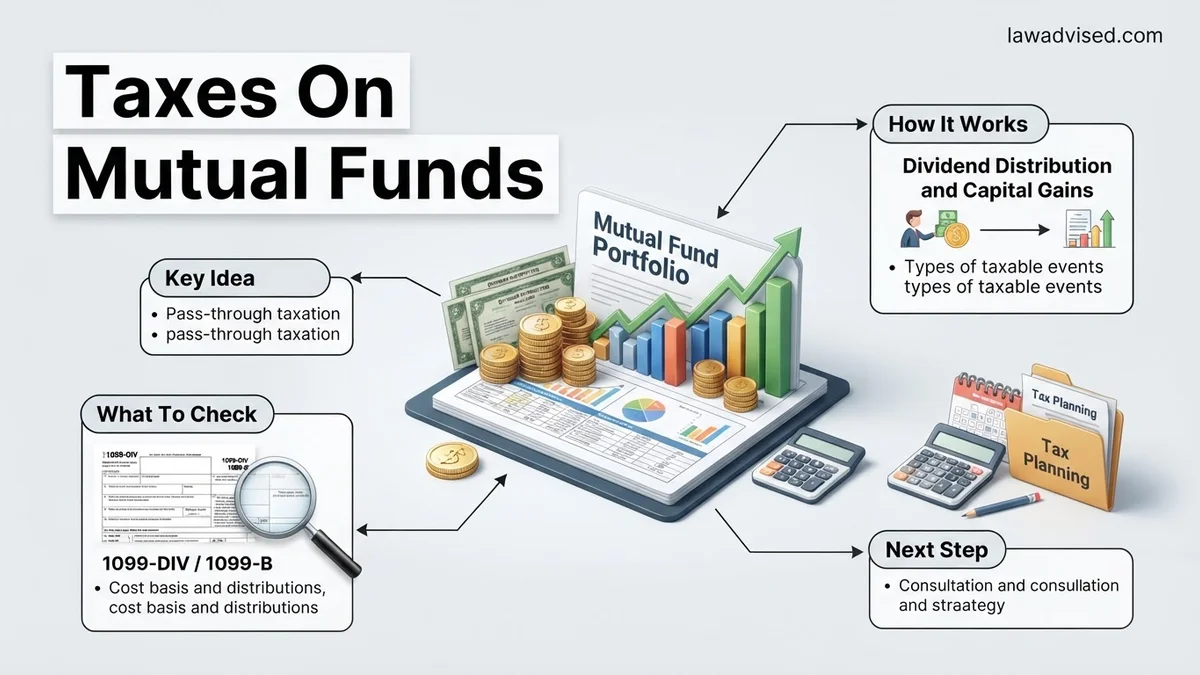
You owe taxes on mutual funds when you sell shares for a profit, but you can also trigger a tax bill even if you never sold a single share. This frustrating reality happens because mutual fund managers constantly buy and sell underlying stocks or bonds inside the portfolio, passing those realized capital gains and dividends directly to you.
Navigating these rules in 2026 requires understanding how distributions work and why traditional taxable brokerage accounts behave entirely differently than tax-advantaged retirement plans. If you hold mutual funds outside of an IRA or 401(k), the internal portfolio churn will impact your annual tax return whether you want to cash out or not.
Key Takeaways
- Mutual fund investors owe taxes on capital gains distributions even without selling shares.
- Short-term capital gains are taxed at ordinary income rates.
- Long-term capital gains benefit from preferential tax rates.
- Retirement accounts like IRAs protect investments from annual tax drag.
- ETFs generally offer better tax efficiency than traditional mutual funds.
What Causes Unexpected Taxes on Mutual Funds
Capital Gains Distributions Explained
When a fund manager sells underlying securities for a profit, the fund must distribute those net realized gains to shareholders. This usually happens toward the end of the calendar year. You receive these distributions based on your ownership percentage, and you must report them on your tax return. Short-term capital gains, triggered by assets held for one year or less, are taxed at your ordinary income tax rate. Long-term capital gains, resulting from assets held for more than a year, benefit from lower preferential tax rates of 0%, 15%, or 20% depending on your income bracket.
Dividends and Interest Income
Mutual funds also distribute the dividends and interest earned from the underlying stocks and bonds they hold. Qualified dividends receive the same favorable tax rates as long-term capital gains. Ordinary dividends and bond interest payments are taxed at your ordinary income tax rate. Even if you choose the automatic reinvestment option to buy more fund shares, the IRS still considers these distributions as taxable income for the year they were issued.
- Phantom Taxes: You pay taxes on distributions even if the fund’s overall value dropped during the year.
- Year-End Surprises: Heavy selling by the fund manager in November can create a massive tax bill in December.
- Reinvestment Trap: Reinvesting dividends buys more shares, but it does not shield you from the initial tax obligation.
How to Step-by-Step Minimize Your Mutual Fund Tax Liability
Utilize Tax-Advantaged Accounts First
The single most effective way to eliminate annual mutual fund tax drag is keeping your funds inside the right type of account. Traditional IRAs, Roth IRAs, and employer-sponsored 401(k) or 403(b) plans shelter your investments from annual capital gains and dividend taxes. Inside a Roth account, your distributions and eventual withdrawals grow entirely tax-free. Reserve taxable brokerage accounts only after you have maximized your annual contributions to these retirement vehicles.
Switch to Tax-Efficient Alternatives in Taxable Accounts
If you must invest in a taxable brokerage account, traditional actively managed mutual funds are often a poor choice due to high turnover. Consider shifting your strategy toward exchange-traded funds (ETFs) or index funds that track broad market benchmarks. ETFs use an in-kind creation and redemption mechanism that rarely triggers capital gains distributions, making them vastly more tax-efficient for taxable portfolios.
- Audit your accounts: Identify which mutual funds sit in taxable versus tax-advantaged accounts.
- Check turnover ratios: Look for funds with low portfolio turnover to minimize internal trading events.
- Transition gradually: Sell taxable mutual funds with losses to offset gains, or wait for favorable market conditions before moving cash into ETFs.
What If Tax-Loss Harvesting Still Leaves You with High Capital Gains
Tax-loss harvesting remains a foundational strategy for mitigating mutual fund tax liabilities, but volatile market conditions can sometimes leave investors with substantial residual gains. When offset opportunities are exhausted within a single portfolio, advanced repositioning steps are required to manage your 2026 tax bracket exposure.
Assessing Portfolio Over-Concentration
Persistent capital gains distributions often stem from actively managed funds holding legacy positions with low cost bases. According to Morningstar research, funds with high portfolio turnover rates above 50% generate unexpected taxable events regardless of recent market performance. Evaluating the underlying manager’s turnover ratio is critical for long-term tax mitigation.
Executing Strategic Fund Reallocation
If traditional harvesting falls short, investors should implement structural portfolio adjustments to protect against future taxable distributions. Consider the following procedural steps to regain tax efficiency:
- Audit all taxable brokerage accounts to identify persistently high-distribution funds.
- Transition capital systematically from actively managed mutual funds into tax-managed index funds or broad-market ETFs.
- Utilize direct-indexing strategies for new capital deployments to eliminate mutual fund structure risks entirely.
- Coordinate asset location by shifting fixed-income and high-turnover equity funds into tax-deferred accounts like traditional IRAs or 401(k)s.
Key Considerations for Retaining Tax Efficiency Moving Forward
Sustaining a tax-efficient portfolio requires ongoing vigilance beyond annual April tax filings. As tax codes evolve through 2026, proactive portfolio management prevents unexpected friction between investment growth and net-of-tax returns.
Monitoring Ex-Dividend and Distribution Dates
Mutual funds typically declare capital gains distributions toward the end of the fourth quarter, usually in November or December. Purchasing shares in a taxable account immediately before a distribution date exposes the investor to a “phantom tax”—paying taxes on gains they did not participate in generating. Reviewing fund distribution calendars prior to executing new buy orders is an industry best practice.
Leveraging Direct Indexing for Precision Control
Advanced investors are increasingly replacing traditional mutual funds with direct indexing services to bypass fund-level capital gains distributions altogether. By owning individual stocks that mirror an index rather than a pooled vehicle, investors can harvest individual stock losses daily. Financial planning studies show this approach can add up to 1.0% in annualized after-tax alpha.
What If It Still Doesn’t Work?
When systemic capital gains distributions continue to inflate your adjusted gross income despite aggressive harvesting, automated portfolio solutions may have reached their limit. Consider these fallback steps:
- Engage a Certified Financial Planner (CFP) or a Certified Public Accountant (CPA) specializing in advanced tax-overlay management. Professional advisory fees typically range from $1,500 to $3,500 annually for comprehensive multi-account tax coordination.
- Transition remaining taxable mutual fund holdings via an in-kind transfer to an institutional advisor utilizing custom direct-indexing tax overlays.
- Explore charitable remainder trusts (CRTs) or direct gifting of appreciated fund shares for portfolios exceeding $250,000 in unrealized gains.
- Restructure future systematic investment plans exclusively toward tax-efficient exchange-traded funds (ETFs) that utilize creation/redemption baskets to avoid capital gains distribution triggers.
Conclusion
Navigating mutual fund tax liabilities requires a balance of strategic reallocation, precise timing, and proactive portfolio structuring. By identifying high-turnover risks and utilizing modern tax-efficient vehicles, investors can significantly reduce unnecessary tax drag. According to verified research and expert sources from the Investment Company Institute, proactive tax management preserves crucial compound growth over long investment horizons. Your immediate next step is to review your current taxable brokerage accounts for funds with high turnover rates and schedule a portfolio efficiency audit.
❓ Frequently Asked Questions
Why did I receive a 1099-DIV for a mutual fund I never sold?
Mutual funds are pass-through entities. When the fund manager sells underlying securities for a profit, or when the fund collects dividends, those events are distributed to shareholders and reported on Form 1099-DIV.
What is the difference between short-term and long-term capital gains distributions?
Short-term capital gains result from the fund holding underlying assets for one year or less and are taxed as ordinary income. Long-term capital gains come from assets held longer than one year and qualify for lower tax rates.
How can I avoid paying high taxes on mutual funds?
You can avoid annual taxes by holding mutual funds inside tax-advantaged accounts like IRAs or 401(k)s. In taxable accounts, consider switching to tax-managed funds or exchange-traded funds (ETFs).
What is tax-loss harvesting and how does it help?
Tax-loss harvesting involves selling underperforming investments at a loss to offset capital gains realized from your mutual funds, reducing your overall taxable income for the year.
Are index mutual funds more tax-efficient than actively managed funds?
Generally yes. Index funds have lower portfolio turnover because they simply track a benchmark, which results in fewer capital gains distributions compared to active managers who frequently buy and sell.
When is the best time of year to buy a mutual fund in a taxable account?
It is often recommended to wait until after a fund’s annual distribution date—typically in November or December—to avoid buying ‘phantom income’ and paying immediate taxes on gains you didn’t participate in.

Ismail Hossain is the founder of Law Advised. He is an Divorce, Separation, marriage lawyer. Follow him.