What Causes an IRS Audit Real Red Flags to Avoid 2026
An IRS audit is typically triggered by mismatched income reporting, exceptionally high deductions relative to income, or mathematical errors on your tax return. Automated scoring systems flag returns that deviate from statistical norms, prompting either a simple automated notice or a detailed examination.
Getting flagged by the IRS usually comes down to specific mathematical anomalies, mismatched data, or behavioral patterns that deviate sharply from national norms. Modern tax filing for 2026 relies heavily on automated algorithms that scan millions of returns instantly, looking for statistical outliers and paper trails that do not add up. If your return contains specific red flags—like disproportionate deductions, math errors, or income that fails to match what third-party institutions reported—you dramatically increase your chances of being selected for a closer look.
Understanding what triggers these automated systems allows you to file with confidence and keep your return out of the audit queue. Avoiding an audit is not about paying more tax than you owe; it is about ensuring your paperwork accurately reflects your financial reality without setting off the agency’s automated alarm bells.
Key Takeaways
- Mismatched income between W-2s or 1099s and your tax return is a primary automated trigger.
- Claiming disproportionately high charitable deductions relative to your reported income raises immediate red flags.
- Running a continuous sole proprietorship loss for multiple consecutive years attracts IRS scrutiny.
- Using exact round numbers instead of precise accounting figures suggests estimation rather than accurate record-keeping.
- Keeping meticulous receipts and digital records protects you if your return is flagged for review.
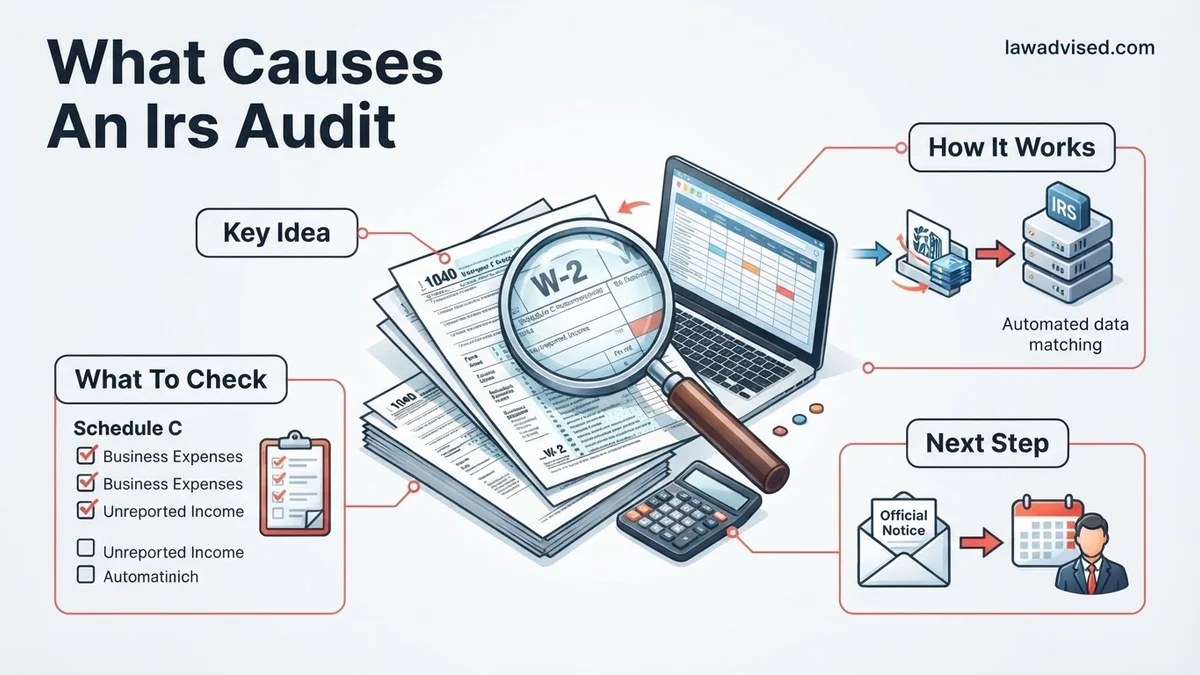
What Causes an IRS Audit and Triggers Red Flags
The IRS rarely selects returns at random anymore. Instead, the agency uses sophisticated scoring systems like the Discriminant Function (DIF) to grade your return. This system compares your tax return against statistical norms for taxpayers in your exact income bracket. When your deductions, expenses, or income figures stray too far from the average, your score rises, which often results in an audit.
High Income Levels and Sole Proprietorships
Earning a high income naturally increases your audit risk because the potential tax recovery is much higher. However, operating a cash-intensive business or reporting continuous sole proprietorship losses on a Schedule C draws immediate scrutiny. The IRS closely monitors businesses that report losses year after year, looking for hobby losses disguised as commercial enterprises.
- Reporting continuous business losses for three out of five consecutive years
- Failing to show a genuine profit motive in your business operations
- Operating entirely on cash, which makes revenue tracking difficult for investigators
Unusual Deductions and Math Errors
Claiming charitable contributions that dwarf your reported income is one of the fastest ways to trigger an automated review. Similarly, basic math errors or rounding every single figure to the nearest hundred or thousand dollars signals to the IRS that you guessed your numbers rather than relying on actual records.
How to Fix Income Discrepancies and Return Errors
One of the most common causes of an IRS audit is a mismatch between what you report on your tax return and what third-party payers submit. Employers, banks, and brokerages send Form W-2, Form 1099, and Form 1098 directly to the IRS. If the income or interest you report on your 1040 form does not match those documents down to the dollar, the IRS automated matching system flags your account.
Reconciling Form 1099 and W-2 Discrepancies
Freelancers and side-hustle workers often receive multiple 1099 forms throughout the year. If a client submits a 1099 showing you earned five thousand dollars, but you accidentally omit it or report four thousand dollars, the system generates a CP2000 notice. This is technically an automated underreporter inquiry rather than a full field audit, but it requires immediate correction.
- Cross-reference every income document against your bank statements before filing
- Report gross income from self-employment separately from business expenses
- File an amended return immediately if you discover you left out a 1099 form
Correcting Rounding Errors and Digital Asset Omissions
Never guess your deductions or round numbers up to clean figures. Using exact cents and numbers from your receipts proves you kept accurate records. Additionally, the IRS has ramped up enforcement regarding digital assets for 2026. Failing to answer the digital asset question at the top of your tax form or omitting cryptocurrency transactions creates an instant compliance flag that can trigger a broader examination of your financial records.
Step-by-Step Guide to Reducing Your Audit Risk
Proactive prevention remains the most effective defense against an unwanted IRS examination. Tax compliance experts and modern filing standards suggest a disciplined approach to preparing your annual return for the 2026 tax season.
1. Cross-Check All Income Documents
The IRS automated matching system compares your reported income directly against W-2s, 1099s, and K-1s issued by third parties. Always wait for every tax document to arrive before filing. Review each figure meticulously to ensure zero discrepancies between your records and government files.
2. Maintain Impeccable Digital Substantiation
If you claim complex write-offs like the home office deduction or business vehicle expenses, strict documentation is legally mandatory. Store receipts, mileage logs, and digital invoices in a secure cloud repository. According to IRS retention guidelines, keeping these records for a minimum of three to six years provides a bulletproof shield during a review.
3. Utilize Professional Tax Software or CPAs
Statistically, returns prepared by certified public accountants or reputable tax software feature lower random audit rates due to integrated validation checks. These systems flag math errors and unusual deduction ratios instantly. Investing in professional oversight minimizes human oversight errors that typically trigger automated IRS flags.
What If Your Return Still Gets Flagged by the IRS
Receiving an official correspondence notice from the IRS does not automatically mean you owe money or face severe penalties. When standard preventive measures fail and your return triggers an examination for 2026, taking systematic action protects your financial standing.
- Review the Notice Thoroughly: Read the specific IRS notice or letter (such as a CP2000 or audit notification) to identify which exact line items or documents require clarification.
- Gather Supporting Evidence: Pull all relevant receipts, bank statements, and logbooks that substantiate the questioned deductions or income sources within the timeframe requested by the agency.
- Respond Before the Deadline: Never ignore an IRS letter. Submit your organized documentation via mail or the secure IRS digital portal well before the stated deadline to avoid escalating penalties.
- Engage Professional Representation: If the audit involves complex business structures or substantial financial sums, hire a licensed CPA, Enrolled Agent, or tax attorney. Professional representation typically costs between $1,500 and $5,000 depending on the complexity of the case, but it ensures proper navigation of tax laws.
Conclusion
Navigating IRS audit triggers requires careful attention to income reporting, realistic deduction ratios, and rigorous record-keeping standards for 2026. Failing to address these red flags can lead to costly delays and stressful correspondence with federal tax authorities. According to verified research and expert tax sources, maintaining complete digital paper trails and double-checking third-party document matching reduces your overall audit probability significantly. Your actionable next step is to audit your own draft return for math consistency and missing 1099s before hitting submit.
❓ Frequently Asked Questions
How does the IRS select tax returns for an audit?
The IRS primarily uses an automated scoring system called the Discriminant Function (DIF) to compare your return against statistical norms for similar income levels. Returns with abnormal ratios or discrepancies are flagged for manual review or automated correspondence.
Will filing a late tax return cause an IRS audit?
Filing late or failing to file incurs failure-to-file penalties and interest, but it does not automatically trigger a traditional audit unless significant income was left unreported.
Are self-employed individuals and small business owners audited more frequently?
Yes, sole proprietors, independent contractors, and cash-intensive businesses face higher audit rates. This is due to the greater potential for mixing personal and business expenses or underreporting cash revenue.
What role do matching documents play in IRS audits?
Employers and financial institutions send copies of tax forms like W-2s, 1099s, and 1098s directly to the IRS. If the numbers on your tax return do not match these digital records, the IRS automated system flags the mismatch immediately.
Can taking large charitable donations trigger a tax audit?
Yes, claiming charitable deductions that are unusually high relative to your adjusted gross income will attract IRS attention. Donating non-cash assets or vehicles without proper appraisals also increases audit risk.
How far back can the IRS audit a tax return?
The IRS typically audits returns filed within the last three years. However, if they discover a substantial omission of income exceeding 25 percent, they can legally review the previous six years or longer in cases of suspected fraud.

Ismail Hossain is the founder of Law Advised. He is an Divorce, Separation, marriage lawyer. Follow him.