What Happens If You Do Not Receive 1099 Step-by-Step 2026
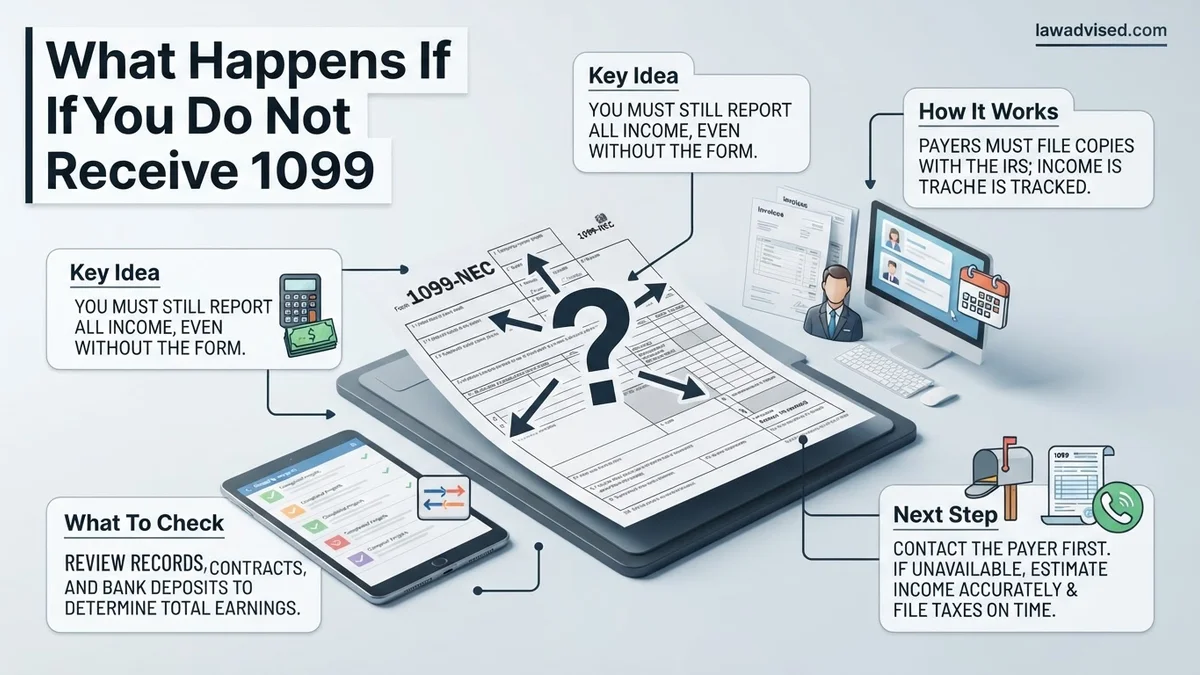
Missing your 1099 form does not excuse you from reporting your earnings to the IRS. You must calculate and report this income using your own business records, bank statements, or invoices to avoid penalties.
You still legally must report and pay taxes on your independent contractor income for 2026, even if you never receive a 1099 form from your client. The IRS receives a copy of that 1099 data directly, so failing to report the income because the physical form got lost will trigger automated mismatch notices and potential penalties.
Missing tax documents create major headaches during filing season. Knowing the exact steps to track down your paperwork or calculate your earnings independently will keep your 2026 tax return accurate and prevent costly IRS delays.
Key Takeaways
- You must still report and pay taxes on independent contractor income even without a 1099.
- Contact the payer immediately to verify your correct mailing address and request a copy.
- Check online payment portals and accounting software to download digital versions of your forms.
- Calculate your missing income accurately using bank deposits, invoices, and accounting records.
- File an extension or use substitute records if the tax deadline arrives before the payer responds.
What Happens If You Do Not Receive 1099 and Why It Happens
The absence of a 1099 form does not mean your income is tax-free. Independent contractors, freelancers, and gig workers must report all business earnings regardless of whether a payer issues tax paperwork.
The IRS Already Knows About Your Income
Businesses file copy A of the 1099 directly with the IRS. If a client paid you $600 or more during 2026, the federal government likely has a record of that payment waiting in their system. Leaving that income off your return creates an immediate discrepancy when automated matching software scans your tax forms.
Common Reasons for Missing Forms
Payers frequently miss IRS delivery deadlines due to administrative oversights. Common reasons you might not have your 1099 include:
- Your mailing address changed recently and the form bounced back.
- The company switched payroll software providers for the 2026 tax year and data transferred incorrectly.
- Your total earnings from that specific client fell just below the $600 statutory threshold.
- The company mistakenly classified you as a W-2 employee instead of a 1099 contractor.
How to Contact the Payer and Verify Your Information
When a 1099 fails to arrive by mid-February 2026, you need to take proactive steps to secure the document or confirm the payout data directly from the source.
Reaching Out to Accounting or Human Resources
Contact the accounts payable department or the person who manages contractor payouts at the client company. Send a clear, direct message asking for your 2026 Form 1099-NEC or 1099-MISC. Provide your current mailing address, email address, and Taxpayer Identification Number (SSN or EIN) to speed up their search.
Checking Vendor Portals and Digital Accounts
Many corporations now use third-party platforms like Contractor Portal, ADP, or Stripe to manage tax documents. Log into any invoicing or payment platforms you used with the client throughout 2026. Look for a dedicated tax center tab where digital copies of 1099s are often published weeks before paper copies ever arrive in the mail.
Step-by-Step Guide to Filing Taxes Without a 1099
Filing your 2026 tax return without a physical 1099 form requires precision. According to IRS guidelines, you are legally obligated to report all self-employment earnings even if a client failed to issue the document. Follow this procedural framework to compile your data and submit your taxes accurately.
1. Reconstruct Your Income Records
- Open your business bank accounts and payment processor dashboards such as PayPal, Stripe, or Venmo.
- Filter transactions by the 2026 calendar year to isolate payments received from the missing payer.
- Cross-reference these deposits with your sent invoices, project management software, and written client contracts.
- Calculate the exact gross income total received from that specific client during the tax year.
2. Complete the Necessary Tax Schedules
- Input your calculated gross receipts into Part I of Schedule C (Profit or Loss From Business).
- Deduct all ordinary and necessary business expenses to determine your net self-employment earnings.
- Transfer your net earnings figure to Schedule SE to calculate your self-employment tax obligations.
- Attach these completed schedules to your Form 1040 before final electronic submission.
What to Do If the Payer Fails to Respond or IRS Intervention Is Needed
If a client ignores your outreach attempts or refuses to provide the corrected 1099 form ahead of the 2026 filing deadline, you must escalate the issue through official federal channels. The IRS provides administrative mechanisms to handle delinquent or uncooperative payers who neglect their tax reporting duties.
1. Initiate Formal IRS Contact
- Call the IRS customer service line at 1-800-829-1040 to report the missing income document.
- Provide the IRS agent with the client’s business name, address, phone number, and Estimated Employer Identification Number (EIN).
- Provide your own taxpayer identification details and a summary of the earnings in dispute.
2. Request Substitute Form Assistance
- Ask the IRS representative to issue a formal failure-to-furnish notice to the non-compliant payer.
- Request guidance on completing Form 4852 (Substitute for Form 1099-NEC) if filing deadlines are imminent.
- Attach the completed Form 4852 to your tax return using your meticulously calculated bank records as supporting documentation.
What If It Still Doesn’t Work?
If your attempts to contact the payer fail and you feel unequipped to handle substitute tax forms independently, execute these fallback steps to ensure compliance:
- Engage a Certified Public Accountant (CPA) or Enlisted Agent to review your substituted income calculations, with professional service fees typically ranging from $250 to $600 for standard self-employment returns.
- File for an automatic six-month tax extension using IRS Form 4868 to buy additional time to resolve reporting discrepancies without incurring late-filing penalties.
- Submit a formal complaint against the business through the Better Business Bureau or state labor department regarding non-compliance with federal tax reporting standards.
- Retain all digital audit trails, certified mail receipts, and email timestamps for a minimum of six years in the event of a future IRS inquiry.
Conclusion
Failing to receive a 1009 form does not excuse you from reporting your independent contractor income to the IRS. By reconciling your payment platform history, utilizing substitute documentation like Form 4852, and leveraging IRS dispute protocols, you can file your 2026 taxes accurately and avoid costly penalties. According to verified research and expert tax sources from the National Association of Tax Professionals, proactive self-reporting remains the single most effective defense against federal audits.
❓ Frequently Asked Questions
What happens if you do not receive 1099 from a client who paid you?
If you do not receive a 1099, you are still legally obligated to report the income on your tax return. The IRS receives a copy of the 1099 if one was generated, so failing to report the income will likely trigger an automated tax notice.
How can I calculate my income if I never get my 1099 form?
You can calculate your missing income by reviewing your bank statements, business invoices, receipts, and accounting software logs. Total the payments received from that specific client during the calendar year to get an accurate figure.
Should I file for a tax extension if my 1099 is delayed?
If you are waiting on a 1099 and the tax filing deadline is fast approaching, filing for a tax extension gives you extra time to gather documents. However, remember that an extension to file is not an extension to pay any estimated taxes owed.
What should I do if a payer refuses or fails to send my 1099?
If a payer ignores your requests or fails to send the form by mid-February, you can contact the IRS for assistance. The IRS will contact the employer on your behalf, though you should still file your taxes using your own records.
Do I need a 1099 to file Schedule C as a freelancer?
No, Schedule C requires you to report your gross receipts and sales from your business operations as a whole. You do not attach individual 1099 forms to your tax return when filing electronically.
Is there a minimum earnings threshold for receiving a 1099?
Generally, clients are required to issue a 1099-NEC if they paid you $600 or more during the calendar year. However, third-party payment networks may have different thresholds based on current tax regulations.

Ismail Hossain is the founder of Law Advised. He is an Divorce, Separation, marriage lawyer. Follow him.