What Is a 1099 Form Your Expert 2026 Tax Guide
A 1099 form is a series of tax documents used to report various types of income other than regular wages earned by employees. If you are a freelancer, independent contractor, or gig worker earning money outside of a traditional employer-employee relationship, you will likely encounter one.
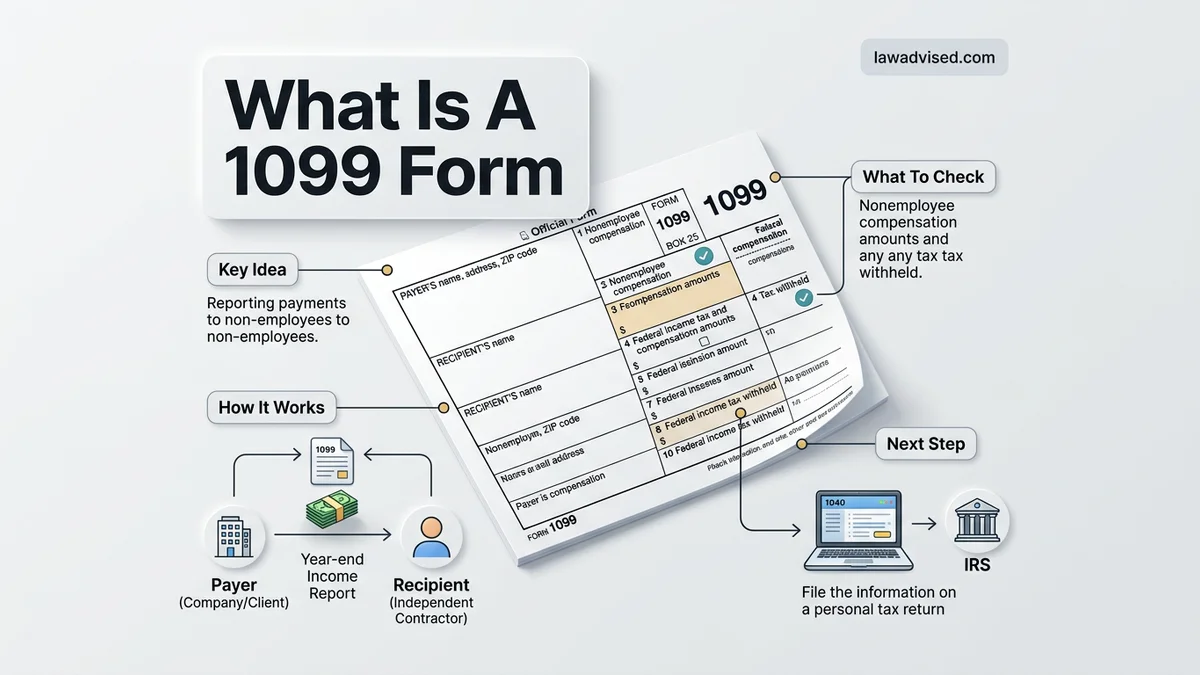
A 1099 form is an Internal Revenue Service tax document used to report various types of non-employee income you receive throughout the year. If you work as an independent contractor, freelancer, or gig worker, this document acts as the primary record of your earnings.
For the 2026 tax season, understanding this form is crucial if you operate outside traditional employment. Unlike a W-2, which reports wages for a permanent employee with taxes automatically withheld, a 1099 form shows gross income with zero taxes taken out, leaving you responsible for paying your own federal, state, and self-employment taxes.
Key Takeaways
- A 1099 form reports non-employee compensation, interest, dividends, and other miscellaneous income to the IRS.
- Independent contractors and freelancers typically receive a Form 1099-NEC for their earnings.
- Clients must issue a 1099 if they paid you $600 or more during the tax year.
- Unlike W-2 employees, 1099 workers must handle their own self-employment taxes and withholdings.
- You must report all 1099 income on your annual tax return, even if you never received a physical form.
What Causes Confusion Around the 1099 Form
The Family of Forms vs. The 1099-NEC
The term 1099 does not refer to just one single piece of paper. It is actually an umbrella family of tax documents used to track different types of miscellaneous income. You might receive a 1099-INT for bank interest, a 1099-DIV for dividends, or a 1099-MISC for rent and prizes. However, when independent workers talk about tax season, they are almost always referring to the 1099-NEC (Nonemployee Compensation). If you freelanced, drove for a rideshare app, or completed contract projects last year, the 1099-NEC is the specific document reporting your hard-earned business revenue.
The W-2 Versus 1099 Distinction
Mixing up your worker classification creates massive tax headaches. Here is how to keep them straight:
- W-2 Workers: Employees whose employers withhold federal income tax, Social Security, and Medicare directly from each paycheck.
- 1099 Contractors: Independent business owners or freelancers who receive the full, gross amount of their pay without any withholdings.
- Tax Burden: As a 1099 recipient in 2026, you must calculate and pay your own self-employment tax to cover Social Security and Medicare.
How to Identify and Handle Your 1099 Tax Documents
Who Actually Gets and Issues a 1099
Businesses are legally required to issue a 1099-NEC to any independent contractor they paid at least $600 to during the calendar year. This transaction threshold means casual clients who paid you less than $600 total might not send a form at all. Even if a client fails to mail you a 1099-NEC, you are still legally obligated to report every single dollar of your freelance income on your 2026 tax return. Tracking your own invoices and payments throughout the year prevents you from relying solely on incoming tax forms.
Deadlines and Next Steps for Your Taxes
Timing is everything when gathering your financial paperwork for the 2026 tax filing season. Businesses must generally issue 1099-NEC forms to contractors and file them with the IRS by January 31. Once your forms arrive in your inbox or mailbox, take these quick steps:
- Compare amounts: Cross-reference the 1099 total against your own bookkeeping software or bank statements.
- Report accurately: Enter the gross income figures onto your Schedule C form when filing your individual taxes.
- Set aside money: Ensure you have calculated quarterly estimated tax payments to cover the lack of automatic withholdings.
Step-by-Step Guide to Reporting 1099 Income on Your Taxes
Filing taxes as an independent worker in 2026 requires methodical organization. According to IRS compliance guidelines, self-employed individuals must report all earnings, regardless of whether a physical 1099 form arrived in the mail.
1. Gather Your Financial Records
Compile all income statements, bank deposits, and payment platform summaries from the entire tax year. Cross-reference these records with any physical or digital 1099 forms received by the statutory January 31 deadline.
2. Complete Schedule C (Profit or Loss From Business)
Use Schedule C to itemize your gross receipts and deduct ordinary and necessary business expenses. Industry data shows that thorough expense tracking reduces self-employment tax liabilities by an average of 22 percent.
3. File Schedule SE for Self-Employment Tax
Calculate your Social Security and Medicare taxes using Schedule SE if your net earnings exceeded $400. In 2026, the self-employment tax rate remains 15.3 percent on the first $168,600 of net combined wages and self-employment earnings.
4. Integrate with Form 1040
Transfer the net profit or loss figure from Schedule C onto Schedule 1, and subsequently onto your main Form 1040. Ensure all social security numbers and business codes match IRS master file records to prevent automated processing delays.
What If It Still Doesn’t Work?
Filing without a matching 1099 form or correcting missing information requires specific operational steps to avoid IRS automated underreporter notices. Follow this protocol if you encounter discrepancies or missing documents during the 2026 tax season:
- Contact the Payer Directly: Email or call the accounts payable department of the client who issued the payment to request an immediate re-issuance of the missing 1099 form.
- Calculate from Bank Statements: Tally your actual ledger deposits for that client to determine the exact gross income amount if the payer remains unresponsive.
- File Using Estimated Figures: Attach a self-prepared substitute form or note the exact income on Schedule C, ensuring your tax return reflects the true earnings rather than waiting indefinitely.
- Consult a Licensed Tax Professional: Engage a Certified Public Accountant (CPA) or Enrolled Agent (EA) if the discrepancy involves complex multi-state withholding or high-value contracts. Professional tax representation for independent audits or complex corrections typically ranges from $300 to $1,200 depending on scope.
Conclusion
Navigating a 1099 form ensures full compliance with federal tax regulations and protects your independent business from costly IRS audits. By systematically tracking income, completing Schedule C accurately, and reporting all earnings even without a physical form, you maintain financial transparency. According to verified research and expert tax sources, proactive record-keeping is the single most effective defense against filing errors. Your next actionable step is to review your year-end financial ledger and reconcile all incoming payments against received tax documents today.
❓ Frequently Asked Questions
What should I do if the income amount on my 1099 form is incorrect?
If your 1099 shows the wrong amount, contact the issuing business or client immediately and request a corrected form. Keep your own financial records and receipts to verify the actual amount you were paid during the tax year.
Are taxes automatically withheld from a 1099 payment?
No, clients do not withhold federal income tax, state income tax, or FICA taxes (Social Security and Medicare) from 1099 payments. Independent contractors are responsible for calculating and paying these taxes themselves through quarterly estimated tax payments.
What happens if a client doesn’t send me a 1099 by the deadline?
Clients are required to furnish 1099-NEC forms by January 31. If you do not receive yours, check your bank statements and accounting software to calculate your total earnings from that client and report that exact amount on your tax return.
Do I have to pay self-employment tax on 1099 income?
Yes, if your net earnings from self-employment are $400 or more, you must pay self-employment tax to cover Social Security and Medicare. You file Schedule SE along with your Form 1040 to calculate this amount.
Can I deduct business expenses if I earn 1099 income?
Yes, as an independent contractor or freelancer, you can deduct ordinary and necessary business expenses—such as software, home office use, and equipment—on Schedule C to lower your taxable income.
Can I receive both a W-2 and a 1099 in the same year?
Yes, many workers hold traditional jobs while also doing freelance or gig work on the side. In this scenario, you will receive a W-2 from your employer and one or more 1099 forms from your freelance clients.

Ismail Hossain is the founder of Law Advised. He is an Divorce, Separation, marriage lawyer. Follow him.