How to Calculate Capital Gains Step-by-Step Guide for 2026
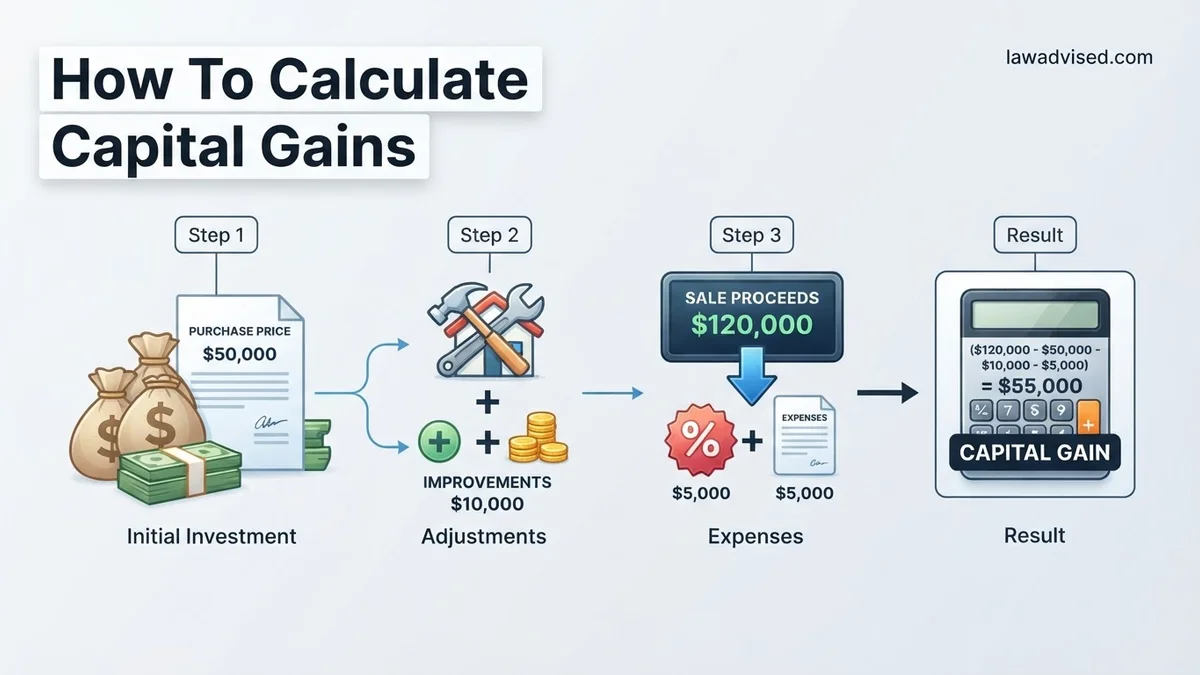
To calculate capital gains, subtract your original purchase price and selling expenses from your final sale price. This determines your taxable profit, which is categorized as either short-term or long-term depending on your holding period.
To calculate your capital gains in 2026, you take the total amount you received from selling an asset, subtract what you originally paid for it, and deduct any eligible selling expenses. The resulting figure is your capital gain, which represents the actual profit you must report on your tax return.
Getting this calculation right prevents you from overpaying the IRS or triggering an audit. Whether you sold shares of stock, cryptocurrency, or residential real estate, understanding the math behind your tax liability puts you in full control of your financial outcomes.
Key Takeaways
- Subtract your cost basis and selling expenses from the total sale proceeds to find your capital gain.
- Include broker fees, commissions, and major home improvements in your adjusted cost basis.
- Assets held for more than one year qualify for lower long-term capital gains tax rates.
- Short-term capital gains apply to assets held for one year or less and are taxed as ordinary income.
- Keep thorough records of purchase dates, prices, and improvement receipts to lower your taxable profit.
What Causes Capital Gains and Defines Your Taxable Profit
A capital gain occurs whenever you sell a capital asset for more than your adjusted purchase price. This simple transaction triggers a reporting requirement for the 2026 tax year. However, you are only taxed on the actual profit, not the total cash that lands in your bank account.
Identifying the Sale Price and Cost Basis
- Sale Price (Proceeds): The total amount of cash, property, or services you receive from the buyer.
- Cost Basis: What you originally paid to acquire the asset, including purchase commissions and buyer fees.
- Adjustments to Basis: Capital improvements that increase your basis, such as a major kitchen remodel on a home, or decreases like claimed depreciation.
Recognizing Taxable Events Versus Non-Taxable Transfers
Not every transfer of property triggers a capital gain. Gifts, transfers between spouses, and unrealized paper gains in your portfolio do not count. The taxable event strictly happens upon the finalized sale or exchange of the asset for value.
Master Capital Gains Calculation in 7 Simple Steps
Calculating your capital gains accurately is crucial for filing your taxes correctly and avoiding costly penalties from the IRS or local tax authorities. Whether you have sold stocks, real estate, or cryptocurrency, understanding the profit you made from an investment determines how much tax you owe. This guide breaks down the complex tax math into an approachable, chronological process to ensure you figure out your tax liability with confidence.
Step 1: Identify and Categorize Your Asset Type
What you need: Your brokerage statements, real estate closing documents, or crypto exchange transaction history.
Instructions: Before you can calculate any numbers, you must clearly define what type of asset you sold. Capital gains rules vary significantly depending on whether you are selling stocks, bonds, mutual funds, physical real estate, or digital assets like Bitcoin. Group your sales by asset category, as the tax brackets and reporting forms (such as Schedule D or Form 8949) will differ. Make sure you have all transaction histories downloaded or printed for the specific tax year in question.
Pro Tip: Do not mix asset classes in your initial sorting; keeping them separate prevents errors when applying specific asset-class tax deductions later.
Step 2: Determine Your Cost Basis
What you need: Original purchase confirmation receipts, settlement statements, or historical price charts.
Instructions: Your cost basis is the total amount you originally paid to acquire the asset. For stocks, this is simply the purchase price multiplied by the number of shares, plus any commissions or fees paid to your broker. For real estate, the cost basis includes the purchase price, legal fees, title insurance, and recording fees. If you inherited the asset, your basis is typically the fair market value on the date of the previous owner’s death. Accurately establishing this baseline is the single most important part of the calculation.
Pro Tip: Keep your original purchase records for as long as you own the asset plus at least seven years after you sell it.
Step 3: Add Capital Improvements to Your Basis
What you need: Receipts, contractor invoices, and records of major upgrades made during ownership.
Instructions: If you are calculating capital gains on real estate or certain business equipment, you can increase your original cost basis by the cost of permanent improvements. Capital improvements add value to the property, prolong its life, or adapt it to new uses—such as a new roof, a room addition, or a modernized HVAC system. Do not include routine maintenance or minor repairs like painting a room or fixing a leaky faucet. Add the total value of these qualifying improvements to your original purchase price to create your adjusted cost basis.
Pro Tip: Maintain a dedicated folder for home improvement receipts throughout the entire time you own the property.
Step 4: Calculate Your Gross Proceeds
What you need: Form 1099-B (for securities), closing disclosure (for real estate), or exchange sale statements.
Instructions: Gross proceeds represent the total amount of money or property you received from the buyer when you sold the asset. If you sold 100 shares of stock at $50 per share, your gross proceeds are $5,000. If you sold a house for $400,000, that is your gross sale figure. Check your 1099 forms to verify that the reported gross proceeds match your own records. Any broker fees or sales commissions subtracted at the point of sale should be noted, as they can be deducted from your final proceeds.
Pro Tip: Always double-check Form 1099-B totals against your own trade logs, as reporting omissions by brokers do occasionally happen.
Step 5: Determine the Holding Period (Short-Term vs. Long-Term)
What you need: Original purchase date and the final sale date of the asset.
Instructions: Calculate the exact duration you owned the asset by counting the day after you acquired it up to and including the day you disposed of it. If you held the asset for exactly one year or less, it is classified as a short-term capital gain, which is taxed at your ordinary income tax rate. If you held the asset for longer than one year (one year and one day or more), it qualifies as a long-term capital gain, which benefits from significantly lower tax rates of 0%, 15%, or 20% depending on your taxable income bracket.
Pro Tip: If you are selling an asset near its one-year anniversary, waiting just a few extra days can drastically reduce your tax rate.
Step 6: Subtract Your Adjusted Basis and Expenses from Proceeds
What you need: Your adjusted cost basis (from Step 3) and your gross proceeds (from Step 4).
Instructions: Now you perform the core mathematical calculation. Take your gross proceeds and subtract any selling expenses (like broker commissions, legal fees, and advertising costs) to find your net selling price. Next, subtract your adjusted cost basis from that net selling price. The resulting positive number is your capital gain. If the result is a negative number, you have experienced a capital loss, which can be used to offset other gains on your tax return.
Pro Tip: Use a spreadsheet application like Microsoft Excel or Google Sheets to automate this subtraction and minimize manual arithmetic errors.
Step 7: Apply Deductions and Calculate Final Tax Owed
What you need: Current IRS tax brackets, Section 121 exclusion rules (for primary residences), and capital loss carryover records.
Instructions: Apply any applicable exclusions or loss offsets. For instance, if you owned and lived in your primary home for two out of the five years prior to the sale, you may exclude up to $250,000 (single) or $500,000 (married filing jointly) of the gain from your taxes. If you have capital losses from other investments, subtract them from your gains. Finally, apply the appropriate short-term or long-term tax rate to the remaining taxable capital gain to determine your exact tax liability.
Pro Tip: Keep track of unused capital losses; you can carry them forward to offset future investment gains in subsequent tax years.
✅ Final Checklist
- All asset sales for the tax year have been identified and grouped by type.
- Original purchase prices and transaction fees have been accurately documented.
- Qualifying home improvements or asset upgrade costs have been added to the cost basis.
- Gross proceeds have been verified against official tax forms like Form 1099-B or closing statements.
- Holding periods have been checked to correctly distinguish between short-term and long-term gains.
Important Notes:
- Tax laws change frequently; always consult the most current IRS guidelines or local tax authority publications before filing.
- Seek professional help from a Certified Public Accountant (CPA) or a tax attorney if you are dealing with complex asset sales, inherited property, or multi-state transactions.
- Estimated time: 1 to 3 hours per asset class; Cost range: Free if done yourself, or $150 to $500+ if utilizing a professional tax preparer.
How to Calculate Capital Gains Step-by-Step
Calculating your profit requires a straightforward formula that accounts for every dollar spent and received during the asset’s lifecycle. Executing these steps in order ensures accuracy when tax season arrives in 2026.
The Core Calculation Formula
To find your raw capital gain, use this exact mathematical sequence:
- Start with your total Gross Sale Price.
- Subtract direct Selling Expenses (broker commissions, advertising costs, legal fees). This gives you your Net Proceeds.
- Subtract your Adjusted Cost Basis (purchase price plus improvements minus depreciation).
- The final number is your Capital Gain (or Capital Loss, if the result is negative).
Practical Real Estate and Investment Example
Imagine you purchased an investment property for two hundred thousand dollars and spent twenty thousand dollars on permanent structural improvements, making your adjusted basis two hundred twenty thousand dollars. In 2026, you sell that property for three hundred thousand dollars, paying fifteen thousand dollars in agent commissions and closing fees.
Your net proceeds equal two hundred eighty-five thousand dollars. Subtracting your two hundred twenty thousand dollar adjusted basis leaves you with a capital gain of sixty-five thousand dollars. This is the exact amount you will evaluate for short-term or long-term tax rates.
How to Adjust Your Cost Basis for Real Estate and Stocks
Calculating your baseline purchase price is rarely as simple as looking at the initial receipt. To minimize your tax liability in 2026, you must accurately adjust your cost basis by factoring in improvements, fees, and corporate actions. Failing to adjust your basis upward means you will overpay on your capital gains taxes.
Adjusting Basis for Real Estate Property
For real estate investments, your original purchase price must be modified by adding capital improvements and subtracting allowable depreciation. According to IRS guidelines, routine repairs do not count toward your cost basis. Follow these steps to calculate your adjusted real estate basis:
- Start with the original purchase price, including acquisition costs like legal and recording fees.
- Add the documented cost of permanent capital improvements, such as a new roof, HVAC system, or room addition.
- Subtract any cumulative depreciation deductions you claimed (or were allowed to claim) on past tax returns during the period of ownership.
- Subtract any casualty losses or insurance reimbursements received for property damage.
Adjusting Basis for Stocks and Corporate Equities
For stocks, your baseline cost must account for brokerage commissions, stock splits, and dividend reinvestment plans (DRIPs). According to financial reporting standards, modern brokerages often track this automatically, but older or transferred lots require manual adjustment:
- Take the total purchase price of the shares and add any broker commissions or transaction fees paid at purchase.
- Account for corporate actions like stock splits or stock dividends, which increase your share count while proportionally reducing the basis per share.
- Add the value of any automatically reinvested dividends, as you already paid income tax on those amounts when they were issued.
What If Your Calculations Are Wrong or You Face Losses?
Tax calculations are complex, and errors can trigger automated notices or audits from tax authorities. If you discover discrepancies in your records, or if your investment sold at a loss rather than a gain, specific corrective actions are required. Capital losses can be used to offset capital gains, reducing your overall tax burden for the 2026 tax year.
Handling Capital Losses and Offsets
If your total capital losses exceed your capital gains, you can use the excess loss to offset up to $3,000 of ordinary income per year ($1,500 if married filing separately). Unused losses can be carried forward indefinitely into future tax years.
Fallback Steps for Calculation Errors
If your initial capital gains calculations seem incorrect or your broker-reported 1099-B forms do not match your records, execute these fallback steps:
- Reconcile your monthly brokerage and bank statements against trade confirmations to locate missing buy or sell execution dates.
- File an amended tax return (Form 1040-X) if you already submitted a return with incorrect capital gains data.
- Consult a certified public accountant (CPA) or enrolled agent if complex multi-asset portfolios or wash sale rules apply to your trades. Professional tax preparation and advisory services typically cost between $300 and $1,200 depending on portfolio complexity.
Conclusion
Calculating your capital gains accurately is essential for staying compliant with tax regulations and avoiding unnecessary overpayments. By carefully determining your holding period, establishing your adjusted cost basis, and properly accounting for losses, you can optimize your tax liability for 2026. According to verified research from financial regulatory bodies, maintaining meticulous transaction records is the single most effective way to eliminate audit risks and safeguard investment returns. Your next actionable step is to gather all historical trade confirmations and closing statements for assets sold within the current tax year.
❓ Frequently Asked Questions
How do capital gains taxes work for stocks sold in a brokerage account?
When you sell stocks for a profit, you trigger a taxable event. You calculate the gain per lot by subtracting the purchase price from the sale price and report it on IRS Form 8949 and Schedule D.
Can I subtract selling costs from my capital gains calculation?
Yes, allowable selling expenses such as broker commissions, legal fees, transfer taxes, and advertising costs directly reduce your gross proceeds, lowering your overall tax liability.
How do home improvements affect my capital gains calculation on real estate?
Capital improvements like adding a roof, remodeling a kitchen, or installing a new HVAC system increase your adjusted cost basis. A higher cost basis reduces your overall profit when you sell the property.
What happens if I inherit stocks or real estate?
Inherited assets generally receive a ‘step-up’ in basis to the fair market value on the date of the original owner’s death, which minimizes capital gains taxes if sold shortly after.
Are cryptocurrency transactions subject to capital gains calculations?
Yes, trading crypto for fiat currency, swapping one token for another, or using crypto to buy goods are all taxable events that require capital gains calculations.
What tax brackets apply to long-term capital gains?
Long-term capital gains are taxed at federal rates of 0%, 15%, or 20%, depending on your taxable income and filing status for the tax year.

Ismail Hossain is the founder of Law Advised. He is an Divorce, Separation, marriage lawyer. Follow him.