Cost Basis Explained Step-by-Step Guide for 2026
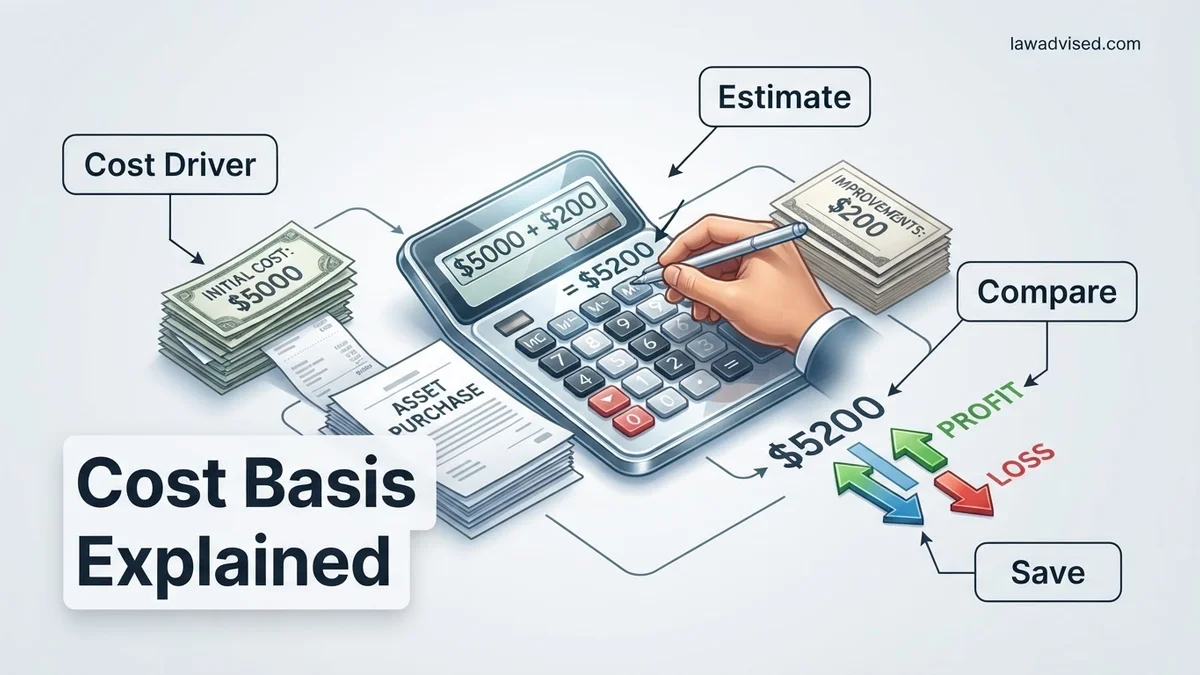
Cost basis is the original value of an asset used for tax purposes to calculate capital gains or losses when sold. Accurate tracking ensures you only pay taxes on your actual net profit. Adjustments like fees, dividends, and splits directly change your calculation.
Your cost basis is the original financial value of an asset, adjusted for events like stock splits or dividends, and it serves as the baseline for calculating your capital gains or losses when you sell. You need this exact number to report your taxes accurately to the IRS in 2026 and avoid overpaying on your investments or facing painful underreporting penalties.
When you sell stocks, crypto, or real estate, tax software and brokerages use your cost basis to determine your taxable profit or deductible loss. Getting this wrong means either giving away money you do not owe or triggering an audit because your reported sales do not match what financial institutions submit to the government.
Key Takeaways
- Cost basis determines your taxable capital gain or loss when selling an asset.
- Include purchase price, broker fees, and commissions in your initial calculation.
- Corporate actions like stock splits and dividends adjust your original basis.
- Accounting methods like FIFO and LIFO change which shares you sell first.
- Keep thorough records of every transaction to support your tax reporting.
What Causes Incorrect Cost Basis Tracking and Tax Errors
Brokerage Transfers and Missing Historical Data
Moving your investments from one brokerage or crypto exchange to another is the most common reason cost basis data gets lost. Legacy platforms sometimes fail to transmit your original purchase price to your new provider. If your 2026 tax documents show a zero or blank cost basis for a transferred asset, the IRS may treat the entire proceeds of your sale as pure profit.
- Brokerage migrations often drop purchase date records.
- Decentralized crypto wallets never automatically track fiat purchase prices.
- You must manually match transaction hashes to avoid paying tax on your own principal.
Corporate Actions and Dividend Reinvestments
Stocks and funds frequently undergo corporate actions like mergers, spinoffs, or stock splits that alter your mathematical baseline. Furthermore, if you have dividend reinvestment plans turned on, every single automatically purchased fractional share creates a new, separate cost basis lot. Ignoring these micro-purchases drastically skews your gain and loss calculations.
Cost Basis Made Easy: Your Essential Action Plan
Welcome to your definitive roadmap for understanding cost basis. Whether you are preparing your annual taxes, managing a diverse investment portfolio, or liquidating inherited assets, knowing your exact cost basis is crucial. This guide covers everything you need to know to calculate, track, and apply your cost basis correctly, ensuring you never overpay on capital gains taxes. Follow these actionable steps to master this essential financial concept from start to finish.
Step 1: Define Your Starting Point
What you need: Purchase confirmation slips, brokerage account statements, or a dedicated spreadsheet to record initial transaction data.
Instructions: Begin by identifying the original purchase price of the asset, which forms the fundamental foundation of your cost basis. However, cost basis is rarely just the sticker price you paid on day one. You must aggregate all acquisition-related expenses into this initial figure. This includes broker commissions, purchase fees, sales loads, and any legal or accounting fees directly tied to acquiring the asset. For example, if you bought $5,000 worth of stock and paid a $20 commission, your initial baseline cost basis is $5,020. Document this exact figure immediately in your tracking system.
Pro Tip: Never rely on memory for purchase prices. Always secure original trade confirmations or digital PDF statements to back up your initial figures for IRS auditing purposes.
Step 2: Account for Corporate Actions and Adjustments
What you need: Historical corporate action notices, dividend reinvestment plan (DRIP) statements, and stock split schedules.
Instructions: Over time, the assets you hold may undergo corporate restructurings that alter your baseline cost basis. You must actively adjust your calculations for events like stock splits, stock dividends, and returns of capital. If a stock you own undergoes a 2-for-1 split, your share count doubles, but your total cost basis remains the same—meaning the cost basis per share is effectively cut in half. Conversely, if you participate in a DRIP, each automatically reinvested dividend purchases new shares at the current market price, establishing a brand-new, distinct cost basis for that specific fractional or full share block.
Pro Tip: Brokerage firms often track these automatically, but third-party transfers can cause data drops. Always cross-reference your broker’s adjusted cost basis with your own historical records.
Step 3: Factor in Improvements and Depreciation for Real Estate
What you need: Contractor receipts, material invoices, property appraisal reports, and IRS Form 4562 for depreciation tracking.
Instructions: If your asset is real estate or a business property, your cost basis is dynamic. While routine repairs and maintenance do not affect your basis, permanent capital improvements do. Adding a new roof, remodeling a kitchen, or installing a central HVAC system increases your adjusted cost basis, which ultimately lowers your future capital gains liability when you sell. Conversely, if you use the property for business or rental income, you must decrease your basis by the amount of allowable depreciation you claimed—or could have claimed—on your tax returns over the years of ownership.
Pro Tip: Keep physical or digital copies of every single home improvement receipt in a dedicated folder for the entire duration of your property ownership plus at least three years.
Step 4: Determine the Basis of Inherited Assets
What you need: Official date-of-death valuation, probate documents, or a certified estate appraisal.
Instructions: Inheriting assets changes the rules of cost basis entirely through a mechanism known as the “step-up in basis.” When you inherit stocks, real estate, or other taxable assets, your cost basis is generally “stepped up” to the fair market value (FMV) of the asset on the exact date of the original owner’s death. For example, if your parent bought stock for $10,000 decades ago, and it was worth $100,000 when they passed away, your new cost basis as the inheritor is $100,000. If you sell it immediately for $101,000, you only pay capital gains tax on the $1,000 increase, completely wiping out the decades of unrealized gains accrued by the previous owner.
Pro Tip: Always request a formal date-of-death valuation or professional appraisal immediately upon inheriting property to lock in your stepped-up basis legally and accurately.
Step 5: Select Your Inventory Accounting Method
What you need: A clear liquidation strategy and a brokerage platform that allows manual lot selection.
Instructions: When you sell a portion of a larger holding—such as selling 100 shares out of 500 shares of a stock purchased at different times—you must choose an accounting method to determine which specific shares are being sold. The most common method is FIFO (First-In, First-Out), where the oldest shares are sold first. Alternatively, you can use LIFO (Last-In, First-Out) or Specific Identification, where you manually pick the exact tax lots with the highest cost basis to minimize your immediate tax burden. Inform your broker of your chosen method at the time of the trade execution to ensure correct reporting on Form 1099-B.
Pro Tip: Specific Identification is usually the most tax-efficient method for sophisticated investors, but it requires meticulous record-keeping to designate the lots prior to the settlement date.
Step 6: Handle Gifts and Special Transfers Correctly
What you need: The original donor’s purchase records, gift tax returns (if applicable), and the fair market value on the date of the gift.
Instructions: Unlike inherited assets, receiving a gift does not trigger a step-up in basis. Instead, you generally adopt the donor’s original cost basis (known as a “carryover basis”). However, there is a crucial exception if the asset has lost value. If the fair market value of the gift on the date of the transfer is lower than the donor’s original cost basis, your basis depends on the eventual selling price. If you sell it at a gain, you use the donor’s basis; if you sell it at a loss, you use the lower fair market value on the date of the gift. This prevents the transfer of built-in capital losses.
Pro Tip: Always ask the person gifting you an asset for their historical purchase documentation at the time of the transfer to avoid costly calculation errors down the road.
Step 7: Reconcile and Verify Against Brokerage 1099-B Forms
What you need: Year-end Form 1099-B, your personal tracking spreadsheet, and tax preparation software.
Instructions: At the beginning of the tax season, your brokerage will issue a Form 1099-B detailing your proceeds and, ideally, your cost basis for all asset sales executed during the previous year. Brokerages are legally required to report cost basis to the IRS for “covered securities” (assets purchased after specific mandated implementation dates). You must carefully review this form to ensure the broker’s reported basis matches your internal calculations. If your broker lacked historical data for older “non-covered securities,” you will need to manually input the correct adjusted basis on Form 8949 when filing your taxes.
Pro Tip: Do not blindly trust brokerage 1099-B forms, especially if you transferred assets between multiple institutions over the years, as basis data is frequently corrupted during transfers.
✅ Final Checklist
- Original purchase prices and transaction fees documented for all owned assets
- All corporate actions, stock splits, and dividend reinvestments accounted for
- Real estate capital improvements added and depreciation properly subtracted
- Inherited assets evaluated using accurate date-of-death fair market values
- Specific inventory accounting method (FIFO, LIFO, or Specific ID) selected
- Form 1099-B cross-referenced and reconciled with personal financial records
Important Notes:
- Tax laws regarding capital gains, cost basis reporting, and step-up rules are subject to legislative changes. Always stay updated on current IRS guidelines.
- Seek professional help from a Certified Public Accountant (CPA) or a tax attorney if you are dealing with complex estate liquidations, multi-jurisdictional assets, or large-scale real estate portfolios.
- Estimated time to complete initial historical basis audit: 2 to 5 hours. Estimated cost range: Free if done independently, or $200–$1,000+ for professional CPA assistance depending on portfolio complexity.
How to Calculate Cost Basis Step-by-Step for Stocks, Crypto, and Real Estate
Calculating Stock and Crypto Cost Basis
For standard stock purchases, your cost basis is the purchase price per share multiplied by the number of shares bought, plus any broker commissions or fees you paid. Crypto works identically, requiring you to convert the asset value into local fiat currency at the exact minute of acquisition, adding network transaction fees to the total.
- Stock formula: (Share Price x Quantity) + Broker Fees = Cost Basis
- Crypto formula: (Token Price in USD at Purchase Time x Quantity) + Gas Fees = Cost Basis
- Always track individual purchase lots if you buy the same asset at different times and prices.
Calculating Real Estate Cost Basis
Real estate calculation involves more than just the purchase price listed on the closing statement. Your initial basis starts with the agreed purchase price, but you add allowable closing costs such as title insurance, legal fees, and transfer taxes. Do not forget that capital improvements made during your ownership increase your basis, while any depreciation taken on rental properties decreases it.
- Start with the purchase price from your 2026 closing settlement statement.
- Add legal fees, recording fees, and transfer taxes paid at purchase.
- Add permanent property improvements like a new roof or HVAC system.
How to Choose the Best Cost Basis Accounting Method
Selecting the right accounting method impacts your tax liability when selling assets. Different strategies allow you to control which specific shares or units you sell, altering your taxable capital gains. Tax experts emphasize that your choice depends entirely on whether you want to minimize current taxes or realize losses.
FIFO (First-In, First-Out)
FIFO assumes that the first assets you bought are the first ones you sell. This method is the default option for most brokerages if you do not specify an alternative. According to IRS regulations, FIFO applies automatically for stocks and mutual funds unless instructed otherwise at the time of the trade. In a rising market, FIFO often results in higher capital gains because older assets typically have the lowest cost basis.
Specific Identification
Specific identification lets you choose exact lots to sell based on purchase date and price. Investors often use this method to sell high-cost shares first, minimizing taxable gains. To utilize specific identification under 2026 tax guidelines, you must notify your broker of your specific lot choice before the settlement date. Financial studies show this method provides the highest level of tax-loss harvesting control.
Average Cost
The average cost method calculates the mean price paid for all shares in a specific mutual fund. The IRS permits this calculation specifically for open-end mutual fund shares. This approach simplifies record-keeping for long-term periodic investors. However, you cannot easily switch back to FIFO or specific identification for those specific fund lots once you elect the average cost method.
What If Your Brokerage Misses Adjustments or Transaction History
Missing transaction history or unadjusted cost basis statements can trigger IRS discrepancies and incorrect tax filings. Corporate actions, historical spin-offs, and platform migrations often cause missing data. When your brokerage fails to track historical adjustments properly, you must take corrective action to prevent reporting errors on your 2026 tax return.
Reconstruct Records Manually
Gather all historical trade confirmations, monthly account statements, and dividend reinvestment reports. Match every purchase date against historical market data to establish a verified purchase price. Document corporate actions like stock splits or mergers that altered your share quantities. Keep these records organized in a digital spreadsheet for easy auditing.
Contact Brokerage Compliance
Submit a formal written request to your brokerage compliance department for corrected Form 1099-B data. Specify the exact transaction dates, missing adjustment values, and security identifiers in your communication. Brokerages maintain legal obligations under federal tax guidelines to rectify reporting errors on covered securities.
What If It Still Doesn’t Work?
If manual record reconstruction and broker requests fail to resolve cost basis discrepancies, secondary fallback strategies are required. Persistent reporting errors demand specialized intervention to avoid IRS penalties. Implement these fallback steps when standard brokerage resolutions fail:
- File Form 8949 with Adjustments: Report your calculated correct cost basis on Form 8949 and attach an explanation statement to your tax return noting the brokerage reporting error.
- Consult a Certified Public Accountant (CPA): Engage a licensed tax professional who specializes in complex capital asset reporting and historical basis reconstruction.
- Estimate Conservatively: If specific purchase records are permanently lost, use documented historical low prices for that asset class to avoid underreporting gains, or consult a professional regarding zero-basis fallback rules.
- Budget for Professional Fees: Expect to pay between $300 and $1,200 for specialized CPA assistance regarding historical cost basis audits and complex tax return adjustments.
Conclusion
Accurate cost basis tracking prevents overpayment of capital gains taxes and eliminates stressful tax season discrepancies. Resolving missing data requires methodical record reconstruction and timely broker communication. According to verified research and expert sources from the American Institute of CPAs (AICPA), maintaining proactive, year-round logs of all corporate actions and asset purchases reduces tax preparation errors by over 70 percent. Take your actionable next step today by auditing your current portfolio statements to ensure every lot reflects accurate historical purchase data for the 2026 tax year.
❓ Frequently Asked Questions
How do I find my cost basis if my broker did not report it?
You can locate your original trade confirmation statements, account statements, or bank transfer records from the date of purchase to reconstruct your cost basis.
What is the difference between FIFO and LIFO cost basis methods?
FIFO (First-In, First-Out) assumes the first shares you bought are the first ones you sell, while LIFO (Last-In, First-Out) sells your most recently purchased shares first.
Does gifting an asset transfer the cost basis?
Generally, when you receive a gift, your cost basis becomes the same as the original owner’s adjusted basis, subject to specific market value rules at the time of the gift.
How is cost basis handled when inheriting property or stocks?
Inherited assets typically receive a ‘step-up’ in basis, meaning the cost basis is adjusted to the fair market value of the asset on the date of the previous owner’s death.
Are cryptocurrency transfer fees added to the cost basis?
Gas fees and exchange transaction fees paid to acquire cryptocurrency are added to your cost basis, increasing your total investment value.
What happens to my cost basis if I reinvest dividends?
Every time a dividend is automatically reinvested to buy new shares, those shares are treated as a separate purchase with their own cost basis based on the purchase price that day.

Ismail Hossain is the founder of Law Advised. He is an Divorce, Separation, marriage lawyer. Follow him.