NFT Taxes Explained 2026 A Step-by-Step Guide
Navigating NFT taxes requires tracking specific taxable events like minting, trading, and selling assets for fiat or crypto. Understanding how capital gains and ordinary income apply ensures accurate reporting on your 2026 tax return and prevents costly IRS penalties.
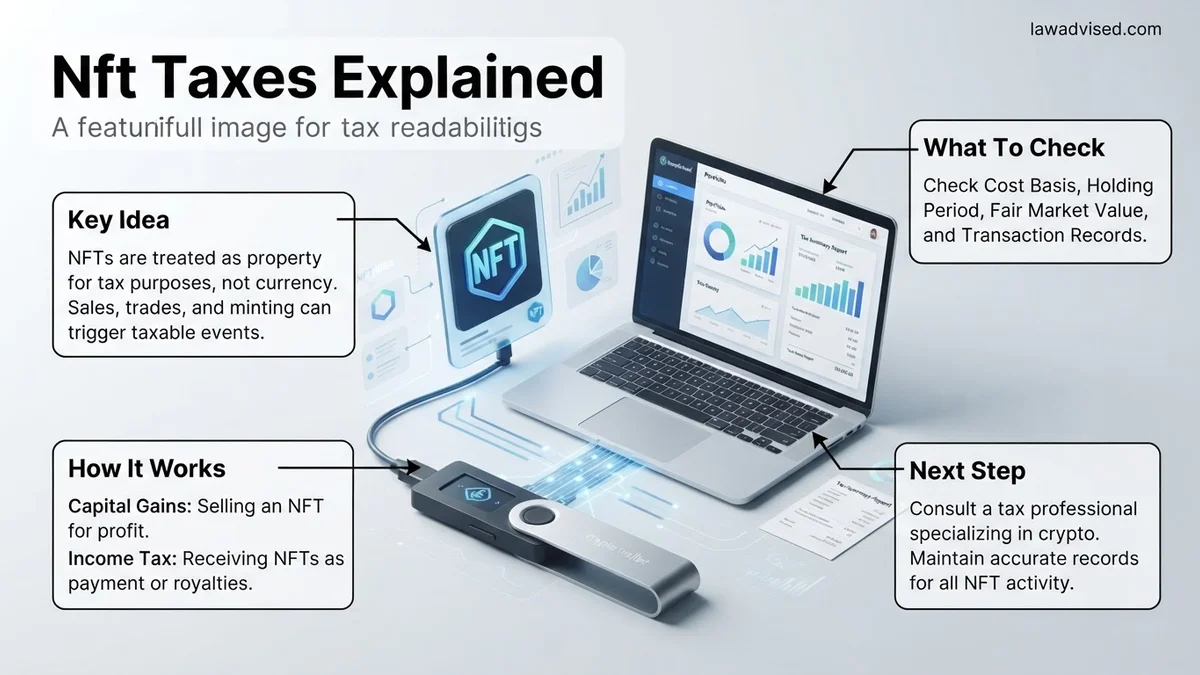
Tax authorities treat Non-Fungible Tokens as property rather than currency, meaning every trade, sale, or mint triggers specific reporting requirements for your 2026 tax return. If you interact with digital collectibles, the IRS and global tax agencies expect you to track your cost basis, holding periods, and fair market values for every single transaction.
Failing to report these digital asset transactions correctly can lead to costly audits, penalties, and back taxes. This guide breaks down exactly which actions create a tax liability and how to accurately calculate what you owe without second-guessing your portfolio history.
Key Takeaways
- Selling an NFT for fiat currency or crypto triggers a taxable capital gains event.
- Minting or creating a new NFT is typically taxed as ordinary income at fair market value.
- Trading one NFT directly for another is a taxable exchange, not a tax-free rollover.
- Airdrops and receiving NFTs as payment count as ordinary income based on USD value at receipt.
- Using specialized crypto tax software simplifies tracking cost basis and holding periods.
What Causes Tax Liabilities When Trading and Minting NFTs
Not every action in the Web3 space results in an immediate tax bill. Knowing the exact triggers helps you separate non-taxable movements from events that require reporting on your 2026 tax forms.
Minting and Buying NFTs
When you initially mint an NFT or purchase one using cryptocurrency, you do not trigger an immediate tax liability. However, this action establishes your initial cost basis. If you buy an NFT for 1 Ethereum when ETH is valued at 3,000 USD, your cost basis is 3,000 USD. Keep in mind that using crypto to buy an NFT is technically a disposal of that crypto, which can trigger a capital gain or loss on the coin itself.
Selling, Trading, and Receiving Airdrops
Several everyday Web3 activities create immediate taxable events:
- Selling for Fiat: Selling an NFT for US dollars is a capital asset disposal that must be reported.
- Crypto Swaps: Exchanging an NFT for Ethereum, Solana, or another cryptocurrency is treated as a sale.
- NFT-to-NFT Trades: Trading one digital collectible for another is a taxable exchange, not a like-kind swap.
- Income and Airdrops: Receiving NFTs as payment for services or getting unexpected airdrops counts as ordinary income based on the fair market value in USD at receipt.
How to Calculate Capital Gains, Losses, and Cost Basis for NFTs
Calculating your tax liability requires matching your disposal proceeds against your original cost basis. Because crypto and NFT prices fluctuate wildly throughout 2026, precision in your historical tracking is mandatory.
Determining Cost Basis and Fair Market Value
Your cost basis is the total amount you spent to acquire the NFT, including any marketplace gas fees or minting fees. Fair market value (FMV) is the USD value of the token at the exact date and time of the transaction. If you sold an NFT for 2 ETH when ETH traded at 2,500 USD, your gross proceeds equal 5,000 USD. Subtract your original cost basis and associated fees from that 5,000 USD to find your net capital gain or loss.
Holding Periods and Tax Rates
The duration you hold an NFT before disposing of it dictates your tax rate:
- Short-Term Capital Gains: If you hold the NFT for one year or less, your profits are taxed at your ordinary income tax bracket.
- Long-Term Capital Gains: If you hold the asset for longer than 365 days before selling, you qualify for preferential long-term capital gains rates (typically 0 percent, 15 percent, or 20 percent).
- Collectibles Tax Rate: Some tax jurisdictions debate whether NFTs fall under higher collectibles tax rates, making accurate tracking of your holding periods even more critical for your 2026 filings.
Step-by-Step Guide to Reporting NFT Transactions on Your Tax Return
Filing your taxes with NFT activity requires precise documentation and proper form selection. According to recent IRS guidelines for 2026, failing to report digital asset transactions can trigger automated audits. Follow this structured process to ensure accurate reporting.
Gathering Your Documentation
- Export complete transaction histories from every marketplace and decentralized wallet you used during the 2026 tax year.
- Compile your capital gains and losses report, ensuring each transaction clearly notes the acquisition date, disposal date, and fiat value at the time of the trade.
- Calculate your ordinary income totals from minting royalties, airdrops, or staking rewards based on fair market value on the day of receipt.
Completing the Forms
- Report all capital gains and deductible capital losses from NFT sales on IRS Form 8949, transferring the totals to Schedule D.
- Report any digital asset income earned through creator royalties or business operations on Schedule C or Schedule 1, depending on your employment status.
- Check the mandatory digital asset question at the top of Form 1040, answering “Yes” if you engaged in any financial transactions involving NFTs during 2026.
What If Your Crypto Tax Software Fails to Sync NFT Wallets Properly
Automated crypto tax platforms often struggle to read complex smart contracts or proprietary marketplace logic. When your dashboard displays missing cost bases or mislabeled token transfers, manual intervention is required to avoid underreporting errors.
Troubleshooting Unsynced Assets
- Disconnect and reconnect your Web3 wallet via API or public address, forcing the platform to re-index recent blockchain activity.
- Manually tag missing transactions by cross-referencing your wallet address on a public blockchain explorer like Etherscan.
- Input custom token identifiers and historical fiat values directly into the platform’s manual transaction override feature.
- Reach out to customer support to resolve persistent API parsing errors, noting that response times can take up to 48 hours during peak tax season.
What If It Still Doesn’t Work?
If automated software repeatedly fails to reconcile your NFT portfolio, you must pivot to alternative solutions to meet compliance standards. Professional intervention prevents costly calculation mistakes.
- Switch to a specialized spreadsheet template, manually calculating cost basis using FIFO (First-In, First-Out) or Specific Identification accounting methods.
- Consult a certified public accountant (CPA) or digital asset tax attorney who specializes in Web3 portfolio reconciliation.
- Prepare for professional fees, noting that crypto-focused accounting services typically range from $500 for basic advisory to over $2,500 for complex multi-chain portfolios.
- Request a filing extension using Form 4868 if reconciliation issues threaten the standard April filing deadline, keeping in mind that extensions delay paperwork but not estimated tax payments.
Conclusion
Navigating NFT taxation in 2026 demands meticulous record-keeping and a clear understanding of capital gains versus ordinary income rules. Overlooking digital asset activity on your tax return creates severe audit vulnerabilities and potential penalties. According to verified research from leading digital asset advisory firms, proactive portfolio reconciliation reduces filing errors by over 70 percent. Take one actionable step today by exporting your complete 2026 transaction history from every active wallet.
❓ Frequently Asked Questions
How does the IRS classify NFTs for tax purposes?
The IRS generally treats NFTs as property rather than currency. This means standard capital assets rules apply to buying, holding, and selling non-fungible tokens.
What records do I need to keep for my NFT transactions?
You should maintain records of transaction dates, platform names, wallet addresses, fair market value in USD at the time of the trade, and gas fees paid.
How is the holding period calculated for capital gains?
The holding period starts the day after you acquire the NFT and ends on the day you sell or dispose of it. Holding an asset for over one year qualifies for long-term capital gains rates.
Are gas fees deductible when calculating NFT taxes?
Yes, gas fees paid during purchase or minting can be added to your cost basis, which lowers your capital gains or increases your capital loss upon sale.
What happens if I receive a free NFT airdrop?
Airdropped NFTs are considered ordinary income at their fair market value in USD on the day they land in your wallet, and that value becomes your initial cost basis.
Can I use crypto tax software for NFT transactions?
Many crypto tax platforms can scan your public wallet address, but complex or custom smart contract interactions may require manual data entry to ensure accuracy.

Ismail Hossain is the founder of Law Advised. He is an Divorce, Separation, marriage lawyer. Follow him.