How Much Estimated Tax Should I Pay Step-by-Step Guide 2026
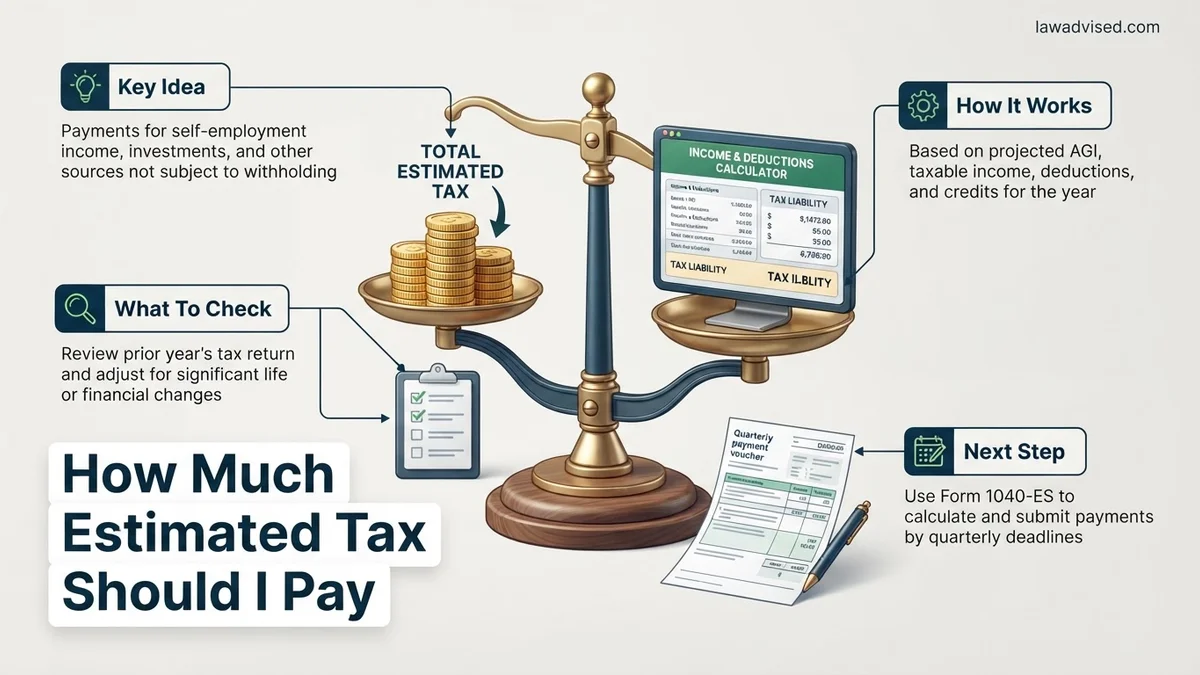
If you are self-employed or earn income without tax withholding, you generally must pay quarterly taxes if you expect to owe $1,000 or more when you file your return. Calculating the correct amount requires estimating your annual adjusted gross income, deductions, and self-employment tax using IRS Form 1040-ES. Utilizing safe harbor rules helps you completely avoid unexpected underpayment penalties at year-end.
You generally need to pay estimated taxes if you expect to owe at least $1,000 in federal tax when you file your 2026 return, and your withholding and refundable credits won’t cover at least 90% of your current tax liability or 100% of your prior year’s liability. Freelancers, independent contractors, small business owners, and investors must calculate and submit these payments four times a year to the IRS.
Missing these payments or paying too little results in costly underpayment penalties and interest charges when tax season arrives. Calculating the exact amount prevents cash flow surprises and keeps you compliant with federal guidelines without giving the IRS an interest-free loan on excess funds.
Key Takeaways
- Pay quarterly estimated taxes if you expect to owe $1,000 or more to the IRS.
- Calculate liability using expected adjusted gross income, deductions, and net self-employment earnings.
- Avoid IRS penalties by paying at least 90% of your current tax or 100% of prior year tax.
- Submit payments four times a year using IRS Direct Pay or Form 1040-ES vouchers.
- Adjust your estimated payments mid-year if your income increases or decreases significantly.
Why You Owe Estimated Taxes and What Triggers the Requirement
The Pay-As-You-Go Tax System Explained
The United States tax system operates on a pay-as-you-go basis. Traditional employees have taxes automatically withheld from every paycheck by their employers. If you earn income that does not have taxes withheld—such as freelance revenue, rental income, capital gains, or business profits—you must take over that responsibility.
- Income without automatic withholding requires quarterly installments.
- The IRS expects you to pay taxes as you earn the money throughout 2026.
- Failing to make these payments triggers the underpayment penalty.
Common Income Sources That Trigger Estimated Taxes
Many taxpayers stumble into estimated tax requirements unexpectedly after picking up side work or transitioning to self-employment. Recognizing your triggers helps you plan your quarterly cash flow effectively.
- 1099 contractor work and freelance writing, design, or consulting.
- Net earnings from a single-member LLC or sole proprietorship.
- Investment income, dividends, and substantial capital gains.
- Rental property income and taxable retirement distributions.
Master Estimated Tax Payments in 7 Simple Steps
Navigating the world of self-employment or unexpected income can be intimidating, especially when it comes to figuring out how much money you need to hand over to Uncle Sam before April rolls around. If you don’t have taxes automatically withheld from a traditional paycheck, you are generally required to make quarterly estimated tax payments to avoid hefty penalties and interest charges. This guide will walk you through the exact mathematical process and strategic decisions needed to calculate your ideal payment amount accurately, ensuring you never overpay or underpay the IRS.
Step 1: Gather Your Financial Records from Last Year
What you need: Your most recent federal tax return (Form 1040), W-2s if you have a part-time job, and profit-and-loss statements from the previous year.
Instructions: Start by pulling out last year’s federal income tax return. Look specifically at your total tax liability, which is found on line 24 of the standard Form 1040. This number acts as your historical baseline. If your income has been relatively stable year-over-year, last year’s total tax is your best friend because it unlocks the “safe harbor” rule. By paying in at least 100% of last year’s tax liability (or 110% if your adjusted gross income exceeds $150,000), you are legally protected from underpayment penalties, regardless of how much you earn this year.
Pro Tip: Do not rely on memory. Having the exact physical or digital copies of your past tax forms prevents costly transposition errors when doing initial math.
Step 2: Project Your Gross Income for the Current Year
What you need: A spreadsheet or budgeting software, current invoices, and historical sales trends.
Instructions: Estimate your total gross income for the current calendar year. If you are a freelancer or business owner, review your revenue for the first quarter and multiply it out, or look at seasonal trends from previous years to forecast the remaining months. Be realistic—factor in any major contracts you’ve lost or gained. Write down this projected gross revenue number, as it forms the foundation for calculating your expected adjusted gross income (AGI) and subsequent tax bracket.
Pro Tip: Always lean slightly conservative with your income projections. It is usually better to overestimate your taxes slightly and get a refund than to scramble for cash during a lean quarter.
Step 3: Calculate Your Anticipated Business Deductions
What you need: Receipts, software logs for mileage, home office square footage measurements, and business expense categories.
Instructions: Subtract your ordinary and necessary business expenses from your projected gross income to find your expected net profit. Review common write-offs including software subscriptions, professional development, advertising, equipment, travel, and a portion of your internet or phone bills if used for business. If you qualify for the Qualified Business Income (QBI) deduction, keep that in mind as it may reduce your taxable business income by up to 20%.
Pro Tip: Keep meticulous digital records of every single business expense. Mixing personal and business spending is the number one trigger for missed deductions and costly audits.
Step 4: Factor in Above-the-Line Personal Deductions
What you need: Records of traditional IRA contributions, health savings account (HSA) funding, and self-employed health insurance premiums.
Instructions: Adjust your net business income by subtracting personal “above-the-line” deductions that lower your adjusted gross income before standard or itemized deductions are applied. For self-employed individuals, this frequently includes half of your self-employment tax, contributions to retirement accounts like a SEP-IRA or Solo 401(k), and premiums paid for health, dental, and qualified long-term care insurance for yourself and your family.
Pro Tip: Deducting half of your self-employment tax is a mandatory step that many beginners forget. Failing to include this will cause you to artificially inflate your estimated tax liability.
Step 5: Compute Your Self-Employment Tax
What you need: IRS Schedule SE (Form 1040) guidelines and a calculator.
Instructions: Calculate your self-employment tax, which covers Social Security and Medicare taxes. Multiply your net self-employment earnings (usually 92.35% of your net business income) by the combined self-employment tax rate of 15.3%. Specifically, 12.4% goes toward Social Security (up to the annual wage limit) and 2.9% goes toward Medicare. If your net earnings exceed certain thresholds, an additional 0.9% Medicare tax may apply.
Pro Tip: Remember that self-employment tax is separate from federal income tax. You owe this tax regardless of what income tax bracket you fall into.
Step 6: Estimate Your Federal Income Tax Liability
What you need: Current year IRS federal income tax brackets and standard deduction amounts.
Instructions: Take your adjusted gross income, subtract the standard deduction (or your expected itemized deductions) and half of your self-employment tax to find your taxable income. Apply the current federal income tax brackets to this taxable income figure based on your filing status (Single, Married Filing Jointly, etc.). Once you arrive at your income tax amount, add the self-employment tax calculated in the previous step to get your total estimated annual tax liability.
Pro Tip: Tax brackets are progressive, meaning only the income that falls within a specific bracket is taxed at that rate—not your entire income.
Step 7: Divide into Quarterly Payments and Submit
What you need: IRS Direct Pay portal, bank account routing numbers, and IRS Form 1040-ES payment vouchers.
Instructions: Take your total estimated annual tax liability and subtract any expected withholding (if you also hold a W-2 job or have a spouse with a traditional job). Divide the remaining balance by four. This is the exact amount you should pay for each quarterly installment. The IRS payment deadlines typically fall on April 15, June 15, September 15, and January 15 of the following year. Use the online IRS Direct Pay system to make free electronic transfers directly from your checking or savings account.
Pro Tip: Set up calendar reminders two weeks before each quarterly deadline so you never miss a payment date and trigger penalties.
✅ Final Checklist
- Verified last year’s total tax liability to check eligibility for safe harbor rules
- Calculated realistic net profit after subtracting all eligible business expenses
- Accounted for self-employment tax and the above-the-line deduction for half of it
- Divided the final annual estimated liability evenly into four quarterly payments
- Saved confirmation numbers for every payment submitted through the IRS portal
Important Notes:
- Missing a quarterly payment or paying significantly too little can result in IRS underpayment penalties and accumulating interest.
- Consider consulting a certified public accountant (CPA) or tax professional if your income fluctuates wildly month-to-month or if you experience major life changes like marriage or buying a home.
- Estimated time to complete this calculation is 45 to 60 minutes, with zero financial cost if using free IRS calculation worksheets and online payment portals.
Step-by-Step Instructions to Calculate Your Exact Estimated Tax Payment
Step 1: Estimate Your Adjusted Gross Income (AGI) for 2026
Start by projecting your total gross income for the 2026 tax year. Subtract any above-the-line deductions you expect to take, such as self-employed health insurance premiums or deductible retirement account contributions. This gives you your expected Adjusted Gross Income.
- Review your income from the previous year as a baseline.
- Adjust upward or downward based on signed contracts or market shifts.
- Keep a conservative estimate if your freelance revenue fluctuates monthly.
Step 2: Calculate Income Tax and Self-Employment Tax
Once you have your estimated AGI, apply the standard deduction or your itemized deductions to find your taxable income. Run that figure through the 2026 federal income tax brackets. If you are self-employed, you must also calculate Schedule SE tax, which covers your Social Security and Medicare contributions at a rate of 15.3% on 92.35% of your net self-employment earnings.
- Combine your calculated income tax and self-employment tax.
- Subtract any expected tax credits, like the child tax credit.
- Divide the final annual tax liability by four to find your quarterly payment amount.
How to Use Safe Harbor Rules to Prevent IRS Underpayment Penalties
Calculating your exact tax liability for 2026 can be difficult when your income fluctuates. Fortunately, the IRS provides safe harbor rules to help you avoid unexpected underpayment penalties.
Understanding the 90% and 100% Rules
According to Internal Revenue Service guidelines, you generally will not owe an underpayment penalty if you pay through withholding and estimated tax payments at least the smaller of two specific thresholds. First, you can pay 90 percent of the tax shown on your 2026 return. Second, you can pay 100 percent of the tax shown on your 2025 return. Higher-income earners with an adjusted gross income exceeding $150,000—or $75,000 if married filing separately—must pay 110 percent of their prior-year tax to qualify for safe harbor protection.
Steps to Implement Safe Harbor Protection
- Locate your total tax liability from line 24 of your 2025 federal income tax return.
- Calculate 100 percent (or 110 percent if your income exceeds the high-earner threshold) of that prior-year figure.
- Divide that total by four to determine your exact quarterly installment amount.
- Submit equal quarterly payments by the IRS deadlines to completely eliminate your risk of underpayment penalties, regardless of how much your 2026 income increases.
What to Do If Your Income Changes or You Miss a Quarterly Deadline
Life as a freelancer, contractor, or business owner rarely follows a straight line. When your income shifts mid-year or you accidentally miss a quarterly payment, you need a proactive strategy to minimize financial damage and correct your tax trajectory.
Adjusting Mid-Year When Income Fluctuates
If your income drops significantly during 2026, you can reduce your subsequent quarterly payments to match your lower projected annual liability. Conversely, if your business booms, you must recalculate immediately using IRS Form 1040-ES to avoid a massive year-end surprise. Alternatively, you can use the annualized income installment method on Form 2210 to align payments with when you actually earned the money.
Recovering from a Missed Deadline
- Submit the missed payment immediately through IRS Direct Pay or EFTPS to stop the accrual of failure-to-pay penalties and daily compounding interest.
- File your next quarterly payment on time to demonstrate compliance moving forward.
- Check if you qualify for a first-time penalty abatement or waiver if you have a clean compliance history for the preceding three tax years.
What If It Still Doesn’t Work?
If complex multi-state income sources, changing marital statuses, or shifting investments make calculating your 2026 estimated tax payments too difficult, standard formulas may fall short. Implement these troubleshooting steps when standard calculations fail:
- Consult a Certified Public Accountant (CPA) or Enrolled Agent (EA) who specializes in quarterly tax planning to perform a detailed mid-year projection. Professional consultations typically range from $250 to $600 depending on complexity.
- Hire a tax resolution specialist if you have already missed multiple quarters and accumulated substantial underpayment penalties that require formal abatement requests.
- Utilize professional-grade tax preparation software to sync your real-time business income and automatically generate accurate quarterly vouchers.
- Establish a dedicated business savings account to automatically sweep 30 percent of every incoming client payment directly toward future tax liabilities.
Conclusion
Determining how much estimated tax to pay in 2026 requires balancing current income projections against reliable safe harbor rules to protect your finances from steep IRS penalties. By dividing your prior-year liability into four equal installments or recalculating quarterly when business changes occur, you maintain total compliance without overpaying the government. According to verified research and tax policy experts, proactive quarterly planning remains the single most effective strategy for self-employed individuals to avoid cash flow crunches. Your actionable next step is to pull your 2025 tax return today, calculate your safe harbor baseline, and schedule your upcoming quarterly payments through the IRS Direct Pay portal.
❓ Frequently Asked Questions
How much estimated tax should I pay if my income fluctuates every month?
If your income varies significantly throughout the year, you can use the annualized income installment method on Form 2210. This allows you to calculate and pay estimated taxes based on the actual income you earned during each specific quarter.
Can I adjust my estimated tax payments mid-year if my business slows down?
Yes, you can recalculate your expected tax liability for the remaining quarters using Form 1040-ES. If your income drops, you can pay less in subsequent quarters to avoid overpaying, though you should check if prior quarters were underpaid.
Do I have to pay estimated state taxes as well as federal taxes?
Most states with an income tax also require quarterly estimated tax payments if you have self-employment or non-withheld income. You must check your specific state’s department of revenue guidelines and due dates.
What is the 100% safe harbor rule for estimated taxes?
The safe harbor rule protects you from underpayment penalties if your total estimated payments equal at least 100% of the total tax shown on your previous year’s tax return. For high-income earners with an adjusted gross income over $150,000, this threshold increases to 110%.
What if I have a W-2 job and also earn side-gig income?
Instead of making separate quarterly payments, you can often avoid estimated tax penalties by asking your W-2 employer to withhold additional federal income tax from your paychecks using Form W-4.
Are self-employment taxes included in my quarterly estimated tax payments?
Yes, self-employment tax—which covers Social Security and Medicare taxes—is combined with your income tax liability on Form 1040-ES and paid together through your quarterly installments.

Ismail Hossain is the founder of Law Advised. He is an Divorce, Separation, marriage lawyer. Follow him.