Traditional IRA Tax Rules 2026 Expert Guide to Limits
Navigating traditional IRA tax rules requires understanding specific contribution caps, income deduction limits, and strict withdrawal penalties. Knowing these regulations helps you maximize tax-deferred savings while avoiding costly IRS penalties. This guide breaks down current thresholds and compliance requirements.
Navigating Traditional IRA tax rules in 2026 requires understanding exact contribution caps, income-based deduction phase-outs, and strict withdrawal penalties. For the 2026 tax year, you can contribute up to $7,000 to your Traditional IRA, or $8,000 if you are age 50 or older, provided you have earned income.
However, whether you can actually deduct those contributions on your tax return depends entirely on your modified adjusted gross income (MAGI) and whether you or your spouse have a retirement plan at work. Mastering these rules prevents unexpected tax bills and maximizes your immediate savings.
Key Takeaways
- Traditional IRA contributions may be fully or partially tax-deductible depending on income and workplace plan coverage.
- The standard early withdrawal penalty is 10% for distributions taken before age 59½.
- Required Minimum Distributions (RMDs) mandate withdrawals starting at age 73.
- Contributions must be made using earned income up to annual statutory limits.
- Non-deductible contributions require IRS Form 8606 tracking to prevent double taxation.
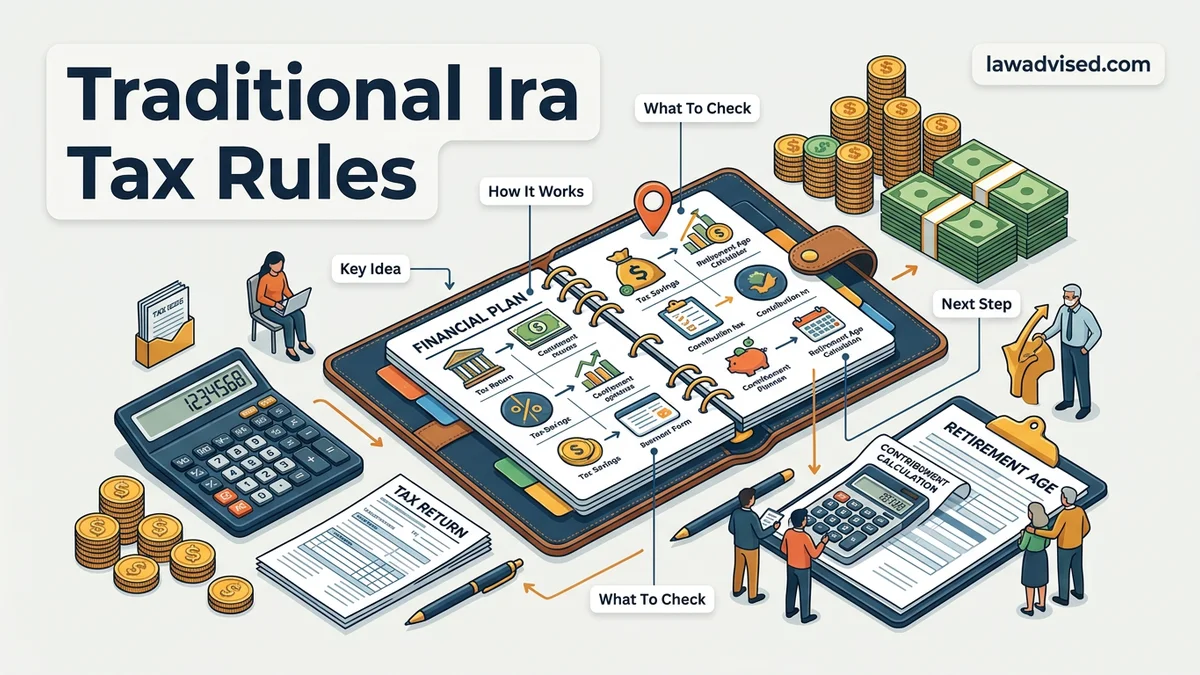
What Causes Traditional IRA Tax Penalties and Deduction Limits
Early Withdrawal Penalties and Required Minimum Distributions
Withdrawing money from your Traditional IRA before age 59½ triggers a major tax penalty. The IRS slaps a 10-percent early withdrawal penalty on top of ordinary income taxes for any pre-retirement distributions.
You can avoid this 10-percent penalty only under specific circumstances, such as:
- Higher education expenses for you, your spouse, or your children
- First-time homebuyer purchases up to a $10,000 lifetime maximum
- Unreimbursed medical expenses exceeding a specific percentage of your adjusted gross income
- Qualified higher education expenses or permanent disability
Once you reach age 73, you must start taking Required Minimum Distributions (RMDs) from your Traditional IRA. Failing to withdraw the mandated RMD amount results in a steep IRS penalty tax on the undistributed amount.
Deduction Phase-Outs for Workplace Retirement Plans
Your ability to deduct Traditional IRA contributions depends heavily on workplace plan coverage. If neither you nor your spouse participates in a retirement plan at work, your contributions are 100-percent tax-deductible regardless of how high your income climbs.
If you or your spouse have access to a 401(k) or similar plan, the IRS enforces strict income limits. Exceeding these thresholds turns your deductible contributions into non-deductible contributions, creating complex tracking requirements on IRS Form 8606.
How to Calculate Your Traditional IRA Contribution and Deduction Limits
Step-by-Step Contribution Cap Math
Calculating your maximum 2026 contribution is straightforward, but it comes with a strict IRS restriction. You cannot contribute more than your total taxable compensation for the year.
If you earned $5,000 in 2026, your maximum Traditional IRA contribution is capped at $5,000, even though the general 2026 limit is $7,000. Married couples filing jointly can make a spousal IRA contribution, allowing a non-working spouse to fund an IRA based on the working spouse’s earned income.
Evaluating 2026 Income Phase-Out Ranges
To determine your exact tax deduction for 2026, you must compare your Modified Adjusted Gross Income against the IRS phase-out tables. For single filers covered by a workplace plan, the 2026 deduction phases out entirely as income rises.
If you are married filing jointly and your spouse has a workplace plan while you do not, you enjoy a much higher income threshold before your deduction begins to reduce. Always review the updated IRS inflation adjustments for 2026 before filing your return to avoid calculation errors.
Step-by-Step Guide to Managing Distributions and Avoiding Early Withdrawal Penalties
Navigating distributions from your Traditional IRA requires careful timing to prevent unnecessary tax burdens and penalties. Taking money out before age 59½ generally triggers a 10% early withdrawal penalty on top of standard income taxes. To protect your retirement savings, follow this structured approach when planning your withdrawals.
Step 1: Verify Your Age and Milestone Dates
Track your exact birth date to determine when you cross the age 59½ threshold. According to Internal Revenue Service guidelines, the 10% early withdrawal penalty lifts the day you turn 59½, making penalty-free distributions accessible.
Step 2: Evaluate Penalty Exceptions
If you need funds before age 59½, review IRS-approved exceptions to bypass the 10% penalty. Qualified higher education expenses, first-time homebuyer purchases up to $10,000, and unreimbursed medical expenses exceeding specific adjusted gross income thresholds qualify for penalty relief.
Step 3: Calculate Required Minimum Distributions (RMDs)
For account holders reaching age 73 in 2026, mandatory withdrawals begin. Use the IRS Uniform Lifetime Table to calculate your exact annual RMD. Divide your prior year-end balance by the distribution period corresponding to your current age.
- Log into your custodian portal by October of the tax year to review your exact prior-year ending balance.
- Locate your corresponding distribution period factor on the official IRS Uniform Lifetime Table.
- Divide your account balance by the table factor to determine your minimum withdrawal amount for the year.
- Initiate the transfer to your checking account or taxable brokerage account well before the December 31 deadline.
What If Your Income Exceeds Deduction Limits or You Miss RMD Deadlines
High earners often discover their modified adjusted gross income surpasses the phase-out thresholds for deductible Traditional IRA contributions. Furthermore, missing a Required Minimum Distribution deadline triggers a steep IRS excise tax. Implement these corrective actions if you encounter these compliance roadblocks in 2026.
Handling Excess Income and Non-Deductible Contributions
If your workplace retirement plan coverage eliminates your deduction eligibility, you can still make non-deductible contributions. File IRS Form 8606 annually to track your basis. This prevents you from paying double taxes on those funds when you eventually take distributions in retirement.
Correcting Missed RMDs
Failing to withdraw your full RMD results in a 25% excise tax on the shortfall amount, which reduces to 10% if corrected in a timely manner. File IRS Form 5329 immediately to report the missed distribution. Request a penalty waiver by attaching a letter of explanation detailing reasonable error and corrective action steps taken.
What If It Still Doesn’t Work?
When complex tax scenarios, high-income phase-outs, or missed deadlines create severe compliance issues, standard self-service methods may fail. Apply these fallback steps to resolve the problem effectively:
- Review your exact year-end account statements and IRS Form 5498 to verify contribution and distribution history before speaking with an expert.
- Consult a certified public accountant or a certified financial planner who specializes in retirement tax optimization to evaluate your specific 2026 tax liability. Expect professional consultation fees to range from $250 to $500 per hour, or $1,000 to $2,500 for comprehensive retirement tax planning packages.
- Submit a formal private letter ruling request to the IRS if you require specialized administrative relief for substantial missed RMD errors.
- Execute a qualified recharacterization or Roth conversion strategy under professional guidance to correct improper contribution types before the annual tax filing deadline.
Conclusion
Mastering Traditional IRA tax rules requires vigilance regarding contribution limits, deduction thresholds, and strict distribution schedules. Failing to manage these parameters can lead to unexpected tax liabilities and severe IRS penalties. According to verified research and expert financial sources, proactive planning and timely execution are the most effective defenses against compliance errors. Take your next actionable step today by logging into your retirement portal to verify your current-year contribution totals and upcoming distribution milestones.
❓ Frequently Asked Questions
How do income phase-outs affect traditional IRA tax deductions?
If you or your spouse participate in a retirement plan at work, your ability to deduct traditional IRA contributions phases out gradually as your modified adjusted gross income exceeds specific IRS thresholds. Exceeding these limits means your contribution becomes non-deductible, requiring careful tracking on Form 8606.
What qualifies as an exception to the 10% early withdrawal penalty?
The IRS allows penalty-free withdrawals for specific circumstances, including qualified higher education expenses, first-time home purchases up to $10,000, unreimbursed medical expenses exceeding a percentage of your adjusted gross income, and certain disability or birth/adoption events.
How are traditional IRA withdrawals taxed?
Distributions from a traditional IRA are taxed as ordinary income at your current federal and state tax rates. If you made non-deductible contributions, the portion of each distribution representing those after-tax contributions is returned tax-free.
Can I roll over funds from a traditional IRA to a Roth IRA?
Yes, you can execute a Roth conversion by moving funds from a traditional IRA to a Roth IRA. However, the converted amount is treated as taxable income in the year of the conversion and is subject to ordinary income tax rates.
What are the consequences of failing to take an RMD?
Failing to withdraw your full Required Minimum Distribution on time results in a steep excise tax on the amount that should have been withdrawn, though corrective actions or waiver requests can sometimes reduce this penalty.
Is there an age limit for making traditional IRA contributions?
There is no maximum age limit for making contributions to a traditional IRA, provided you have taxable earned income. This change allows older workers to continue saving for retirement tax-deferred.

Ismail Hossain is the founder of Law Advised. He is an Divorce, Separation, marriage lawyer. Follow him.