Paycheck Withholding Mistakes Proven Step-by-Step Fix 2026
Making paycheck withholding mistakes can lead to a massive tax bill or an unnecessarily small take-home pay each month. Form W-4 errors often stem from outdated filing statuses, unaddressed multiple jobs, or skipping tax credits. Fortunately, using the IRS Tax Withholding Estimator allows you to quickly identify these errors and submit corrections.
A massive surprise tax bill or an unnecessarily tiny paycheck usually stems from one single document: your Form W-4. Entering 2026, millions of workers will miscalculate their tax withholding because of outdated forms, life changes, or simple arithmetic errors.
Fixing these mistakes requires submitting a newly adjusted Form W-4 to your employer’s payroll department. Getting this right ensures you keep more of your hard-earned money each payday while avoiding an unwanted debt to the IRS when filing season arrives.
Key Takeaways
- Check your W-4 annually to prevent unexpected tax bills.
- Failing to account for multiple jobs causes severe under-withholding.
- Use the IRS Tax Withholding Estimator for precise adjustments.
- Incorrect filing status instantly skews your tax bracket calculations.
- Submitting a new W-4 to your employer is free and easy.
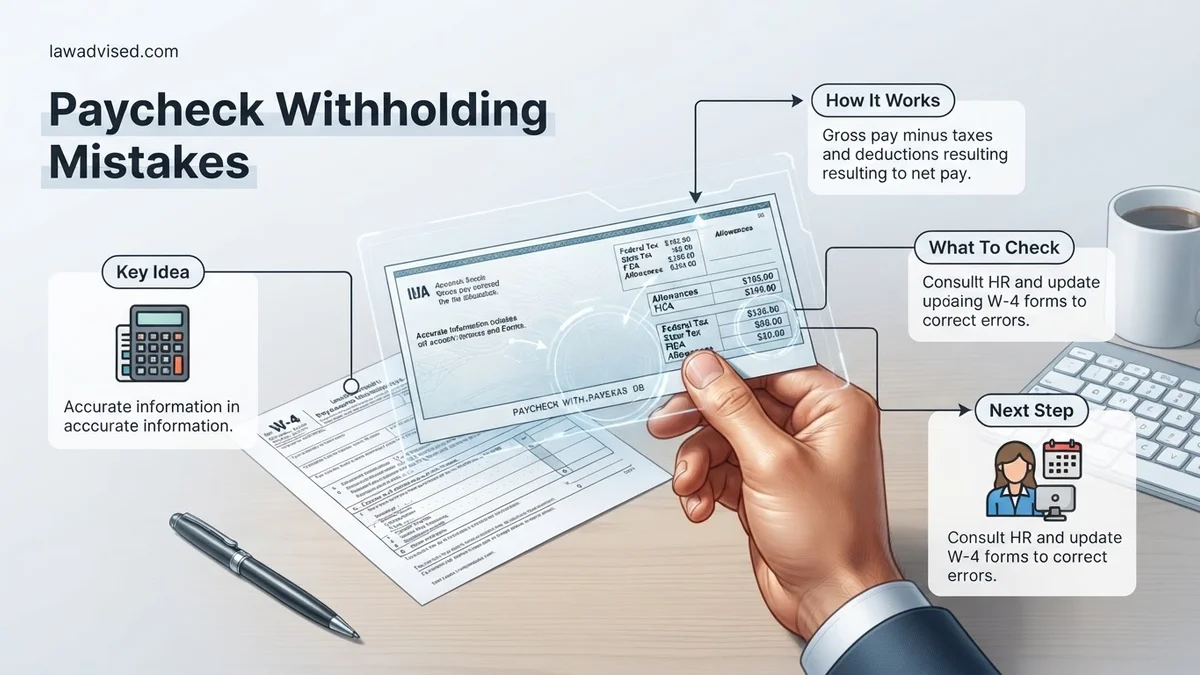
Top Paycheck Withholding Mistakes and Why They Happen
Most withholding errors happen because people set their Form W-4 once when starting a new job and never look at it again. Major life shifts and misinterpretations of the IRS instructions lead straight to payroll disaster.
Failing to Update After Major Life Events
Getting married, having a child, or buying a home completely changes your tax liability. If you experience these milestones in 2026 and forget to submit a new W-4, your employer keeps withholding taxes based on your old single status or missing deductions. For example, welcoming a child adds a significant dependent credit, which means you should be withholding less tax per paycheck to see that money immediately.
The Two-Earner Household Trap
Couples where both partners work often check only the box for their individual job without accounting for combined income. This pushes the household into a higher marginal tax bracket. Because each employer calculates withholding in a vacuum, neither job takes out enough tax. This mistake guarantees a painful tax bill in April.
-
Common triggers for this mistake:
- Assuming standard single rates apply to dual-income households.
- Forgetting to check Step 2 on the W-4 for multiple jobs.
- Failing to account for side-gig or freelance income.
Paycheck Withholding Mistakes: What Causes It and How to Fix It
Discovering an error in your federal or state income tax withholding can be stressful, whether you are suddenly facing a massive tax bill or realizing you gave the government an interest-free loan all year. This practical guide walks you through the exact process to identify, diagnose, and correct paycheck withholding errors so you can take control of your personal finances and optimize your take-home pay.
Step 1: Gather Your Documentation and Paystubs
What you need: Access to your employer’s online payroll portal, your most recent year-to-date paystub, and a copy of last year’s federal and state tax returns.
Instructions: Log into your employee self-service portal and download your last two to three paystubs, as well as your year-end statement (Form W-2) if available. Locate the “Federal Income Tax,” “Social Security,” and “Medicare” line items. Compare the current year-to-date tax withheld against your total projected earnings for the year. Check your state and local tax deductions as well. Look specifically for sudden, unexplained changes in deduction amounts that do not match the parameters you originally selected when you were hired or during the last open enrollment period.
Pro Tip: Do not rely solely on memory; HR departments occasionally apply universal tax updates incorrectly across departments, making paystub verification essential.
Step 2: Review Your Current Form W-4 Selections
What you need: A copy of the information currently on file with your employer regarding your Form W-4 (Employee’s Withholding Certificate).
Instructions: Request a printout or digital view of your active Form W-4 from your human resources or payroll department. Examine Step 2 (Multiple Jobs or Spouse Works), Step 3 (Claim Dependents), and Step 4 (Other Adjustments, such as other income, deductions, or extra withholding). A very common withholding mistake stems from checking the box in Step 2(c) incorrectly, or failing to update dependents when family structures change due to marriage, divorce, or the birth of a child, which drastically alters your tax liability.
Pro Tip: Many taxpayers mistakenly believe that writing “Exempt” on their W-4 means permanent tax freedom; if you earned income last year and had a tax liability, claiming exempt is illegal and triggers severe penalties.
Step 3: Run the IRS Tax Withholding Estimator
What you need: Your most recent paystub, your spouse’s recent paystub (if applicable), and a copy of your most recent federal tax return to estimate deductions and credits accurately.
Instructions: Navigate to the official Internal Revenue Service website and open the interactive Tax Withholding Estimator tool. Input your filing status, number of jobs, exact income figures from your paystubs, and expected adjustments like student loan interest or charitable contributions. The tool will calculate whether you are currently on track for a refund or a balance due, and it will output precise, step-by-step instructions on how to fill out a new Form W-4 to hit your exact target number.
Pro Tip: Run this estimator at least twice a year—once in January and again in July—to account for mid-year pay raises, bonus structures, or side hustle income changes.
Step 4: Communicate the Error to Your Payroll Department
What you need: A written summary of the discrepancy, your calculated corrections, and your completed draft of a new Form W-4.
Instructions: Contact your company’s payroll or HR representative via email to create a clear paper trail. Explain the specific mistake you found—whether it is a missing dependent credit, an incorrect withholding bracket, or a clerical data-entry error made by payroll staff. Attach your newly completed Form W-4 and explicitly request confirmation of the exact pay period in which the corrected withholding will take effect in the payroll cycle.
Pro Tip: Always ask for a written confirmation email stating the exact date the payroll change will be processed to ensure there is no administrative delay.
Step 5: Submit a Corrected Form W-4
What you need: The latest IRS Form W-4 PDF downloaded from the IRS website or provided through your company HR software.
Instructions: Fill out the updated Form W-4 carefully. If you want to increase your withholding to cover an unexpected shortfall, enter a specific dollar amount in Step 4(b) for “Extra withholding.” If you want to decrease withholding because you received a massive refund last year, adjust your dependent claims in Step 3 or enter deductions in Step 4(b). Sign and date the document electronically or physically, and submit it directly to your employer’s secure portal.
Pro Tip: Double-check that you signed and dated the form; unsigned W-4 documents are legally invalid and will be rejected by payroll departments, causing frustrating delays.
Step 6: Monitor Subsequent Paystubs for Accuracy
What you need: Your next one to two consecutive paystubs following the submission of your revised Form W-4.
Instructions: Review your very next paycheck to confirm that the federal and state tax withholding amounts have changed in the anticipated direction. Calculate the percentage of gross income being withheld and compare it to the recommendations provided by the IRS Tax Withholding Estimator. If the payroll department missed the processing window for that pay cycle, check the subsequent paystub. Should the withholding amounts remain completely unchanged after two full pay periods, immediately follow up with human resources.
Pro Tip: Keep a dedicated digital folder for all paystubs and tax correction documents throughout the calendar year to simplify tax season preparation.
✅ Final Checklist
- Verified current year-to-date tax withholdings against total gross earnings
- Identified and documented exact Form W-4 input discrepancies
- Completed the official IRS Tax Withholding Estimator to find target numbers
- Submitted a newly corrected and signed Form W-4 to payroll
- Confirmed adjustments appeared accurately on subsequent paystubs
Important Notes:
- Ensure you do not accidentally under-withhold too severely, as the IRS charges penalties and interest for underpayment if you owe more than $1,000 at tax time.
- Seek help from a Certified Public Accountant (CPA) or Enrolled Agent (EA) if you have complex multi-state income, rental properties, or significant capital gains.
- Estimated time to complete this entire diagnostic process: 1 to 2 hours. Cost: Free (using official IRS tools).
How to Fix Your W-4 Withholding Step-by-Step
Correcting your paycheck deductions takes about fifteen minutes if you use the right tools. You do not need to guess your numbers or rely on outdated advice.
Gather Your Financial Documents
Before touching the Form W-4, pull together the items you need to calculate an accurate withholding rate. Accuracy here prevents you from swinging too far in the opposite direction and getting a zero-dollar paycheck.
-
Essential items to collect:
- Your most recent pay stubs from all jobs you or your spouse hold.
- A copy of your most recent federal tax return.
- Estimates for any 2026 deductions, such as childcare costs or mortgage interest.
Use the IRS Tax Withholding Estimator
Skip the confusing worksheets attached to the paper W-4 form. Navigate directly to the official IRS Tax Withholding Estimator online tool. Plug in your current income, expected deductions, and tax credits for 2026. The tool will calculate the exact dollar amount you need to enter on Step 4 of the new Form W-4 to break even by the end of the year.
Signs Your Paycheck Withholding Is Still Wrong
Even after submitting a corrected Form W-4, errors can persist due to payroll department delays or data entry mistakes. Monitoring your paystubs throughout 2026 ensures your adjustments took effect properly.
Sudden Net Pay Fluctuations
If your net pay changes drastically without a raise or benefit deduction shift, your withholding calculation may contain an input error. Payroll processors sometimes misread multi-job checkboxes or dependent credit allocations. Compare your current stub against your expected take-home pay immediately.
The Year-End Tax Surprise Warning
According to the Internal Revenue Service, taxpayers should perform a mid-year paycheck checkup to avoid unexpected liabilities. Watch for these specific red flags:
- Your cumulative year-to-date federal tax withheld is less than 90 percent of your total estimated 2026 tax liability.
- Your quarterly bonus or overtime paychecks show flat withholding rates that do not match your updated W-4 elections.
- Your state income tax withholding remains untouched while your federal withholding changed, creating an imbalance.
What If Your Next Paycheck Doesn’t Reflect the Changes
Payroll departments typically require one to two pay cycles to process Form W-4 updates. If your withholding remains incorrect after that window, structured escalation is required.
Step-by-Step Payroll Troubleshooting
- Contact your human resources or payroll department in writing to request a formal audit of your submitted W-4 form against their active software profile.
- Verify that your employer’s payroll software successfully transmitted your updated data to the internal processing gateway without truncation errors.
- Submit a duplicate Form W-4 marked clearly as a revised adjustment if payroll confirms they lost or misfiled the original document.
- Consult a certified public accountant or enrolled agent if internal payroll corrections stall, ensuring you calculate manual estimated quarterly tax payments to the IRS to avoid penalties. Professional tax advisory fees for this specific intervention generally range from $150 to $350.
Conclusion
Correcting paycheck withholding mistakes prevents painful tax season surprises and ensures your hard-earned cash stays in your pocket throughout the year. By auditing your paystubs, leveraging the IRS Tax Withholding Estimator, and promptly addressing payroll discrepancies, you maintain total control over your financial health in 2026. According to verified research and expert financial sources, proactive W-4 management is the single most effective way to eliminate tax-time stress. Take your single actionable next step today: log into your employer portal and review your current paystub’s federal tax line.
❓ Frequently Asked Questions
Why did I get a large tax bill even though I thought my withholding was correct?
A massive tax bill usually happens because of life changes like a raise, a second job, or changes in tax laws that your old W-4 did not account for. If your employer withheld too little tax throughout the year, you must pay the difference at tax time.
What is the most common paycheck withholding mistake people make?
The most frequent error is leaving the multiple jobs section blank when both spouses work or when an individual holds more than one job. This causes each employer to calculate withholding as if it is your sole source of income, resulting in severely under-withheld taxes.
How do I know if I am having too much money withheld from my paycheck?
Receiving a giant tax refund every spring is a primary indicator that your withholding is too high. While getting money back feels nice, it essentially means you gave the government an interest-free loan throughout the year instead of keeping that cash in your daily paycheck.
Should I update my W-4 after major life events?
Yes, you should submit a revised Form W-4 within days of major life changes such as getting married, having a child, buying a home, or experiencing a significant shift in household income. These events dramatically alter your tax liability.
Do I need any special documents to use the IRS Tax Withholding Estimator?
To get the most accurate results from the IRS estimator, you should have your most recent paystubs for all jobs in your household and a copy of last year’s federal tax return handy.
Can my employer tell me how to fill out my Form W-4?
No, employers are legally prohibited from providing tax advice or telling you what numbers to put on your Form W-4. They can only process the form you submit and ensure it is complete.

Ismail Hossain is the founder of Law Advised. He is an Divorce, Separation, marriage lawyer. Follow him.