IRA Early Withdrawal Tax Explained 2026 Guide
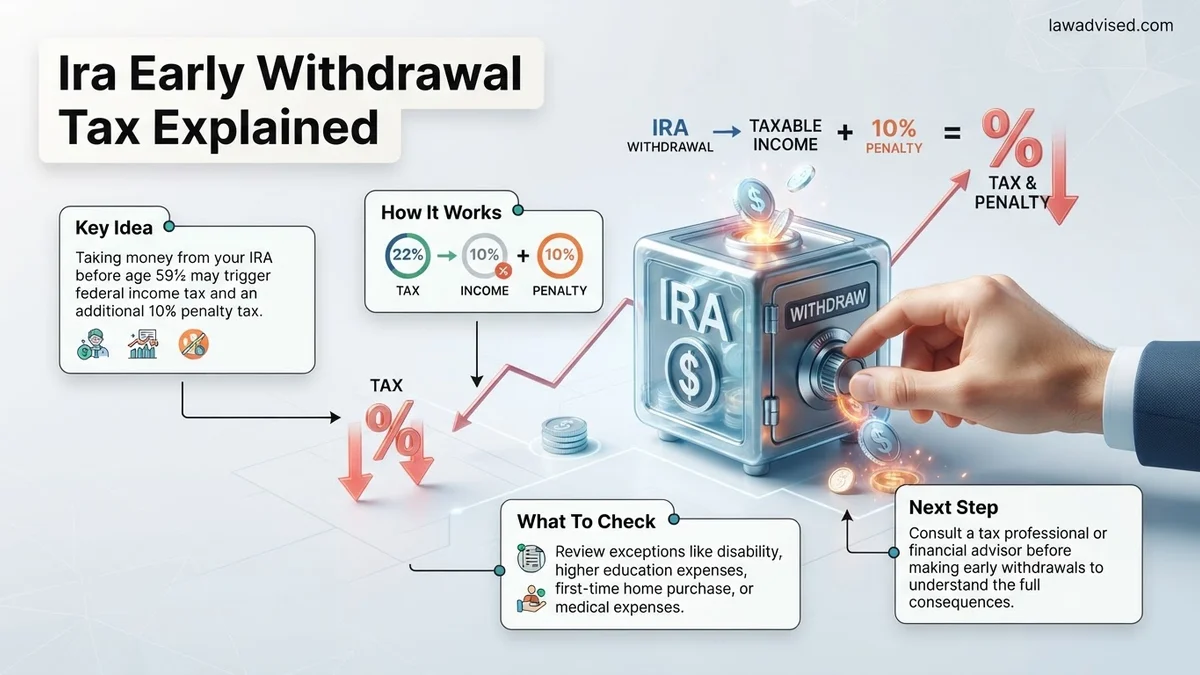
Withdrawing money from an IRA before age 59½ triggers ordinary income taxes plus a 10% federal early withdrawal penalty in most cases. Understanding the distinct tax rules for Traditional versus Roth accounts is essential to minimizing financial losses. Fortunately, specific IRS exemptions allow certain taxpayers to bypass the extra penalty fee entirely.
If you take money out of your Individual Retirement Arrangement before turning 59½, you will generally face a steep 10% federal early withdrawal penalty on top of ordinary income taxes. This double-hit can wipe out a massive chunk of your savings overnight, turning a $20,000 emergency withdrawal into a much smaller net amount after tax season.
Navigating the rules in 2026 requires understanding exactly how the IRS treats these distributions. Whether you are facing an unexpected financial hurdle or simply exploring your options, knowing the hard math behind early withdrawals protects you from devastating tax surprises.
Key Takeaways
- Traditional IRA early withdrawals face ordinary income tax plus a 10% penalty.
- Roth IRA contributions can be withdrawn anytime tax-free and penalty-free.
- Roth IRA earnings face taxes and penalties unless a five-year rule is met.
- IRS exceptions allow penalty-free withdrawals for medical bills, higher education, and first homes.
- State taxes may also apply to early IRA distributions depending on where you live.
What Causes IRA Early Withdrawal Penalties and Heavy Taxes
Traditional Versus Roth Account Rules
The exact tax impact of your withdrawal depends heavily on whether you hold a Traditional or Roth IRA. The IRS views the flow of money differently based on when you get your tax breaks:
- Traditional IRA: Because you likely funded this account with pre-tax dollars, every single dollar you withdraw counts as ordinary income. That means the distribution is added on top of your regular 2026 earnings, potentially bumping you into a higher federal income tax bracket.
- Roth IRA: You funded this account with after-tax dollars. Therefore, you can withdraw your exact contribution amounts at any time, for any reason, completely tax-free and penalty-free. However, withdrawing investment earnings early triggers both ordinary income tax and the 10% penalty.
Why the IRS Penalizes Early Access
Congress created retirement accounts with the express goal of long-term wealth accumulation for senior life. To discourage people from treating retirement funds like a standard checking account, the federal government tacks on a strict 10% additional tax for distributions taken before the age of 59½. This penalty applies nationwide, though you might also owe state income taxes depending on where you live in 2026.
How to Calculate Your Total Tax Bill and 10% Penalty
The Math Behind the Combined Tax Hit
When you pull money from a Traditional IRA early, you have to account for two distinct financial liabilities. First, your plan administrator will withhold taxes, but that might not cover your full liability. You must combine your marginal income tax rate with the flat 10% early withdrawal penalty.
Consider a practical numerical example for 2026. Suppose you live in a state with no income tax, you are single, and your job puts you squarely in the 22% federal income tax bracket. You decide to pull $30,000 out of your Traditional IRA to clear some personal debts:
- Ordinary Income Tax: At your 22% bracket, that $30,000 adds $6,600 straight to your federal tax bill.
- Early Withdrawal Penalty: The mandatory 10% IRS penalty tacks on an extra $3,000.
- Total Deducted Cost: You lose a combined $9,600, leaving you with just $20,400 of the original $30,000 balance.
Calculating the Damage on Roth Withdrawals
If you pull funds from a Roth IRA, the math looks different if you dip into earnings. If you contributed $10,000 years ago and it grew to $15,000, withdrawing the full amount means your first $10,000 in contributions costs nothing extra. But pulling $5,000 of earnings subjects that specific portion to your ordinary income tax rate plus the 10% penalty.
Step-by-Step Guide to Claiming Valid IRS Penalty Exceptions
Qualifying for an IRS penalty exception does not automatically exempt you from paying the standard income tax on your traditional IRA distribution. You must explicitly claim the exception when filing your annual federal tax return to avoid the 10 percent early withdrawal penalty.
How to Report the Exception on Your Tax Return
- Receive Form 1099-R from your IRA custodian early in 2026, which details your gross distribution amount in Box 1 and your taxable amount in Box 2a.
- Obtain IRS Form 5329 (Additional Taxes on Qualified Plans (Including IRAs) and Other Tax-Favored Accounts), which is the primary document used to calculate and report your early withdrawal penalties.
- Enter your total distribution amount on Part I of Form 5329, then identify the specific exception code that applies to your situation on line 2.
- Transfer the resulting penalty calculations from Form 5329 directly onto your main Form 1040 to ensure the 10 percent surcharge is properly waived by the IRS.
Common IRS Exception Codes for 2026
According to IRS guidelines, you must use precise numerical codes on Form 5329. For instance, code 02 designates distributions made because of total and permanent disability, while code 08 applies to qualified higher education expenses. Using the correct code prevents automated processing delays and reduces your risk of an IRS audit.
What If It Still Doesn’t Work?
If the IRS rejects your claimed exception or issues a CP2000 notice regarding your early withdrawal, immediate corrective action is necessary. Financial regulatory compliance experts recommend the following fallback steps:
- Review your filed Form 5329 and Form 1099-R side-by-side to verify that the distribution codes and dollar amounts match perfectly.
- Gather secondary documentation proving your qualification for the exception, such as university billing statements for education expenses or medical receipts for unreimbursed healthcare costs.
- File an amended tax return using Form 1040-X if you discover a clerical error or forgot to attach Form 5329 to your original 2025 or 2026 filing.
- Consult a Certified Public Accountant (CPA) or a federally authorized Enrolled Agent to draft a formal response to the IRS notice. Professional representation for IRS correspondence typically ranges from $300 to $1,000 depending on the complexity of the audit defense.
Conclusion
Navigating an IRA early withdrawal in 2026 requires careful planning to minimize the bite of ordinary income taxes and the steep 10 percent federal penalty. By understanding specific exemption categories and correctly filing IRS Form 5329, you can protect a significant portion of your retirement savings during financial emergencies. According to verified research from tax compliance experts, proactively organizing your documentation before filing remains the single most effective defense against unexpected IRS penalties. Your actionable next step is to review your custodian’s Form 1099-R instructions and consult a qualified tax professional before requesting any early distributions.
❓ Frequently Asked Questions
How does the IRS calculate the 10% early withdrawal penalty on a Traditional IRA?
The 10% penalty is assessed directly against the gross taxable amount of the distribution you pull from the account before age 59½. This penalty is completely separate from, and added to, your standard federal and state income tax liabilities for that tax year.
What is the ordering rule for Roth IRA withdrawals?
The IRS mandates that Roth IRA distributions come out in a specific order: first your direct regular contributions (tax-free and penalty-free), then taxable conversions, and finally earnings. Because contributions come out first, you can often take small distributions without triggering taxes.
Can I use penalty-free IRA withdrawals to pay for college expenses?
Yes, withdrawals used to pay qualified higher education expenses for yourself, your spouse, your children, or grandchildren are exempt from the 10% penalty. However, the distribution amount may still be subject to ordinary income taxes if taken from a Traditional IRA.
Are unreimbursed medical expenses eligible for a penalty waiver?
You can avoid the 10% early withdrawal penalty if your unreimbursed medical expenses exceed 7.5% of your adjusted gross income (AGI) for the year. The withdrawal amount must be used directly to pay or reimburse those qualifying medical bills.
What qualifies as a substantially equal periodic payment (SEPP) exemption?
Under IRS Rule 72(t), you can take a series of annual penalty-free distributions based on your life expectancy. This strategy requires strict adherence to calculation methods and must continue for at least five years or until you turn 59½, whichever is later.
What happens if I accidentally miss reporting an early withdrawal on my tax return?
Failing to report an early distribution or filing Form 5329 incorrectly can trigger an IRS audit, resulting in back taxes, the 10% penalty, accrued interest, and potential accuracy-related failure-to-file penalties.

Ismail Hossain is the founder of Law Advised. He is an Divorce, Separation, marriage lawyer. Follow him.