Are Social Security Benefits Taxable in ? 2026 Expert Guide
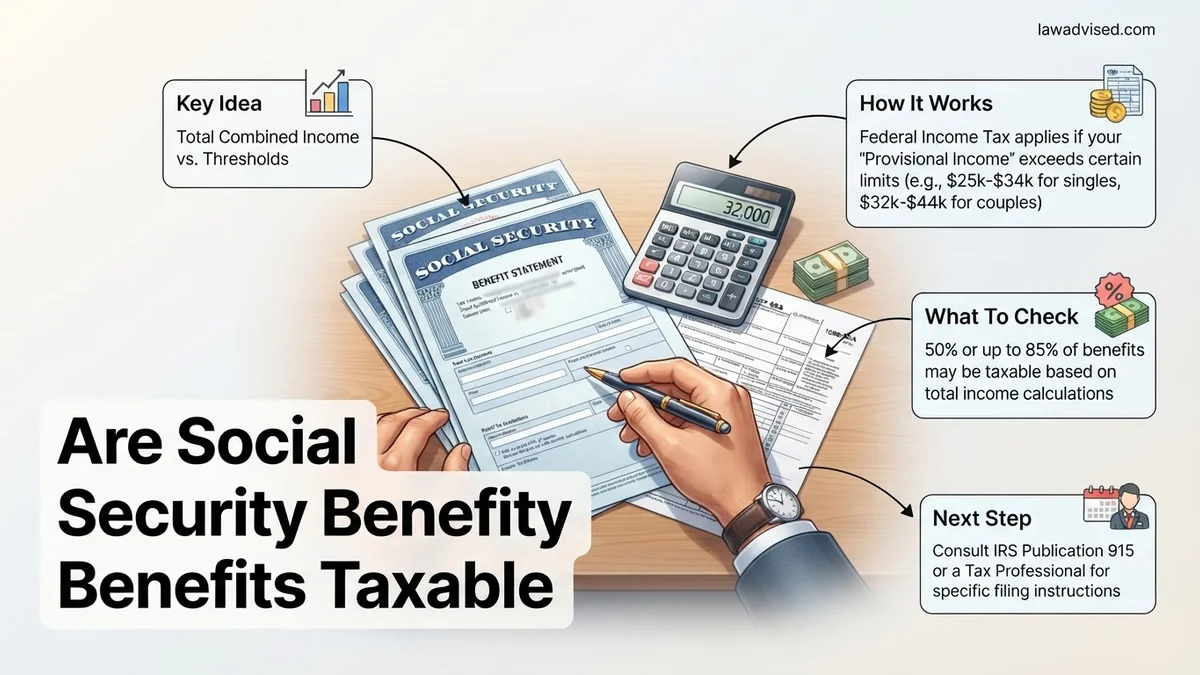
Yes, Social Security benefits can be taxable depending entirely on your overall income level. Whether you owe federal income tax relies on calculating your combined income against specific IRS thresholds for individuals and married couples.
Yes, your Social Security benefits can be subject to federal income taxes. Whether you actually owe taxes depends entirely on your total financial picture for the 2026 tax year, not just your monthly benefit check. Many retirees are surprised to learn that up to 85 percent of their benefits can be taxed if their overall income crosses specific government limits.
Understanding these rules is essential for protecting your retirement nest egg. If you do not plan ahead, you might face an unexpected tax bill or penalties for failing to make estimated quarterly tax payments. Let us dive straight into the numbers so you can figure out where you stand in 2026.
Key Takeaways
- Combined income determines if your Social Security benefits are subject to federal income taxes.
- Individuals earning between $25,000 and $34,000 may pay taxes on up to 50% of benefits.
- Individual combined income above $34,000 taxes up to 85% of your Social Security benefits.
- Married couples filing jointly face a base threshold starting at $32,000 before taxes apply.
- Most U.S. states do not tax Social Security benefits, though a select few maintain state levies.
Why Are Social Security Benefits Taxable? The Diagnosis of IRS Thresholds
Congress changed the tax code decades ago to require higher-income beneficiaries to pay taxes on their Social Security benefits. The IRS uses a specific metric called combined income to determine your tax liability. If your total income stays below a certain baseline, your benefits remain completely tax-free.
The Individual Tax Thresholds
If you file your federal taxes as an individual, your tax liability depends on two distinct income brackets established by the IRS:
- Under $25,000: If your combined income is below 25,000 dollars, you pay zero federal income tax on your Social Security benefits.
- Between $25,000 and $34,000: You may have to pay income tax on up to 50 percent of your benefits.
- More than $34,000: Up to 85 percent of your Social Security benefits may be subject to ordinary income taxes.
The Married Filing Jointly Tax Thresholds
Married couples filing a joint tax return face a different set of IRS thresholds for their combined household earnings:
- Under $32,000: Couples with a combined income below 32,000 dollars owe no federal taxes on their benefits.
- Between $32,000 and $44,000: You could pay taxes on up to 50 percent of the received benefit amount.
- More than $44,000: Up to 85 percent of your combined Social Security benefits will be taxable at your marginal rate.
How to Calculate Combined Income Step-by-Step to Find Your Tax Liability
To find out if your 2026 benefits are taxable, you must calculate your “combined income.” This figure goes beyond your standard adjusted gross income and includes specific types of tax-advantaged money that many retirees overlook.
The IRS Combined Income Formula
You can determine your provisional income by following this straightforward mathematical formula:
- Take your Adjusted Gross Income (AGI) from traditional sources like pensions, part-time wages, and taxable retirement distributions.
- Add any tax-exempt interest income you earned during the year, such as municipal bond interest.
- Add exactly one-half (50 percent) of your total annual Social Security benefits received.
A Practical Example for 2026
Imagine you file as an individual in 2026. You pull 20,000 dollars from a traditional IRA, earn 2,000 dollars in tax-exempt municipal bond interest, and collect 24,000 dollars in annual Social Security benefits.
- Your AGI is 20,000 dollars.
- Add 2,000 dollars of tax-exempt interest (Subtotal: 22,000 dollars).
- Add 12,000 dollars, which is half of your 24,000 dollar Social Security benefit.
- Your final combined income equals 34,000 dollars.
Because your combined income sits at the top of the first tier for individuals, you will owe taxes on a portion of your benefits for the year.
Step-by-Step Fixes to Minimize Taxes on Your Social Security Benefits
Tax minimization requires strategic income orchestration before and during retirement. Financial planners emphasize that proactive adjustments can keep provisional income below IRS thresholds.
1. Optimize Traditional IRA and 401(k) Withdrawals
Large mandatory distributions from pre-tax accounts push retirees into higher provisional income brackets. Taking smaller, controlled distributions earlier in retirement prevents sudden taxable spikes later.
2. Utilize Tax-Exempt Municipal Bond Interest
Municipal bond interest remains exempt from federal income taxes. However, tax experts remind taxpayers that this interest still counts toward the provisional income calculation for Social Security.
3. Execute Strategic Roth Conversions
Converting traditional retirement accounts to Roth accounts before claiming Social Security reduces future required minimum distributions. Lower future distributions directly decrease taxable provisional income percentages in 2026.
What If Your Income Still Exceeds the Limits? Advanced IRS Fallback Options
Exceeding the provisional income thresholds in 2026 requires advanced fallback measures to mitigate tax liabilities. When standard withdrawal adjustments fail to lower tax exposure, specific administrative steps become necessary.
- File IRS Form W-4V: Request voluntary federal income tax withholding directly from your monthly Social Security payments to avoid underpayment penalties.
- Adjust Estimated Quarterly Taxes: Submit Form 1040-ES payments to the IRS if your investment income fluctuates unpredictably throughout the year.
- Consult a Certified Public Accountant (CPA): Engage a licensed tax professional specializing in senior taxation for complex multi-stream retirement portfolios. Professional fees typically range from $300 to $1,500 depending on return complexity.
- Utilize IRS Penalty Abatement: Request a first-time penalty abatement if unexpected benefit taxation triggers an unanticipated shortfall in your annual tax filings.
Conclusion
Taxable Social Security benefits depend heavily on your combined provisional income calculation. Implementing strategic withdrawals and utilizing tax-free accounts can substantially lower your overall tax burden. According to verified research and expert financial sources, the most effective next step is to calculate your projected 2026 provisional income today to identify potential tax thresholds before filing season begins.
❓ Frequently Asked Questions
What are the exact combined income thresholds for individuals?
For individual filers, a combined income between $25,000 and $34,000 means up to 50% of benefits may be taxable. If combined income exceeds $34,000, up to 85% of benefits can be taxed.
What are the thresholds for married couples filing jointly?
For married couples filing jointly, combined income between $32,000 and $44,000 subjects up to 50% of benefits to tax. Income above $44,000 taxes up to 85% of benefits.
How does the IRS calculate the 50% and 85% taxable portions?
The taxable amount is not a flat tax rate on your entire check; rather, it determines what portion of your benefit is added to your taxable income and taxed at your ordinary marginal income tax rate.
Can I have federal income taxes withheld directly from my Social Security check?
Yes. You can choose to have federal taxes withheld automatically by filing IRS Form W-4V with the Social Security Administration.
Does tax-exempt municipal bond interest count toward combined income?
Yes. Even though municipal bond interest is exempt from standard federal income tax, it must be included when calculating your combined income for Social Security tax purposes.
What happens if my income fluctuates year to year?
Your benefit taxation changes annually based on your tax return. If your income drops one year, you may owe less or no tax on your benefits for that tax period.

Ismail Hossain is the founder of Law Advised. He is an Divorce, Separation, marriage lawyer. Follow him.