401k Early Withdrawal Tax Explained A 2026 Expert Guide
Taking money from your retirement account before age 59½ triggers a 10% federal penalty plus ordinary income taxes on the entire distribution. This 2026 guide breaks down the exact math, exemptions, and smarter alternatives to prevent losing nearly half your savings.
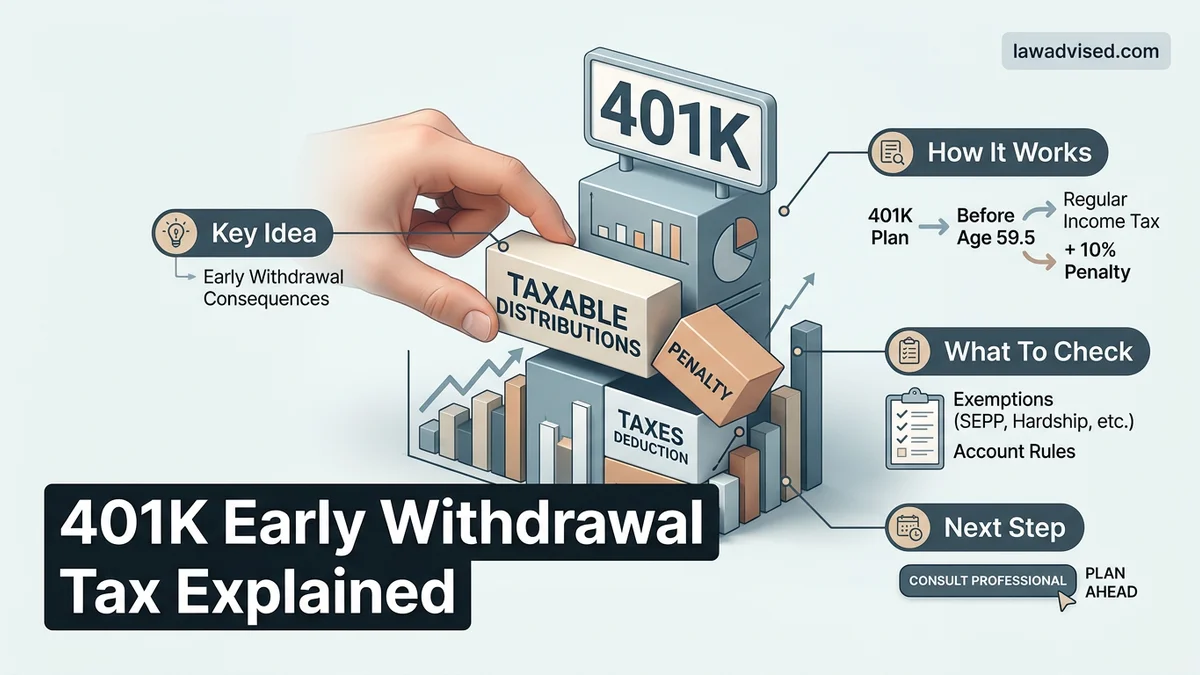
If you take money out of your traditional 401(k) before age 59½, you will generally face a brutal financial double-whammy: federal ordinary income taxes plus a 10% early withdrawal penalty. Depending on your tax bracket and where you live, you could easily lose 30% to 50% of your total withdrawal to the government before you even see a dime.
This guides you through the exact math and rules for 2026. Knowing these numbers in advance helps you avoid devastating tax surprises and helps you decide if tapping your retirement savings is ever truly worth the cost.
Key Takeaways
- Early withdrawals face a standard 10% federal penalty plus ordinary income tax.
- A $10,000 withdrawal can shrink to less than $6,000 after combined taxes and penalties.
- Certain hardships and life events qualify you to bypass the 10% penalty entirely.
- Consider 401k loans or hardship withdrawals as lower-cost alternatives to cashing out.
- Raiding retirement accounts severely damages your long-term wealth through lost compounding.
What Causes High Taxes and Penalties on Early 401(k) Withdrawals
The Dual Tax Burden of Pre-Tax Accounts
When you contribute to a traditional 401(k), you do so with pre-tax dollars. The IRS deferred your taxes until retirement. When you pull that money out early, the government treats the entire withdrawal as ordinary income for the 2026 tax year. This means your withdrawal stacks on top of any wages, salaries, or business income you earned that year, which can easily push you into a much higher federal income tax bracket.
The 10% Federal Early Withdrawal Penalty
On top of your standard income tax bracket, the IRS slaps a flat 10% early distribution penalty on the total amount you withdraw. This penalty exists specifically to discourage people from raiding their future retirement funds early. Combined with federal and state income taxes, a premature distribution often triggers one of the highest effective tax rates you will ever pay.
- Federal ordinary income tax rates range up to 37% in 2026.
- The federal early withdrawal penalty adds a flat 10%.
- State and local income taxes can add another 0% to over 13% depending on your state.
How to Calculate Your Total Early Withdrawal Tax Liability Step by Step
Step 1: Determine Your Ordinary Income Tax Bracket
To calculate your exact tax liability, you must first add your 401(k) withdrawal amount to your total taxable income for 2026. If you earn $70,000 a year and pull out a $30,000 early distribution, your new taxable income becomes $100,000. That lump sum might push a portion of your earnings into a higher marginal tax bracket, increasing the percentage you owe on the withdrawal.
Step 2: Add the 10% IRS Penalty and State Taxes
Once you figure out your federal income tax hit, apply the flat 10% penalty. Next, factor in your state income tax rate. Here is a practical example for 2026: If you withdraw $50,000 early, live in a state with a 5% income tax, and fall into the 22% federal tax bracket, your math looks like this:
- Federal Income Tax (22%): $11,000
- IRS Early Penalty (10%): $5,000
- State Income Tax (5%): $2,500
- Total Taxes and Penalties: $18,500
In this scenario, you keep only $31,500 of your hard-earned $50,000 withdrawal. Running these numbers beforehand ensures you are never caught off guard during tax season.
How to Fix Cash Flow Issues Using 401(k) Loans and Hardship Alternatives
When cash flow emergencies strike, raiding your retirement savings permanently should be a last resort. Fortunately, qualified plan participants can leverage alternative mechanisms that avoid the devastating combination of ordinary income taxes and the 2026 early withdrawal penalties.
Utilizing a 401(k) Loan Instead of a Distribution
Borrowing from your retirement account lets you access capital without triggering taxable events or early withdrawal penalties, provided you follow strict regulatory guidelines.
- Check Plan Provisions: Confirm that your current employer’s plan document explicitly permits participant loans, as plan sponsors are not legally required to offer them.
- Calculate Your Maximum Limit: Under IRS regulations, you can generally borrow up to 50 percent of your vested account balance or $50,000, whichever is less.
- Set Up Repayment: Establish a strict repayment schedule through payroll deductions, ensuring the loan is fully amortized with regular payments at least quarterly over a maximum term of five years.
Qualifying for a Safe Harbor Hardship Withdrawal
If your plan does not allow loans, a hardship withdrawal remains an option for immediate and heavy financial needs, such as preventing foreclosure or paying high medical expenses.
- Demonstrate Immediate Need: Provide documentation proving the expense cannot be met from other reasonably available resources of the employee.
- Limit the Withdrawal Amount: Request only the exact dollar amount required to satisfy the financial need, plus any taxes or penalties generated by the distribution.
- Understand Tax Implications: Remember that unlike a 401(k) loan, hardship distributions are fully subject to income tax and the 10 percent penalty if you are under age 59½, though they are exempt from the mandatory 20 percent federal withholding.
What If You Still Need to Withdraw and Need Penalty Exceptions
If standard alternatives fail and you must take an early distribution, you can minimize financial damage by utilizing statutory exceptions that waive the standard 10 percent early withdrawal penalty for specific life events.
- Evaluate IRS Penalty Exceptions: Review qualified exemptions such as total and permanent disability, unreimbursed medical expenses exceeding 7.5 percent of your adjusted gross income, or IRS levy actions.
- Utilize Substantially Equal Periodic Payments: Set up a schedule of Series of Substantially Equal Periodic Payments (SEPP) under IRS Rule 72(t), which allows penalty-free withdrawals based on life expectancy tables regardless of your age.
- Leverage the SECURE 2.0 Provisions: Take advantage of newer penalty exemptions designed for specific emergencies, including domestic abuse situations or federally declared disaster distributions up to $22,000.
- Consult a Certified Financial Planner: Engage a licensed professional or CPA to verify your exact eligibility before executing the transaction, with professional advisory fees typically ranging from $150 to $300 per hour or a flat project fee of $1,500 to $3,000.
Conclusion
Navigating a 401(k) early withdrawal requires balancing urgent liquidity needs against the severe long-term costs of lost compound growth, ordinary income taxes, and statutory penalties. Exploring alternatives like plan loans or statutory exceptions can protect your retirement nest egg from permanent depletion. According to verified research and expert sources from retirement policy institutes, taking proactive measures before executing a distribution significantly improves long-term financial stability. As an actionable next step, log into your retirement plan portal today to review your specific plan document rules and calculate your exact vested balance before making any definitive financial commitments.
❓ Frequently Asked Questions
How is the ordinary income tax calculated on a 401k withdrawal?
The gross withdrawal amount is added directly to your total taxable income for the calendar year. This can potentially push you into a higher federal income tax bracket.
What is the Rule of 55 and how does it prevent penalties?
If you leave your job during or after the year you turn 55, you can withdraw from that specific employer’s 401(k) without facing the 10% early withdrawal penalty.
Do I have to pay withholding taxes immediately upon withdrawal?
Plan administrators typically withhold 20% for federal taxes upfront before sending you the check. However, if your actual tax rate is higher, you will owe the difference at tax time.
What qualifies as an IRS hardship withdrawal exemption?
IRS-approved immediate and heavy financial needs include preventing eviction, paying certain medical bills, or repairing severe storm damage to your primary residence.
Can I reverse an early 401k withdrawal if I change my mind?
Generally, standard 401(k) distributions cannot be reversed or paid back into the account outside of the standard 60-day rollover window if you transition the funds to an IRA.
How does an early withdrawal impact long-term retirement savings?
Beyond immediate taxes, taking money out early robs you of decades of potential compound interest and market growth, significantly reducing your final retirement fund size.

Ismail Hossain is the founder of Law Advised. He is an Divorce, Separation, marriage lawyer. Follow him.