How Rental Income Is Taxed 2026 Step-by-Step Guide
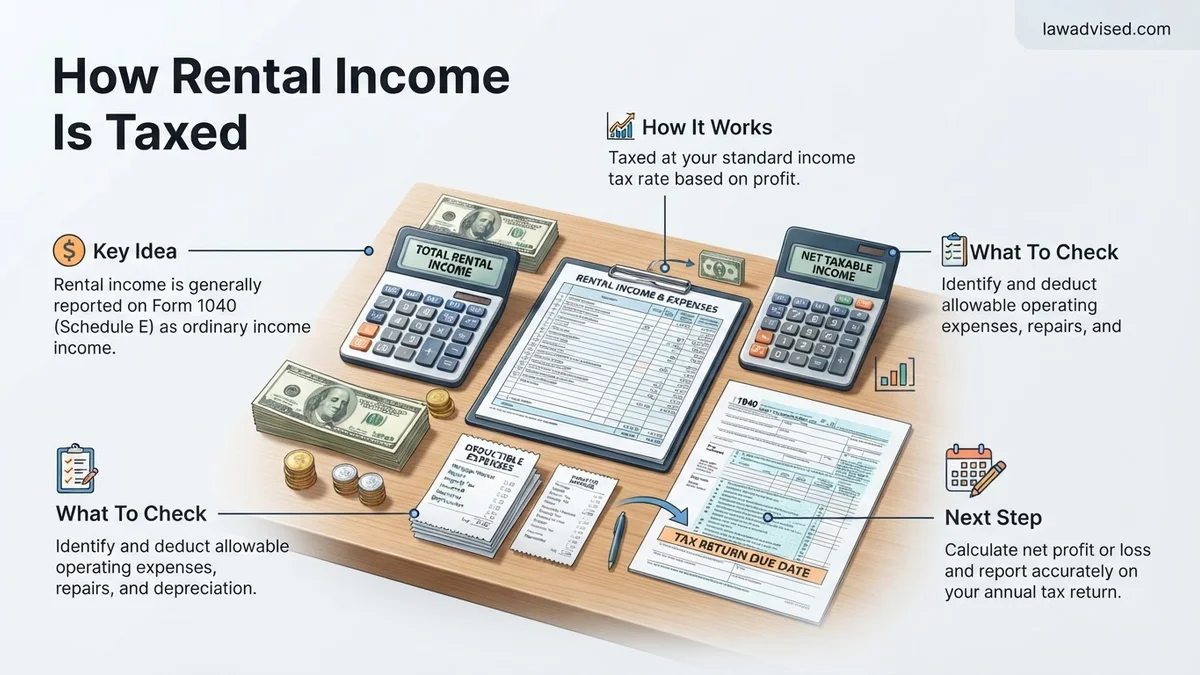
Rental income is generally taxed at ordinary income tax rates rather than capital gains rates. Property owners must report all gross rental receipts and calculate net taxable income by subtracting allowable operating expenses and depreciation.
Rental income is taxed by the IRS as ordinary income, meaning it gets added directly to your W-2 wages or other earnings and taxed at your marginal tax bracket rates. To figure out what you actually owe, you must calculate your net taxable rental income by taking your gross rents collected and subtracting all allowed operating expenses and depreciation.
Many landlords get tripped up because they assume rental income is taxed at preferential capital gains rates, or they fail to track expenses properly. Understanding the precise math of gross income minus deductions is the only way to protect your cash flow and legally lower your tax burden for the 2026 tax year.
Key Takeaways
- Rental income is taxed at ordinary income rates based on your overall tax bracket.
- You must report all advance rent and tenant-paid expenses as gross income immediately.
- Depreciation allows you to deduct the cost of property wear and tear over 27.5 years.
- Net rental income is calculated by subtracting deductible operating expenses from gross rental receipts.
- Landlords report earnings and deductions annually using IRS Schedule E on Form 1040.
What Causes High Taxes on Rental Income Without Proper Deductions
Treating Gross Rental Receipts as Net Profit
The single biggest mistake landlords make is looking at their monthly rent roll and assuming that is the number the IRS taxes. If you collect twenty-four thousand dollars in annual rent, the IRS does not care what you spent on repairs or property management until you officially report those expenses on Schedule E. Without active, documented deductions, you will pay ordinary income tax on every single dollar of gross cash flow. This pushes many property owners into unnecessarily high tax brackets.
Ignoring the Danger of Uncaptured Depreciation
Real estate physical structures degrade over time, and the IRS rewards you for this with a massive deduction called depreciation. If you fail to factor depreciation into your yearly filings, you artificially inflate your taxable income. Residential property is depreciated over a 27.5-year timeline. If you leave this deduction off your return, you are essentially handing free money back to the government and facing a heavily inflated tax bill.
How to Fix Your Tax Burden by Step-by-Step Calculation and Deductions
Step 1: Tallying Gross Rental Income
Your tax calculation for 2026 always starts with the absolute top-line revenue generated by your property. This figure includes:
- All standard monthly rent payments collected throughout the calendar year
- Non-refundable deposits kept from broken leases
- Tenant reimbursements for utilities, HOA fees, or property taxes
- Early termination fees paid directly to you
Once you have this cumulative gross number, you are ready to apply your write-offs.
Step 2: Subtracting Ordinary Operating Expenses
To drop your taxable base, you must subtract every ordinary and necessary cost required to keep the rental operational. Common deductible items include:
- Mortgage interest payments made to your lender
- Property taxes paid to local municipalities
- Landlord insurance policies and umbrella liability coverage
- Property management fees and legal consultation costs
- Ongoing maintenance, repairs, and professional cleaning services
Subtracting these operational costs from your gross income leaves you with your baseline operating profit before depreciation.
How to Report Rental Income and Deductions Using Schedule E
Reporting your rental income and expenses accurately requires filing IRS Form 1040, Schedule E (Supplemental Income and Loss). According to IRS guidelines for the 2026 tax year, you must list each property separately and match every expense to its correct category.
Step-by-Step Reporting Guide
- Gather financial statements: Compile your 2026 monthly rent ledger, tenant security deposit records, and all categorized receipts for repairs, utilities, and property management fees.
- Complete Part I of Schedule E: Enter the physical address of the rental property and indicate the fair rental days and personal use days.
- Input gross rents and expenses: Transfer your total annual income to Line 3. Distribute your deductible expenses across categories like advertising, insurance, mortgage interest, and repairs.
- Calculate net income or loss: Subtract your total expenses from your total gross rents to find your net rental income or loss, which then flows to your main Form 1040.
- Attach Form 4562 for depreciation: If you are claiming depreciation on the residential building structure for 2026, complete and attach Form 4562, reporting the calculated amount on Schedule E, Line 18.
What If Passive Activity Loss Rules Limit Your Rental Deductions
Real estate rental activities are generally considered passive by the IRS. If your rental expenses exceed your rental income, you generate a passive loss. Under standard passive activity loss rules, you cannot use these losses to offset active income like W-2 wages unless you qualify for specific exceptions.
Navigating the Special Allowance and Real Estate Professional Status
- Check the $25,000 special allowance: If your Modified Adjusted Gross Income (MAGI) is under $100,000, and you actively participate in managing the property, you can deduct up to $25,000 of rental losses against non-passive income.
- Understand phase-out rules: The $25,000 allowance phases out completely when your MAGI reaches $150,000 for the 2026 tax year.
- Qualify for Real Estate Professional Status (REPS): If you or your spouse meet IRS material participation tests—spending more than 750 hours and more than 50 percent of your working time in real property trades—your rental losses become non-passive and can fully offset other income.
- Carry over suspended losses: Any losses disallowed by passive activity rules do not disappear. They convert to suspended losses and carry forward indefinitely until you generate future rental income or sell the property in a fully taxable transaction.
What If It Still Doesn’t Work?
If complex depreciation schedules, mixed personal and rental use, or strict passive loss limitations make filing your 2026 tax return overly complicated, consider these troubleshooting steps:
- Audit your categorization: Re-examine your receipts to ensure you did not accidentally classify capital improvements as standard, deductible repairs.
- Consult a Certified Public Accountant (CPA): Reach out to a licensed tax professional who specializes in real estate taxation to review your Schedule E entries.
- Factor in professional costs: Hiring a qualified CPA to prepare complex rental schedules typically ranges from $300 to $800+ per property, depending on the volume of transactions.
- Utilize advanced tax software: Upgrade to a business-tier tax preparation software that automates depreciation calculations and guides you through passive loss thresholds.
Conclusion
Mastering how rental income is taxed ensures you remain compliant with IRS regulations while keeping your hard-earned cash in your pocket. By correctly tracking gross rents, deducting legitimate operating expenses, and understanding passive loss limits, you protect your real estate investments from unnecessary tax penalties. According to verified research from the IRS and leading national real estate CPA firms, meticulous record-keeping is the single most effective defense during an audit. Your actionable next step for 2026 is to set up a dedicated digital bookkeeping system today to automatically categorize every rental income and expense transaction as it occurs.
❓ Frequently Asked Questions
Is rental income subject to self-employment taxes?
Generally, rental income is considered passive and is not subject to self-employment taxes, unless you provide substantial services primarily for your tenant’s convenience, such as daily hotel-like housekeeping.
Are repairs and improvements taxed or deducted the same way?
No, ordinary repairs that keep the property in normal operating condition are fully deductible in the year incurred. Improvements that add permanent value or prolong the property’s life must be capitalized and depreciated over time.
What happens if my rental expenses exceed my rental income?
If you experience a net loss, passive activity loss rules generally limit your ability to deduct that loss against active income like W-2 wages, unless your modified adjusted gross income is below $150,000 and you actively participate.
How do I handle advance rent received from a tenant?
Advance rent must be reported as taxable income in the year you receive it, regardless of the period it covers or the accounting method you use.
Can I deduct travel expenses related to my rental property?
Yes, ordinary and necessary travel expenses incurred to collect rent, make repairs, or inspect the property are deductible, subject to IRS mileage or actual expense tracking rules.
What tenant-paid expenses count as rental income?
If a tenant pays a utility bill or performs maintenance in lieu of paying rent, the value of that service or payment must be included as gross rental income.

Ismail Hossain is the founder of Law Advised. He is an Divorce, Separation, marriage lawyer. Follow him.