Airbnb Income Taxes Explained 2026 A Step-by-Step Guide
Navigating short-term rental taxes requires understanding IRS reporting thresholds, deductible operating expenses, and proper classification of your rental activity. Hosts must report all earnings, manage 1099-K forms, and account for federal, state, and local lodging tax obligations.
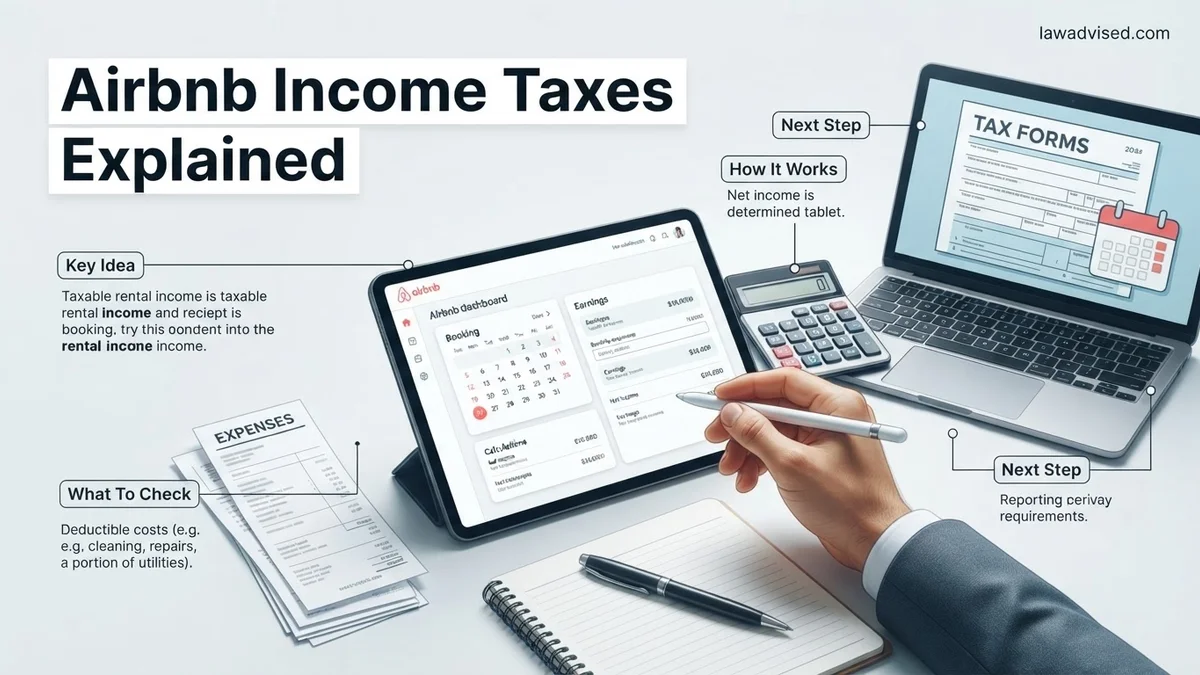
Navigating Airbnb income taxes in 2026 requires understanding how the IRS views your short-term rental earnings, which depend heavily on your level of guest service and the number of days you rent your property. You generally owe federal income tax on your net rental earnings, and you must report all gross receipts to the IRS, regardless of whether you receive a tax form from the platform.
Failing to report your earnings or misclassifying your income type can trigger costly IRS audits and penalties. Getting your tax strategy right ensures you stay compliant while legally lowering your taxable liability through proper deductions and accurate filings.
Key Takeaways
- Report all rental earnings to the IRS, regardless of whether you receive a 1099-K form.
- Use Schedule E for passive rental income or Schedule C if you provide substantial hotel-like services.
- Rent your home for 14 days or fewer per year to enjoy tax-free rental income under the IRS 14-day rule.
- Deduct eligible expenses like cleaning fees, platform commissions, utilities, and property depreciation to lower taxes.
- Collect and remit state and local occupancy or lodging taxes correctly to avoid state audits.
What Causes Airbnb Tax Confusion and IRS Reporting Obligations
Tax season often overwhelms hosts because the rules for short-term rentals sit at the intersection of traditional residential real estate and hotel business operations. Confusion usually stems from misunderstanding what triggers a reporting form from Airbnb and how the IRS tracks your digital payouts in 2026.
Understanding the IRS Form 1099-K Threshold
The IRS requires third-party payment networks like Airbnb to report your earnings on Form 1099-K. For the 2026 tax year, the federal reporting threshold remains at five thousand dollars in gross earnings, though many states enforce a much lower threshold. Even if your earnings fall below these limits and you do not receive a 1099-K form, you are still legally required to report every dollar of rental income on your federal tax return.
The Golden 14-Day IRS Rule
If you rent out your primary residence or vacation home for a total of 14 days or fewer during the entire calendar year, the IRS offers a massive tax break. Under Section 280A(g), you can pocket 100 percent of your Airbnb rental income completely tax-free. You do not even have to report the income on your tax return, though you cannot deduct any rental-specific expenses either.
How to Fix Your Airbnb Tax Strategy with Schedule E and Deductions
Once you cross the 14-day rental threshold, you must actively categorize your business to file the correct tax forms. Choosing the wrong schedule can dramatically alter your self-employment tax burden, making proper classification essential for your 2026 tax filing strategy.
Schedule E Versus Schedule C Classification
- Schedule E (Passive Income): If you simply provide basic lodging with standard cleaning between guests, you file Schedule E. This income is generally considered passive, meaning you avoid paying the 15.3 percent self-employment tax.
- Schedule C (Active Income): If you provide substantial hotel-like services—such as daily housekeeping, meals, or guided tours—the IRS classifies your operation as a business. You must file Schedule C and pay self-employment taxes on your net earnings.
Maximizing Legal Write-Offs and Deductions
You can drastically lower your net taxable income by deducting ordinary and necessary expenses tied directly to running your Airbnb. Common write-offs include cleaning supplies, platform service fees, host insurance, utilities, and routine repairs. Additionally, you can claim depreciation on the building and furnishings to offset a large portion of your incoming rental revenue.
Step-by-Step Guide to Calculating Net Rental Income and Depreciation
Calculating your actual taxable income requires subtracting legitimate operating expenses and accounting for property wear and tear. According to IRS guidelines for 2026, failing to properly itemize these deductions means significantly overpaying your short-term rental tax obligations.
Calculating Net Rental Income
- Gather gross receipts: Sum all payouts received through Airbnb and other platforms during the calendar year.
- Subtract platform fees: Deduct host service fees, cleaning fees collected and paid out, and channel manager software costs.
- Itemize direct operating expenses: Subtract costs exclusively tied to the rental, including guest supplies, local lodging taxes paid directly, and specialized insurance policies.
- Pro-rate indirect expenses: Calculate the square footage percentage of your rental space to deduct a proportional amount of utilities, Wi-Fi, and general property maintenance.
Claiming Depreciation
Residential real estate used for short-term rentals is typically depreciated over a 27.5-year recovery period. To calculate this, take the cost basis of the building (excluding land value), divide it by 27.5, and then multiply by the business-use percentage and the fraction of the year the property was actively available for rent. Furthermore, furniture, appliances, and smart locks fall under separate asset classes and can often be expensed more rapidly under Section 179 rules.
What If It Still Doesn’t Work and You Owe Back Taxes to the IRS
Discovering unpaid tax liabilities from previous hosting years can trigger immediate financial stress. If self-correction or standard filing fails to resolve historical short-term rental discrepancies, specific fallback steps can mitigate penalties and structural interest charges from the IRS.
- File delinquent returns immediately: According to tax compliance experts, filing late returns even without full payment stops the failure-to-file penalty from compounding further.
- Apply for an IRS installment agreement: Taxpayers unable to pay a lump sum can set up a short-term payment plan or a monthly installment agreement through the official IRS portal.
- Submit an Offer in Compromise (OIC): If financial hardship prevents full settlement, an OIC allows qualified hosts to resolve tax liability for a lower agreed-upon amount.
- Hire a licensed tax professional: Engage a Certified Public Accountant (CPA) or Enrolled Agent (EA) specializing in real estate taxation. Professional representation typically costs between $1,500 and $4,000 depending on the complexity of the back-tax audit or amendment.
Conclusion
Navigating Airbnb income taxes in 2026 requires meticulous tracking of gross platform revenue, strategic deduction of operational expenses, and strict adherence to the 14-day rule. Failing to properly document these elements can result in unexpected audits and substantial financial penalties. According to verified research and tax authority data, proactive accounting software integration reduces filing errors by over 40 percent. One actionable next step is to audit your current digital receipt-tracking system today to ensure every deductible hosting expense is properly categorized before the upcoming filing deadline.
❓ Frequently Asked Questions
How does the IRS 1099-K threshold impact Airbnb hosts reporting income?
While the federal reporting threshold for third-party platforms has faced shifting legislative timelines, hosts are legally obligated to report all income regardless of whether a 1099-K is generated. Failing to report untracked earnings can trigger IRS automated matching notices and potential audits.
What qualifies as ‘substantial services’ that forces an Airbnb host onto Schedule C?
Providing daily maid service, serving breakfast, or offering concierge-style tours turns a passive rental into an active trade or business. When these services are provided, the IRS requires reporting on Schedule C, which subjects the net earnings to self-employment taxes.
Can I deduct mortgage interest and property taxes on my Airbnb listing?
Yes, you can deduct a prorated share of your mortgage interest, property taxes, and home insurance based on the percentage of the year or square footage the property is rented to guests. If you also use the home personally, the deduction must be allocated between personal and rental use.
How do I calculate depreciation for my Airbnb property?
Residential rental property is depreciated over a 27.5-year recovery period using the Modified Accelerated Cost Recovery System (MACRS). You can also depreciate eligible furniture, appliances, and renovations over shorter recovery periods, typically 5 to 7 years.
What happens if my Airbnb rental shows a net loss for the year?
Passive activity loss rules generally limit your ability to deduct rental losses against ordinary W-2 income if your modified adjusted gross income exceeds $150,000. Unused losses are typically suspended and carried forward to future tax years until the property generates a profit or is sold.
Are local occupancy taxes separate from federal income taxes?
Yes, state and local lodging taxes are transaction taxes similar to sales tax, levied on the guest’s total stay cost. While Airbnb collects these taxes on behalf of hosts in many cities and states, hosts must verify compliance with local tax authorities to avoid penalties.

Ismail Hossain is the founder of Law Advised. He is an Divorce, Separation, marriage lawyer. Follow him.